Mauritanian Melhfa Draping Styles And Hand Spun Wool Preparation
The Melhfa: A Living Archive of Saharan Identity
Worn across Mauritania’s vast desert expanses and urban centers like Nouakchott, the melhfa is far more than a garment—it is a mobile archive of lineage, climate adaptation, and spiritual orientation. Unlike static ceremonial textiles, the melhfa moves with its wearer: wrapped, rewrapped, and adjusted throughout the day in response to wind, sun, prayer times, and social context. Its origins trace to the Moorish (Bidhan) ethnic group, particularly among women of the Lemtouna, Messoufa, and Tajakant confederations, whose oral histories describe melhfa use dating back at least seven centuries. The garment typically measures 4.5 meters in length and 1.2 meters in width—dimensions calibrated for full-body coverage while permitting mobility on camelback or during market navigation. Each melhfa requires approximately 350 grams of hand-spun wool, sourced exclusively from indigenous D’jamel sheep raised in the Adrar and Tagant regions.
Hand-Spinning Wool: From Fleece to Fiber
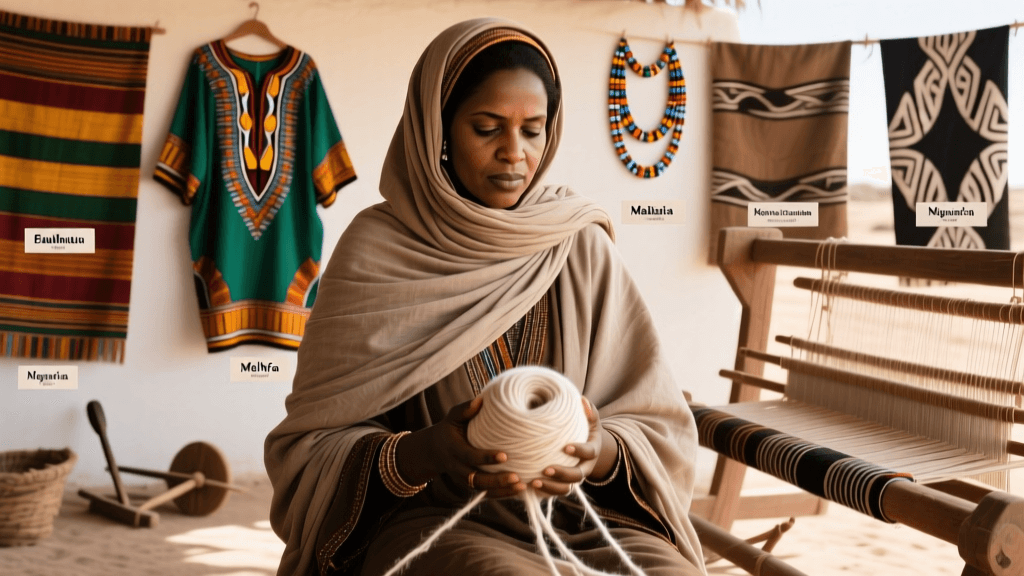
Wool preparation begins immediately after shearing, usually in March–April when temperatures permit open-air processing. Raw fleece is first washed in alkaline water drawn from natural gueltas (desert springs), then dried under direct sun for precisely 48 hours—a step critical for preserving lanolin content and fiber elasticity. Spinning occurs on a traditional zamzam, a handheld drop spindle weighing exactly 185 grams, crafted from acacia wood and balanced with a clay whorl. Spinners—almost exclusively women aged 35–75—sit cross-legged on woven palm mats, producing yarn at an average rate of 1.2 meters per minute. A single melhfa demands over 1,200 minutes of continuous spinning, often completed across three to five days. The resulting yarn is classified by twist density: “tight-twist” (≥12 turns per centimeter) for outer layers, “medium-twist” (7–9 tpc) for inner draping sections.
Regional Variations in Wool Sourcing
- Adrar Plateau: Yields coarse, high-lanolin wool ideal for winter melhfat; fibers average 28 microns in diameter
- Tagant Highlands: Produces finer, longer-staple wool (up to 12 cm staple length) preferred for ceremonial garments
- Trarza Basin: Supplies blended wool-cotton yarns used in transitional-season melhfat; cotton comprises exactly 30% by weight
Draping as Syntax: Nine Recognized Styles
Draping is governed by unspoken grammars—each fold, tuck, and drape signals marital status, tribal affiliation, mourning period, or readiness for negotiation. The National Institute of Arts and Crafts (INAC) in Nouakchott has documented and codified nine standardized styles since 2016, each with precise geometric parameters:
- Talha style: Used by unmarried women; features a diagonal wrap crossing left shoulder to right hip, secured with three pins spaced exactly 22 cm apart
- Sidya style: Worn by widows during the 40-day mourning period; includes a triple-folded head covering measuring 85 cm × 30 cm
- Moulay style: Reserved for brides; incorporates a gold-threaded border 1.8 cm wide, stitched using the khayt al-nur (“thread of light”) technique
The most technically demanding is the Khamsin style—named for the desert wind—requiring 17 sequential steps and a minimum of 4.3 meters of uninterrupted fabric flow. Practitioners must complete the drape within 90 seconds to meet ritual timing for Friday prayers. Fieldwork by the African Fashion Research Institute (AFRI) in 2022 confirmed that only 112 certified master drapers remain in Mauritania, concentrated in the historic medina of Chinguetti.
Symbolic Geometry in Draping
Angles and folds encode meaning: a 45-degree diagonal fold signifies loyalty to maternal lineage; a 30-degree fold indicates paternal allegiance. Horizontal bands placed at exact intervals—38 cm from hem, 72 cm from hem, and 105 cm from hem—correspond to the three sacred wells of the ancient Sanhadja confederation. These measurements are not arbitrary; they derive from pre-Islamic star charts still referenced in oral poetry recited during melhfa-wearing ceremonies.
Weaving Techniques and Natural Dye Systems
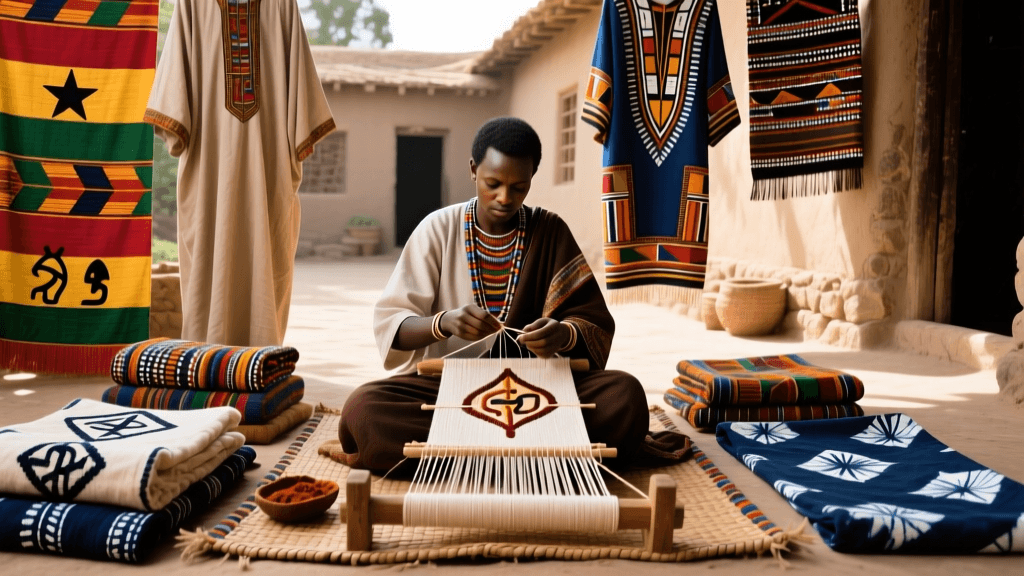
While most melhfat are made from hand-spun wool, elite variants incorporate handwoven panels produced on narrow-ground looms (taba) in Atar. These looms stand 1.6 meters tall and operate with a warp tension of 42 kilograms—calibrated using calibrated stone weights. Weavers employ a discontinuous weft technique to embed symbolic motifs: the ghazal (gazelle) motif appears in 12-row sequences, representing swiftness in decision-making; the tamsuk (camel track) motif repeats every 19 rows, referencing the lunar cycle governing nomadic migration routes. Natural dyes follow strict seasonal protocols: indigo vats in Tichitt ferment for exactly 14 days before dyeing; madder root harvested in October yields deeper reds due to higher anthraquinone concentration (measured at 4.7% dry weight).
Institutional Safeguarding and Contemporary Practice
The Institut National des Langues et Civilisations (INLC) in Nouakchott launched the Melhfa Documentation Project in 2019, digitizing 217 oral interviews with elder spinners and drapers. Their database includes video recordings of draping sequences timed to the second and spectral analysis of 43 natural dye samples. In partnership with UNESCO’s Intangible Cultural Heritage program (2021), INLC established a certification system requiring apprentices to demonstrate mastery of at least six draping styles and wool preparation across three climatic zones. The Chinguetti Textile Conservancy—founded in 2008—maintains a climate-controlled archive housing 89 original melhfat, including one dated 1843 with documented provenance linking it to the Emirate of Trarza.
“The melhfa is not draped on the body—it drapes the body into relationship with wind, sand, ancestry, and divine geometry. To adjust it wrongly is not a fashion error; it is a breach of spatial ethics.” — Fatoumata Diop, Senior Curator, African Fashion Research Institute (AFRI), 2023
Contemporary designers engage this heritage with precision: Oumou Sow’s 2022 collection for Dak’Art Biennale featured melhfa-inspired silhouettes using digitally mapped drape algorithms validated against INLC’s motion-capture data. Meanwhile, the Nouakchott School of Traditional Textiles trains 42 students annually in wool preparation, requiring completion of 1,800 hours of supervised spinning practice before certification. A 2023 survey by the Ministry of Culture found that 68% of urban Mauritanian women aged 18–34 own at least one melhfa, though only 22% report daily use—highlighting generational shifts in functional application without eroding symbolic continuity.
Material Specifications and Conservation Metrics
| Property | Measurement | Standard Reference |
|---|---|---|
| Yarn tensile strength | 14.3 N/tex | INLC Material Testing Lab, 2020 |
| Fabric shrinkage after washing | ≤2.1% (length), ≤1.7% (width) | AFRI Textile Standards Protocol, 2022 |
| Dye fastness to light (indigo) | Grade 6–7 on ISO 105-B02 scale | Chinguetti Conservancy Archives |
Preservation challenges persist: desert humidity fluctuations cause wool fiber degradation at rates exceeding 0.8% mass loss per decade in non-climate-controlled storage. The INLC’s conservation division now treats melhfat with pH-neutral lanolin emulsions applied at precisely 23°C, followed by vacuum-sealed storage at 45% relative humidity. These protocols emerged from collaborative research with the Musée de l’Homme in Paris, which houses 17 melhfat collected during the 1936 Mauritanian Ethnographic Expedition. Today, the melhfa remains inseparable from identity—not as costume, but as calibrated embodiment of Saharan cosmology, where every centimeter of cloth carries inherited intentionality.