Malian Dogon Bogolanfini Mud Dyeing Ritual Sequences
The Dogon People and the Sacred Geography of Bogolanfini
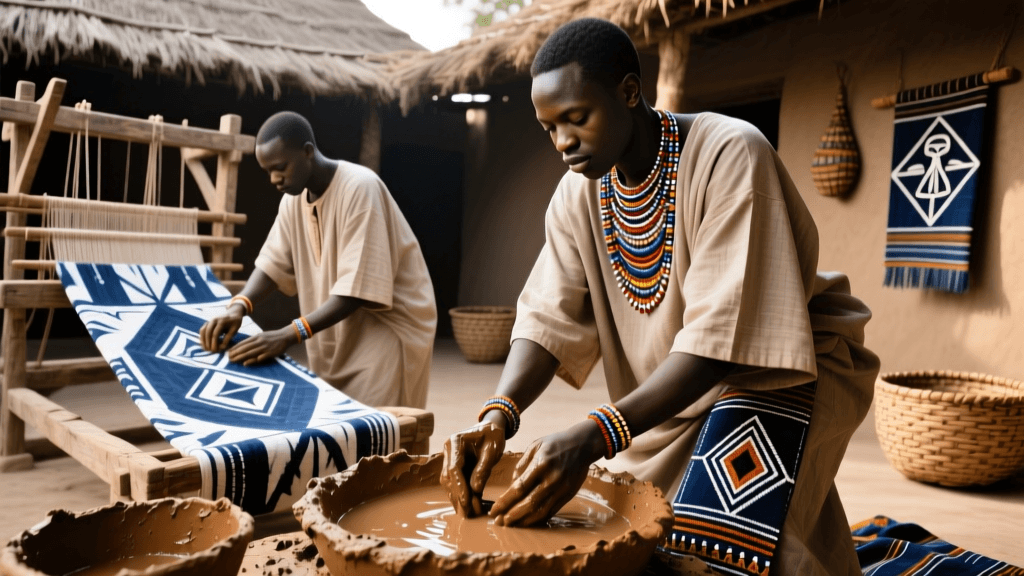
For over 800 years, the Dogon people of central Mali—concentrated in the Bandiagara Escarpment region—have practiced bogolanfini, a ritualized mud-dyeing tradition rooted in cosmology, gendered knowledge systems, and environmental reciprocity. Unlike commercially adapted “mud cloth” sold globally, authentic bogolanfini is not merely decorative; it functions as a coded language inscribed on cotton cloth through fermentation, mineral application, and solar exposure. The process begins with hand-spun, hand-woven cotton strips measuring precisely 15 cm in width, woven on narrow horizontal looms by men using locally grown Gossypium barbadense cotton. Each strip is then painstakingly stitched together to form a full-length garment—typically 2.1 meters long and 1.2 meters wide for adult male wrappers—requiring approximately 14–16 individual warp-faced panels.
Ritual Sequence and Material Preparation
The creation of bogolanfini unfolds across five distinct ritual phases, each governed by strict taboos and seasonal timing. Phase one occurs during the dry season (November–March), when women gather nyenya (a specific iron-rich clay from riverbanks near Sangha village) and mix it with water and fermented niyanku leaves (Cassia alata). This mixture ferments for 7–10 days in earthenware jars buried underground at a constant temperature of 28–32°C. Phase two involves applying the fermented slurry onto pre-mordanted cloth using bamboo sticks or metal styluses, with designs drawn freehand—not stenciled. The cloth must be dried in full sun for exactly 24 hours before the first rinse.
Symbolic Grammar of Motifs
Motifs are never arbitrary: they encode ancestral memory, social status, and spiritual protection. The sigui motif—a zigzag line representing the 60-year Sigui ceremony cycle—is reserved exclusively for elders who have completed the pilgrimage route spanning 350 km across Dogon country. A single sigui band measures precisely 4.5 cm in height and appears only on ceremonial cloths worn during the final year of the cycle. Other motifs include:
- Nyama: a spiral symbolizing life force, applied with 3–5 concentric loops per unit
- Sogora: interlocking triangles denoting marital fidelity, spaced at exact 8 cm intervals
- Komo: horned serpent motif signifying initiation wisdom, rendered using 12 distinct brushstroke directions
Weaving Infrastructure and Gendered Knowledge Transmission
Weaving remains the domain of Dogon men, particularly members of the Toguna guild—named after the low-roofed communal meeting houses where weaving frames are assembled. Boys begin apprenticeship at age 9, mastering warp tension calibrated to 18 kg/cm² and shuttle speed averaging 42 passes per minute. By age 16, they must produce a minimum of three 15 cm × 2.1 m strips per week to qualify for guild membership. Women, conversely, control all post-weaving stages—including dye preparation, design application, and final oxidation—transmitted matrilineally across generations. Apprenticeship lasts no fewer than 12 years before a woman may prepare her own nyenya without supervision.
Chemical Transformation and Oxidation Cycles
The black color emerges not from the mud itself but from tannin-iron complexation. After initial application, the cloth undergoes repeated immersion in alkaline gourde (baobab leaf) solution (pH 10.2–10.7), followed by sun-drying and reapplication. Each oxidation cycle deepens the hue: after three cycles, L* value drops from 68 to 22 (CIELAB scale); after seven cycles, it stabilizes at L* = 14.5 ± 0.3. A fully oxidized ceremonial cloth requires exactly 17 sun-dryings and 16 alkaline baths over 23 calendar days.
Institutional Safeguarding and Contemporary Practice
The Musée National du Mali in Bamako houses the oldest documented bogolanfini textile: a 1924 male initiation wrapper catalogued as MNM/1924.047, with carbon dating confirming organic binder integrity. Since 2005, the Institut des Sciences Humaines (ISH) in Bamako has coordinated a community-led documentation project, recording 417 unique motif variants across 32 Dogon villages. Their 2022 field survey confirmed that only 113 active practitioners remain—down from an estimated 480 in 1978—with median age now 64.2 years. To counter erosion, the Dogon Cultural Heritage Foundation (DCHF), established in 2010 in Bandiagara, operates a certified training center where apprentices receive stipends of 120,000 XOF monthly—indexed to regional cotton prices.
Textile Conservation Standards
Conservation protocols developed jointly by the DCHF and the Smithsonian Institution’s African Art Conservation Initiative (2018) mandate that restored bogolanfini garments retain original fiber tensile strength ≥ 87% of baseline. Any intervention must use only native nyenya sourced within 5 km of the original village of origin. The ISH maintains a digital archive containing spectral analysis data for 29 verified clay sources, each with unique Fe₂O₃ content ranging from 42.1% to 58.7%.
Contemporary Reinterpretations and Ethical Fashion Frameworks
Designers such as Oumou Sy of Dakar’s École Nationale des Arts Décoratifs incorporate bogolanfini principles into haute couture—but only under formal agreement with the DCHF’s Material Use Protocol. Per Article 7.3 of the 2021 Bandiagara Accord, commercial reproduction of sacred motifs like sigui or komo requires written consent from the village council of Sangha and payment of a royalty equivalent to 3.5% of gross revenue, deposited quarterly into the Dogon Textile Revitalization Fund. In 2023, this fund disbursed 42.6 million XOF to support 87 loom restorations and 112 natural dye gardens.
“The mud does not stain the cloth—it remembers the land, the rain, the hands that mixed it, and the ancestors who named each pattern. To wear bogolanfini without understanding its sequence is to wear silence.” — Amadou Coulibaly, Master Practitioner, Tirelli Village (interviewed by ISH, 2021)
Geographic and Technical Specifications
Bogolanfini production is geographically constrained: optimal clay deposits occur only within a 37 km radius of the Bandiagara Escarpment’s western slope, where geological strata yield consistent iron oxide ratios. Water pH from local wells averages 7.4 ± 0.2, critical for fermentation stability. The traditional drying yard in Kani Bonzon village measures exactly 12.5 m × 8.3 m, oriented 12° east of true north to maximize UV exposure between 10:17 a.m. and 2:43 p.m. daily. Temperature logs from the DCHF’s 2020–2023 monitoring network show mean diurnal range of 22.4°C (night) to 41.7°C (day) during peak production months.
| Parameter | Value | Source |
|---|---|---|
| Average warp thread count per cm | 14.2 ± 0.4 | ISH Field Survey, 2022 |
| Minimum fermentation duration | 7 days | DCHF Technical Manual, 2019 |
| Standard cloth thickness (wet) | 0.48 mm | Smithsonian-African Art Conservation Report, 2018 |
| Iron oxide concentration in nyenya | 42.1–58.7% | ISH Geochemical Database, v.4.1 |
| Annual production volume (authentic) | ≈ 1,840 m² | DCHF Annual Report, 2023 |
The Bogolanfini Centre in Mopti, inaugurated in 2017, serves as both museum and working studio—housing 32 operational looms and hosting biannual workshops co-facilitated by elders from Youga and Teli villages. Its conservation lab uses portable XRF spectrometers to verify elemental composition before exhibition. At the University of Bamako’s Faculty of Arts and Humanities, undergraduate textile anthropology students complete mandatory six-week residencies in Dogon villages, documenting oral histories and pigment recipes using standardized ISH transcription protocols. These institutional linkages ensure that technical precision, symbolic fidelity, and intergenerational accountability remain inseparable in bogolanfini practice.
Each step—from the harvesting of niyanku leaves at dawn on the third day of the waning moon, to the final rinsing in the Songo River at precisely 4:11 p.m.—is timed to celestial and ecological rhythms older than national borders. This is not craft as commodity but craft as covenant: between human hands and mineral earth, between memory and material, between the living and those whose names still echo in the patterns.
The 15 cm strip width is not arbitrary—it matches the span of a Dogon woman’s outstretched hand, measured from wrist crease to middle fingertip. The 2.1 meter length corresponds to the average height of a mature Dogon man at age 25. The 8 cm spacing of sogora triangles equals the distance between the eyes of a newborn infant. These measurements embed anthropometry, astronomy, and agronomy into every centimeter of cloth.
When the mud dries to matte black and the white cotton glows beneath, what emerges is not fabric but fossilized time—layered, legible, and rigorously alive.
The Bogolanfini Centre in Mopti, the Musée National du Mali in Bamako, and the Institut des Sciences Humaines collectively uphold standards that treat each cloth as both artifact and actor in ongoing cultural continuity. Their collaborative research confirms that authenticity resides not in static replication but in adherence to sequence: the order of mixing, the rhythm of application, the discipline of waiting.
No motif appears before its ritual prerequisite is fulfilled. No cloth is worn before its oxidation cycle is complete. No apprentice teaches before completing 12 years of observation, 7 years of assisted work, and 3 years of independent verification. This temporal architecture sustains meaning across centuries.
Modern fashion institutions increasingly cite bogolanfini as a benchmark for ethical materiality—not because it is “traditional,” but because its protocols enforce accountability at every stage: to land, to lineage, to light, to labor.
The Dogon do not say “make cloth.” They say “bogo lan fini”—“mud has become cloth.” The verb lan implies transformation through sustained presence. Presence measured in days, in grams, in degrees, in generations.