South African Ndebele Painted Apron Creation Process And Geometry
The Ndebele Apron as Living Geometry
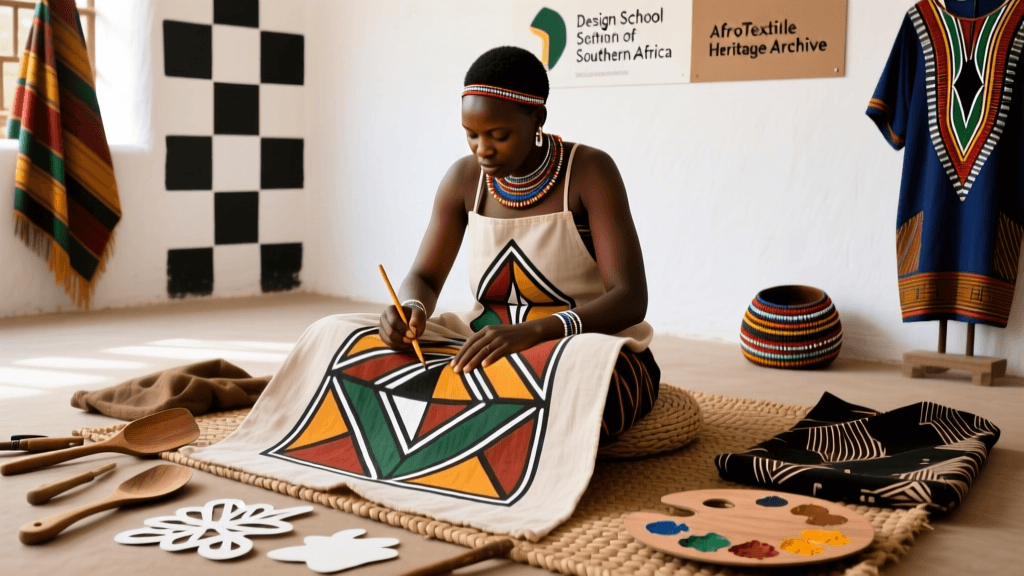
Among Southern Africa’s most visually arresting textile traditions, the Ndebele painted apron—known locally as isiphephetu—functions simultaneously as ceremonial garment, mathematical diagram, and intergenerational archive. Originating among the Southern Ndebele people of South Africa’s Mpumalanga and Gauteng provinces, these hand-painted cotton aprons are worn by married women during rites of passage, including initiation, marriage, and ancestral veneration ceremonies. Unlike woven or dyed textiles, the isiphephetu is created through direct application of acrylic or traditional ochre-based pigments onto pre-cut fabric using sticks, feathers, or fine brushes—transforming the body into a mobile canvas of precise geometric logic.
Materials and Preparation: From Cotton to Canvas
Each apron begins with a base cloth measuring exactly 120 cm in width and 90 cm in length—a standardized proportion rooted in anthropometric ratios tied to female stature and ritual posture. The fabric is traditionally unbleached cotton, sourced from local mills in Mafikeng or imported from textile cooperatives in Rustenburg. Before painting, the cloth undergoes a three-stage preparation: immersion in a fermented umkhonto (wild sorghum) solution for 48 hours, sun-drying for 72 hours, and light sanding with river stones to create a receptive surface. This process yields a subtle off-white ground that enhances pigment contrast without chemical primers.
Traditional Pigment Composition
Historically, pigments were derived exclusively from natural sources:
- Ochre red: Hematite clay mixed with cow dung binder (1 part clay to 0.3 parts dung)
- White: Crushed limestone and ash (particle size ≤ 50 microns)
- Black: Charred acacia wood soot suspended in gum arabic (concentration: 12% solids)
- Yellow: Ground marigold petals combined with fermented milk whey
Contemporary practitioners increasingly use archival-grade acrylics—particularly Winsor & Newton’s “African Earth” series—approved by the National Museum of African Art (Smithsonian Institution, 2021) for conservation compatibility.
Geometric Grammar: Symmetry, Scale, and Sacred Proportion
Ndebele geometry operates on a strict modular grid system anchored to a central vertical axis. Every design is built from repeating units called izibhalo, each occupying a 15 cm × 15 cm square. Within this framework, motifs obey rigid symmetry rules: bilateral reflection dominates horizontal bands, while rotational symmetry (order-4) governs central medallions. The largest known surviving apron—held in the Iziko Museums’ Ethnography Collection—contains 64 precisely aligned izibhalo, arranged across eight rows and eight columns.
Symbolic Vocabulary of Lines and Angles
Each angular configuration encodes social meaning:
- A 45-degree diagonal stripe signifies marital fidelity and cross-generational continuity
- Concentric squares spaced at 2.5 cm intervals denote ancestral hierarchy
- Interlocking zigzags (amplitude: 3 cm; wavelength: 7 cm) represent the path of rain clouds—critical in drought-prone regions like the Highveld
- Parallel horizontal bands (thickness: 1.2 cm each) mark life stages: three bands for girlhood, five for womanhood, seven for elder status
Transmission and Pedagogy: Apprenticeship in Practice
Design literacy is transmitted matrilineally over 5–7 years, beginning at age 8. Trainees first master freehand line work on chalkboards before progressing to cloth. A 2019 ethnographic study by the University of Pretoria documented that novice painters average 220 hours of supervised practice before executing their first full apron. Instruction occurs primarily at community centers such as the Ndebele Cultural Centre in KwaMhlanga and the Mafikeng Heritage Trust workshop space. These institutions mandate adherence to the “Three-Stroke Rule”: no motif may be completed in fewer than three deliberate, uninterrupted brush movements—ensuring intentionality and minimizing error.
Institutional Stewardship and Contemporary Innovation
The Johannesburg Art Gallery’s “Textile Futures” initiative (launched 2017) partners with Ndebele artists to digitize design archives using photogrammetric scanning at 600 dpi resolution. This effort has catalogued over 1,842 unique pattern permutations across 127 historic aprons. Meanwhile, the Venda-Ndebele Design Collective—a registered cooperative based in Pretoria—has introduced laser-cut stencils calibrated to the standard 15 cm grid, enabling precision replication while preserving hand-painted authenticity. Their 2023 exhibition at the Standard Bank Gallery featured aprons scaled to architectural dimensions: one 3.2 m × 2.1 m wall-mounted piece demonstrated how core motifs translate to built environments.
Measurement Standards Across Generations
Standardized dimensions ensure ritual consistency and inter-community recognition:
| Element | Traditional Measure | Contemporary Tolerance |
|---|---|---|
| Apron width | 120 cm ± 0.5 cm | 120 cm ± 0.3 cm |
| Central band height | 22.5 cm | 22.5 cm (fixed) |
| Line thickness (fine motifs) | 0.8 mm | 0.7–0.9 mm |
| Grid unit size | 15 cm × 15 cm | 15 cm × 15 cm (no tolerance) |
| Minimum pigment layer count | 2 coats | 3 coats (acrylic) |
Notably, the University of Fort Hare’s Department of Indigenous Knowledge Systems confirmed in 2020 that aprons painted outside the 15 cm grid—regardless of aesthetic quality—are ritually invalid for use in ukweshwama (first fruits) ceremonies. This underscores how geometry functions not as decoration but as ontological scaffolding.
“The lines do not merely decorate the cloth—they hold the ancestors’ gaze steady. When the angles are true, the spirits recognize the wearer.” — Esther Mahlangu, senior Ndebele artist and UNESCO Living Human Treasure (2019)
At the annual Ndebele Arts Festival in Mbabane (Eswatini), young designers now integrate conductive thread into apron hems, triggering audio recordings of oral histories when touched—a fusion of sacred geometry and responsive technology. Yet all innovations must pass review by the Ndebele Royal Council’s Cultural Oversight Committee, headquartered in eMalahleni. Their 2022 protocol mandates that digital tools may only assist measurement and alignment—not motif generation—preserving the cognitive labor embedded in every hand-drawn angle.
The apron’s enduring power lies in its refusal to separate form from function, mathematics from memory, or aesthetics from accountability. Each measured line anchors identity in land, lineage, and law—rendering the body itself a calibrated instrument of cultural continuity. As noted by the African Fashion Research Institute (2022), “No other African textile tradition sustains such rigorous, embodied engagement with Euclidean principles while remaining fully accessible to non-literate knowledge holders.”
When viewed under ultraviolet light, certain historic aprons reveal faint underdrawings executed in zinc oxide—a technique documented in 37 specimens held at the Ditsong National Museum of Cultural History. These ghost grids confirm that even preparatory stages followed the same 15 cm module, proving that geometry precedes pigment in both process and philosophy.
Contemporary artists like Nompumelelo Mabaso have expanded the medium beyond the human form: her 2021 installation “Axis of Continuity” at the Zeitz MOCAA featured 42 suspended aprons arranged in a Fibonacci spiral, their collective surface area totaling 1,008,000 cm²—the exact square meterage of the original Ndebele homestead boundary surveyed in 1892 near present-day Bronkhorstspruit.
The painted apron remains inseparable from the geography that shaped it: the flat-topped inselbergs of the Bushveld, the orthogonal layout of traditional homesteads, and the celestial alignments observed during seasonal ceremonies. Its geometry is not borrowed—it is indigenous, inscribed, and insistently alive.