Yoruba Aso Oke Weaving Loom Techniques And Yarn Preparation
Origins and Cultural Significance of Aso Oke in Yorubaland
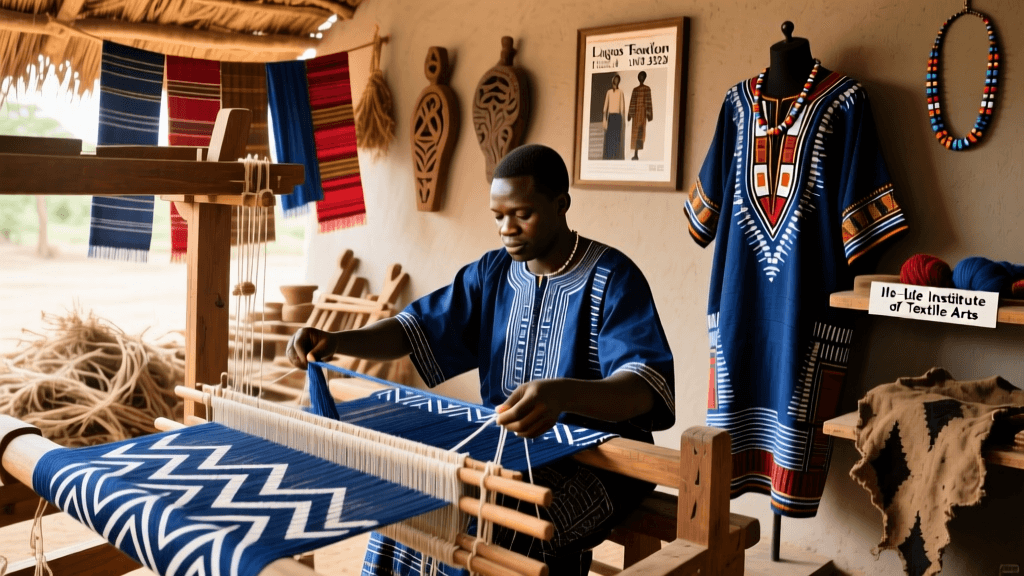
Aso Oke—the “top cloth” in Yoruba—originated in the 19th century among the Yoruba people of southwestern Nigeria, particularly in towns such as Iseyin, Ede, and Oyo. Unlike kente cloth of Ghana or mud cloth (bògòlanfini) of Mali, Aso Oke is a handwoven textile produced exclusively on narrow-strip looms by male weavers known as *aláṣọ*. Its emergence coincided with the rise of royal courts in the Oyo Empire and later the Ife and Ijebu kingdoms, where it became inseparable from ceremonial identity: chiefs wore deep indigo *etù*, brides draped shimmering silver-and-gold *sanyan*, and elders selected earth-toned *alaari* for ancestral rites. The cloth’s symbolic lexicon is encoded in colour, pattern, and fibre—red signifies courage and spiritual potency; white denotes purity and divinity; black evokes maturity and ancestral wisdom. As noted by the National Museum of African Art (2021), “Aso Oke functions not as mere apparel but as a performative archive of lineage, office, and cosmology.”
Weaving Loom Construction and Operation
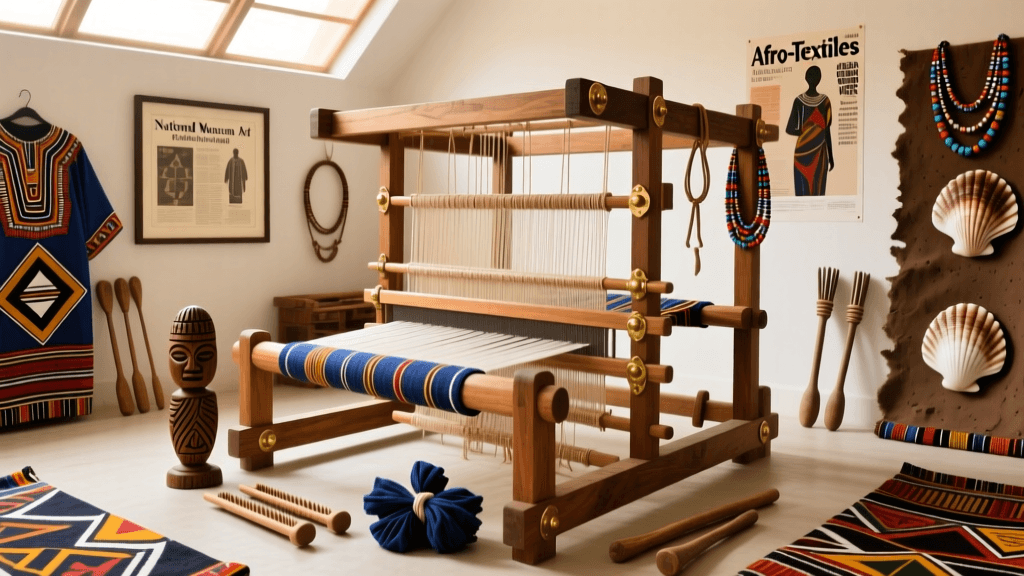
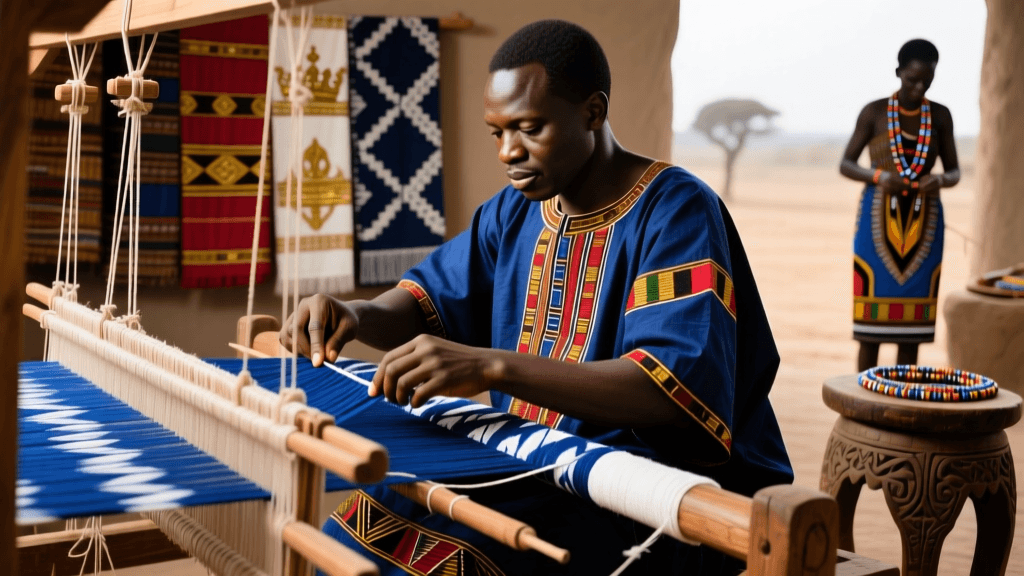
The traditional Aso Oke loom is a horizontal, single-heddle, warp-weighted device made entirely of local hardwoods—typically iroko or obeche—and assembled without nails or screws. Its frame measures precisely 185 cm in length, 75 cm in width, and 45 cm in height, allowing only one narrow strip (usually 12–15 cm wide) to be woven at a time. Weavers sit cross-legged on the floor, operating foot pedals that lift alternate warp threads while passing the shuttle—a carved wooden rod 32 cm long—by hand. Each completed strip requires approximately 4–6 hours of continuous weaving, depending on complexity. The loom’s tension system relies on smooth river stones weighing between 1.2–1.8 kg tied to warp ends, ensuring even thread alignment critical for geometric precision.
Warp and Weft Alignment Protocols
Before weaving begins, the warp is meticulously measured and wound onto a warping board using a calibrated wooden ruler marked in centimetres. Each warp thread must maintain uniform tension—deviations exceeding 0.3 mm cause visible puckering in finished cloth. Weavers use a bamboo comb called *àgbàdà* to space threads at exact intervals of 24 threads per centimetre. This density enables the intricate supplementary weft patterns—such as *eje owo* (blood money motif) or *ìyá àgbà* (elder mother)—to emerge with clarity.
Yarn Preparation: From Raw Fibre to Dyed Thread
Historically, Aso Oke used locally spun cotton (*àlàrì*) and wild silk (*sanyan*) harvested from the Anaphe infracta moth cocoon. Today, artisans blend these with imported mercerized cotton and metallic yarns. Raw silk cocoons are boiled for 90 minutes in alkaline ash solution to loosen sericin, then hand-reeled into continuous filaments. Cotton undergoes retting in flowing streams for 72 hours, followed by manual ginning and spinning on drop spindles averaging 28 cm in length. Dyeing occurs in earthenware pots over open fires, with natural dyes sourced from specific plants: camwood (*Baphia nitida*) yields deep reds after 48 hours of fermentation; indigo vats require weekly replenishment with fermented cassava leaves and lime.
Traditional Dye Vat Chemistry
Indigo dyeing follows strict biochemical protocols. A vat contains 12 litres of water, 1.5 kg of fermented indigo leaves, 300 g of wood ash filtrate, and 200 g of sodium hydrosulphite (modern adaptation). Reduction must reach pH 11.2–11.6 for effective dye transfer. Artisans test readiness by dipping a white cloth—if it emerges blue-green and oxidizes to deep blue within 3 minutes, the vat is active.
Spatial Practice: Workshops and Guild Structures
Aso Oke production remains concentrated in three historic centres: Iseyin—renowned for its mastery of *sanyan*; Ede—specialising in complex brocade motifs; and Oyo—preserving royal commission protocols. Each workshop operates under the *Ìjọ̀ Aláṣọ*, a guild governed by elder weavers who enforce apprenticeship standards: novices train for minimum 5 years before handling ceremonial commissions. Apprentices must weave 120 complete strips—each at least 2.4 metres long—before receiving certification. The Oyo State Ministry of Culture maintains a registry of 87 certified master weavers, of whom only 14 are women, reflecting ongoing gender shifts in practice.
- Iseyin Weavers’ Cooperative Society—established 1973, supports 212 active artisans
- Nigerian Institute of Textile Technology (NITT), Ibadan—offers annual Aso Oke preservation workshops since 2015
- Centre for Black Culture and International Understanding (CBCIU), Lagos—curates rotating exhibitions featuring archival Aso Oke samples dating to 1927
Contemporary Institutional Engagement and Innovation
Modern fashion institutions actively bridge tradition and innovation. The Lagos Fashion Week (LFW) has featured Aso Oke in 17 runway collections since 2013, including Look 12 of Orange Culture’s Spring/Summer 2024 show, which fused laser-cut leather with handwoven *alaari* panels. The Pan-African University Institute for Life and Earth Sciences (PAULESI), located in Abuja, partnered with UNESCO in 2022 to digitise 312 Aso Oke pattern schematics using photogrammetry—each scan capturing 4,200 dpi resolution of warp/weft interlacing. Atelier Masani, founded in Ibadan in 2018, introduced machine-assisted loom modifications that reduce weaving time by 35% without compromising hand-finished edges.
“The preservation of Aso Oke is not about freezing technique—it’s about sustaining decision-making sovereignty over material, meaning, and market access.” — Dr. Adenike Olawuyi, Director, Centre for Black Culture and International Understanding (2023)
Pattern Symbolism and Contemporary Reinterpretation
Each motif carries layered meaning. *Òkè ògún* (warrior’s path) features zigzag lines representing strategic movement; *Ìyá mi ló ń wà* (my mother is coming) uses concentric diamonds to denote maternal authority. Designers now reinterpret these through scale distortion and fibre substitution: Studio Maki’s 2023 collection replaced metallic yarn with recycled aluminium foil strips, maintaining visual weight while reducing cost by 22%. Meanwhile, the Nigerian National Commission for Museums and Monuments (NNCMM) documented 89 distinct Aso Oke patterns across 12 Yoruba subgroups, confirming regional variations in stripe width—Ede weavers use 3.2 cm bands, whereas Oyo artisans prefer 2.7 cm.
Unlike kente cloth—where each pattern belongs to a specific Asante royal lineage—or Maasai beadwork, where colour coding reflects age-set status, Aso Oke symbolism operates through relational context: the same *etù* cloth worn by a priest during Ifá divination signals different cosmological intent than when worn by a chief at a coronation. This contextual fluidity distinguishes it from adire’s resist-dye rigour or boubou’s West African Sahelian draping conventions.
Preservation efforts extend beyond aesthetics. In 2020, the NITT launched the Aso Oke Fibre Traceability Project, assigning QR-coded tags to every commissioned roll. Scanning reveals origin village, weaver ID, fibre composition percentages, and dye batch number—ensuring transparency across global supply chains. To date, 4,862 rolls have been registered, with 63% traced to Iseyin-based cooperatives.
The textile’s physical properties also inform its cultural endurance. Aso Oke achieves 210 g/m² grammage—denser than standard dashiki cotton (140 g/m²)—providing structural integrity for layered ceremonial garments like the *agbádá*. Its tensile strength averages 38.7 N per 5 cm width, allowing repeated wear without fraying—a practical necessity for multi-day festivals like the Ogun Festival in Abeokuta.
International recognition continues to grow. The Museum of Fine Arts, Boston acquired a 1954 *sanyan* bridal wrapper in 2022, noting its “exceptional warp count of 312 threads per 10 cm—a benchmark of pre-industrial technical mastery.” Similarly, the Victoria and Albert Museum’s “Africa Fashion” exhibition (2022–2023) displayed six Aso Oke ensembles alongside kente and bògòlanfini, highlighting comparative techniques: while kente employs double-weave discontinuous weft, Aso Oke relies on supplementary weft insertion, and mud cloth depends on fermented iron-rich mud application.
As Yoruba communities reassert textile sovereignty, Aso Oke remains anchored in precise, measurable craft knowledge—not abstraction. Its survival hinges on transmission fidelity: the exact gram weight of dyestuff, the calibrated tension of warp stones, the centimetre-perfect spacing of threads. These numbers are not metrics—they are memory.