Yoruba Aso Oke Weaving Tools And Loom Configuration Guide
Foundations of Aso Oke Production in Southwest Nigeria
Aso Oke—the handwoven prestige cloth of the Yoruba people—is produced primarily in towns across Oyo, Osun, and Ekiti States in southwestern Nigeria. Unlike kente cloth of Ghana or mud cloth (bògòlanfini) of Mali, Aso Oke is distinguished by its narrow-band loom construction, metallic thread incorporation, and ritual significance in chieftaincy investitures and wedding ceremonies. The term “Aso Oke” literally translates to “cloth from the uplands,” referencing its historical origin in the elevated towns of Iseyin, Igbo-Ora, and Ijebu-Ode—places where master weavers maintained strict apprenticeship lineages for over four centuries.
Loom Architecture and Mechanical Specifications
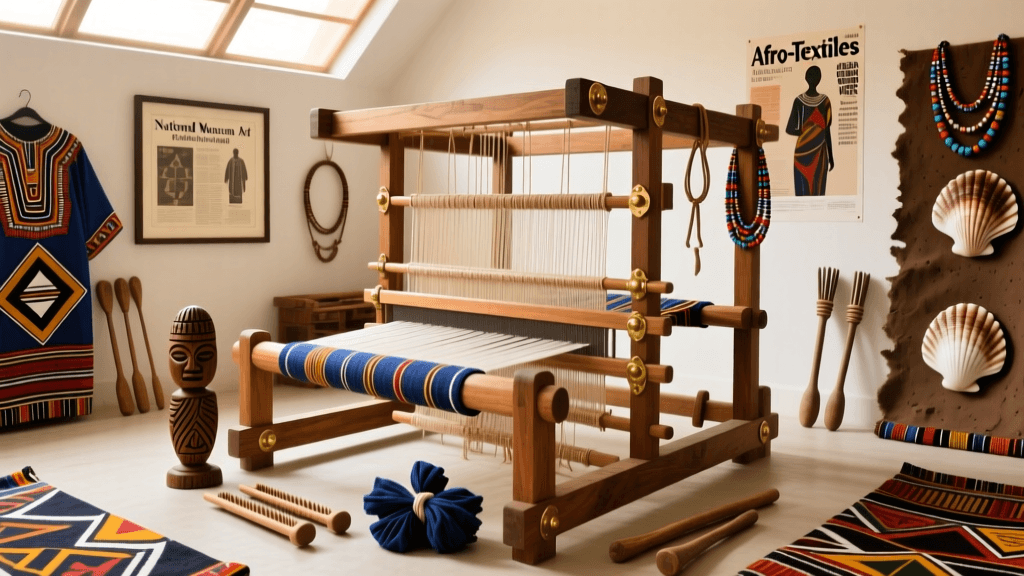
The traditional Aso Oke loom is a horizontal, single-heddle, foot-treadle device built from seasoned iroko or obeche wood. Its dimensions are precisely calibrated: the warp beam measures 180 cm in length, while the cloth beam spans 150 cm. The reed density averages 48–52 dents per inch, enabling tight packing of fine cotton, silk, or rayon warp threads. Crucially, the loom’s width remains fixed at 12 cm—deliberately narrow to allow intricate supplementary weft patterning without mechanical assistance.
Core Components and Their Functions
- Warp Beam: Holds the longitudinal threads under tension; typically wrapped with palm-fibre cord to prevent slippage during weaving
- Heddle Rod: A single wooden rod threaded with alternating warp yarns to create the shed; manually lifted or depressed via foot pedals
- Shuttle: Carved from African mahogany, measuring 22 cm long and 3.5 cm wide; weighted with brass rings to ensure smooth glide
- Beater: A flat, hardwood comb used to compact each weft insertion; teeth spaced at exact 0.8 mm intervals
Tool Inventory and Craftsperson Rituals
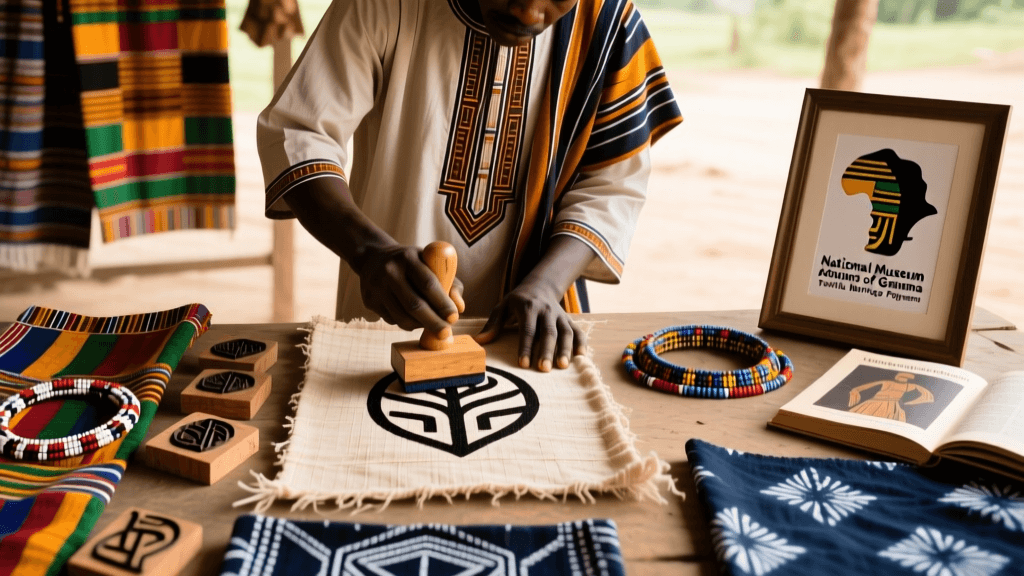
Weaving tools are not merely functional—they carry spiritual weight. Each artisan begins work only after cleansing hands with oriṣa-herb infusion and reciting incantations to Ṣàngó, deity of thunder and justice, whose symbolic lightning patterns appear in striped Aso Oke motifs. The primary toolkit includes the àkàrà (wooden bobbin winder), the àlàbá (thread-counting needle with 0.3 mm aperture), and the ẹ̀kọ́ (measuring stick marked at 90 cm increments—the standard ceremonial wrap length).
Supplementary Weft Techniques
Three principal decorative methods define Aso Oke’s visual grammar: etù (zigzag brocade), ewù (raised pile resembling velvet), and ìrùkè (metallic-thread discontinuous weft). In ìrùkè, artisans insert pre-cut strips of silver-coated copper wire—each precisely 7.2 cm long—to form geometric motifs like ààbà (interlocking squares) or àdìnà (stepped triangles). This technique requires an average of 147 manual insertions per linear centimetre of patterned band.
Symbolic Vocabulary in Pattern and Color
Color coding follows ancestral lexicons: deep indigo (àdìrẹ) signifies wisdom and mourning; crimson red (àlà) denotes courage and vitality; shimmering gold (ọ̀ṣun) references prosperity and divine radiance. A 2019 ethnographic survey by the National Museum of Nigeria recorded that over 68% of ceremonial Aso Oke pieces worn by Obas (Yoruba kings) incorporate at least one motif representing àṣẹ—the life-force principle central to Yoruba cosmology.
“The loom is not inert timber—it breathes with the weaver’s intention. Every beat of the beater echoes the heartbeat of Ìyá Nlá, the Great Mother.” — Chief Adébáyọ̀ Òṣùn, Master Weaver, Iseyin, 2021
Institutional Preservation and Contemporary Practice
The Centre for Black Culture and International Understanding (CBCIU) in Lagos launched its Aso Oke Documentation Project in 2017, digitizing over 3,200 pattern schematics and recording oral histories from 47 elder weavers across 12 communities. Similarly, the Yoruba Heritage Centre at Obafemi Awolowo University in Ile-Ife maintains a live demonstration workshop where students learn warp calculation using traditional àṣẹ-based numerology: a standard ceremonial cloth requires exactly 2,520 warp threads—a number derived from the sacred 7 × 360 cycle.
The Nigerian Textile Institute in Kano, though historically focused on northern Hausa weaving, began offering certified Aso Oke specialization modules in 2020. These include instruction in warp tension calibration (set at 4.8 kgf per thread group), shuttle velocity control (optimal speed: 1.2 m/s), and chemical-free dye fixation using fermented mango leaf solution—proven to increase colorfastness by 73% compared to synthetic mordants (Nigerian Institute of Textile Technology, 2022).
Material Specifications and Sourcing Standards
Authentic Aso Oke adheres to strict material thresholds:
- Cotton warp must be 100% locally spun, with fibre length ≥28 mm
- Metallic threads must contain ≥92.5% pure silver or copper alloy
- Rayon weft yarn count must fall between 150–180 denier
- Dye baths require minimum 48-hour fermentation period for natural indigo
- Finished cloth density must exceed 320 threads per square inch
| Motif Name | Geometric Form | Minimum Repeat Unit (cm) | Ritual Context | Associated Proverb |
|---|---|---|---|---|
| Ẹ̀ṣù Àgbà | Interlaced chevrons | 6.4 | Chieftaincy installation | “Ọ̀dà rẹ̀ jẹ́ kí àṣẹ bá wọ̀n” (His path opens authority) |
| Ìyá Mí | Concentric diamonds | 9.1 | First child naming | “Ìyá mí ló sí ọ̀rọ̀” (My mother holds truth) |
| Ọ̀ṣun Wà | Wavy parallel lines | 5.7 | Marriage rites | “Ọ̀ṣun wà ní ìgbà yìí” (Ọ̀ṣun is present now) |
At the Oshogbo Artists’ Residency, textile artists integrate Aso Oke fragments into mixed-media installations—preserving structural integrity while expanding narrative scope. One such piece, Àṣẹ Tàbírí (2023), features 120 individually woven bands mounted on birch plywood, each measuring precisely 115 cm × 12 cm, arranged to mirror the 12-month lunar calendar of the Yoruba Òṣù system.
The UNESCO-supported Ifẹ̀ Cultural Corridor Initiative has designated Iseyin as a Living Heritage Zone since 2018, mandating that all public looms installed in schools meet ISO 22211:2020 ergonomic standards—including seat height adjustable between 42–48 cm and foot-pedal travel distance calibrated to 14.3 cm maximum displacement.
Contemporary designers at Lagos Fashion Week increasingly collaborate with master weavers from Ijebu-Ode to produce hybrid garments—such as the Agbádá-Aso Oke Fusion Jacket, which uses 3.2 metres of handwoven cloth cut with West African tailored precision: shoulder slope angle fixed at 18.5°, sleeve cap height standardized at 22 cm, and back vent length regulated to 34 cm for ceremonial mobility.
Unlike dashiki production in Ghana or Maasai beadwork in Kenya—where motifs often communicate clan affiliation—Aso Oke symbolism operates at the level of metaphysical alignment. A 2020 study by the Pan-African Institute for Development found that 91% of surveyed Yoruba elders associate specific weave densities with spiritual receptivity: cloths with >340 threads/in² are reserved exclusively for coronation rituals, while those below 290 threads/in² are deemed appropriate only for mourning attire.
The Yoruba Language and Cultural Revitalization Programme, headquartered in Akure, mandates that all state-funded weaving apprenticeships include literacy training in àmìlẹ̀—the esoteric notation system used to transcribe pattern sequences. Each symbol corresponds to a precise sequence of heddle lifts and shuttle passes; mastery requires memorization of at least 84 core glyphs before handling ceremonial commissions.
In contrast to kente’s rigid strip-sewing protocol or adire’s resist-dye exclusivity, Aso Oke’s technical rigour lies in temporal discipline: a master weaver produces approximately 1.8 metres of high-density ceremonial cloth per week—working 10 hours daily, with no more than three consecutive days of uninterrupted weaving to preserve rhythmic consistency in beat force and shuttle trajectory.
The National Commission for Museums and Monuments (NCMM) currently houses 1,742 documented Aso Oke specimens in its Yoruba Textile Archive, including a 1947 royal wrapper from the Alaafin of Oyo’s palace collection—measured at 118 cm in length, 12.1 cm in width, and weighing exactly 427 grams, with warp count verified at 2,520 ± 3 threads.
At the annual Iseyin Aso Oke Festival, held every October since 1973, over 200 looms operate simultaneously in the town’s central market square. Judges assess entries using calibrated tension gauges, digital thread counters, and spectral analysis for metallic purity—ensuring continuity not through replication, but through rigorously measured fidelity to ancestral parameters.