Best 2026 Kimono Sewing Workshops: Master Tanmono Fabric
The Renaissance of Wafuku Sewing in 2026
The global slow fashion movement has catalyzed a massive resurgence in traditional garment making, and in 2026, wafuku (Japanese traditional clothing) sewing workshops are more accessible and technologically integrated than ever before. Unlike Western tailoring, which relies on complex curved patterns to contour the body, traditional Japanese garment construction is a masterclass in geometric precision, zero-waste philosophy, and straight-line sewing. For textile enthusiasts, fashion students, and heritage craft preservationists, attending a dedicated kimono or yukata construction seminar offers a profound shift in how one interacts with fabric.
According to the Victoria and Albert Museum, the fundamental T-shape silhouette of the kimono has remained remarkably consistent for centuries, yet the methods of teaching and preserving these techniques have evolved. Today’s 2026 seminars blend centuries-old hand-stitching methods with modern pedagogical tools, allowing international students to master the art of the tanmono (fabric bolt) without needing to apprentice in a Kyoto atelier for a decade.
Understanding the Tanmono: A Paradigm Shift in Fabric
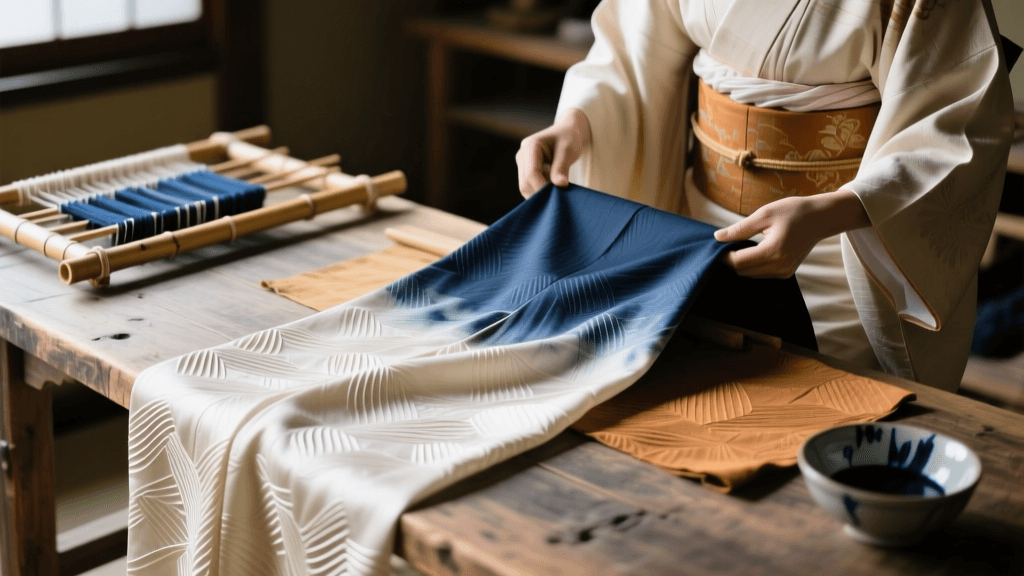
To learn wafuku sewing, one must first unlearn Western pattern cutting. In Western tailoring, fabric is woven in wide widths (typically 115cm to 150cm), and patterns are nested to minimize waste, inevitably creating offcuts. In traditional Japanese garment making, the fabric is woven specifically for the garment. This bolt is called a tanmono.
A standard tanmono is woven to a precise width of approximately 36 to 38 centimeters (about 14 to 15 inches) and is roughly 11 to 12 meters long. This exact length and width contain the precise amount of material needed to construct a single adult kimono or yukata with zero waste. As highlighted by Encyclopedia Britannica, this loom-width dictated the very architecture of Japanese dress. When you attend a 2026 wafuku workshop, the first module always focuses on how to manipulate these narrow, continuous strips into sleeves (sode), body panels (migoro), and overlapping collars (eri) using only straight seams.
Top Wafuku Workshop Formats for 2026
Whether you are looking to travel to Japan or learn from your home studio, the 2026 landscape of traditional garment seminars offers diverse pathways to mastery.
In-Person Kyoto & Tokyo Intensives
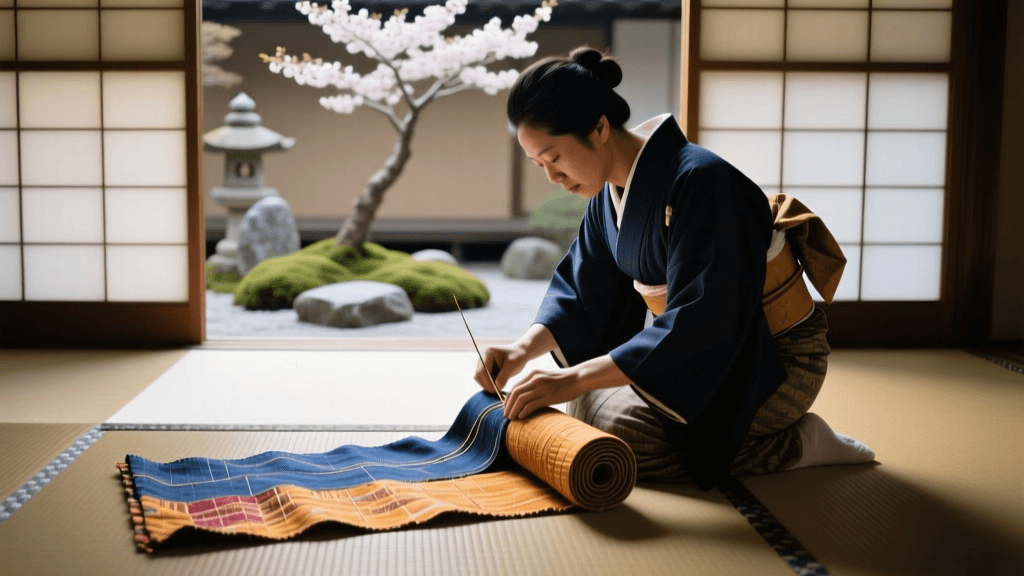
For the ultimate immersion, multi-day retreats in Japan remain the gold standard. In 2026, premier ateliers in Kyoto’s Nishijin weaving district offer 5-to-7-day intensive courses. These workshops provide students with pre-dyed, high-quality cotton tanmono to construct a fully lined or unlined yukata. Students learn to use traditional floor cushions (zabuton) and low sewing tables, mastering the physical posture required for long, perfectly straight running stitches. Current 2026 pricing for these all-inclusive intensives averages ¥195,000 to ¥250,000, which covers materials, studio time, and a final professional fitting (kitsuke) session.
Global Hybrid & Virtual Masterclasses
For international students, hybrid seminars have revolutionized wafuku education. In 2026, top-tier instructors utilize augmented reality (AR) fitting applications. Students input their personal measurements, and the AR software maps the tanmono yardage to their specific body proportions, generating a customized cutting guide that respects traditional panel ratios while accommodating modern, non-standard body types. Instructors ship the tanmono and tool kits globally, conducting live, multi-angle camera sessions to correct stitch tension and seam allowances in real-time.
Essential 2026 Toolkit for the Traditional Sewist
Wafuku sewing requires a specialized toolkit that differs vastly from a standard Western sewing kit. Workshops will typically provide or require the following:
- Herabari: A bamboo or wooden spatula used instead of pins. Because pinning can damage delicate silk or leave marks on cotton, the herabari is tucked under the sewer's knee or weight to hold the fabric taut while stitching.
- Kujira-shaku: The traditional 'whale ruler.' Unlike the metric system, this ruler is divided into shaku, sun, and bu. Modern 2026 workshops often provide dual-sided rulers featuring both metric and kujira-shaku measurements to ease the transition for international students.
- Shinshi: Bamboo stretchers equipped with tiny needles at the ends. These are used to stretch the fabric taut during the ironing process, ensuring the narrow tanmono panels remain perfectly straight and do not warp.
- Kote: A traditional Japanese iron. While vintage charcoal-heated kote are beautiful artifacts, 2026 workshops utilize modern, temperature-controlled electric versions designed specifically for pressing narrow seam allowances without scorching the fabric.
Workshop Comparison Chart: 2026 Pricing & Formats
| Workshop Type | Location | Duration | 2026 Est. Cost | Best For |
|---|---|---|---|---|
| Kyoto Intensive Retreat | Kyoto, Japan | 5 - 7 Days | ¥195,000 - ¥250,000 | Immersive learners seeking authentic atelier environments and silk handling. |
| Tokyo Weekend Seminar | Tokyo, Japan | 2 Days | ¥45,000 - ¥60,000 | Travelers wanting to construct a basic unlined cotton yukata quickly. |
| Virtual AR-Guided Masterclass | Global / Online | 4 Weeks (Part-time) | $450 - $600 USD | International students needing custom body-mapping and remote instruction. |
| Local Guild Study Group | Major Global Cities | 8 Weeks | $300 - $400 USD | Community-focused learners preferring weekly, paced instruction. |
Organizations like the Japan National Tourism Organization frequently update directories of certified traditional craft studios that welcome international visitors, making it easier than ever to book these specialized in-person experiences.
Core Techniques Taught in Modern Seminars
The true magic of wafuku construction lies in how the garment is finished. Because the fabric is cut in straight lines along the selvedge, the raw edges are entirely hidden from the outside world without the need for modern sergers or zigzag stitches.
The Hon-Nui (Standard Stitch) and Seam Allowances
The primary stitch taught in any beginner seminar is the hon-nui, a precise running stitch. Students learn to maintain an exact stitch length (usually around 3mm to 4mm) to ensure the seam is strong yet flexible. Unlike Western seams that are pressed flat or open, wafuku seams are folded together. The seam allowance is not trimmed; it is carefully folded inward, creating a self-encased edge known as kise. This kise technique ensures that no raw edges are ever exposed to the inside or outside of the garment, making the kimono fully reversible and incredibly durable.
Kujira-shaku vs. Metric Measurements
A significant portion of any 2026 seminar is dedicated to the mathematics of the kujira-shaku system. While a metric tape measure is useful for taking initial body measurements, the actual drafting of the garment is done in traditional units. One shaku is approximately 37.8 centimeters. It is divided into 10 sun (3.78 cm each), and each sun is divided into 10 bu (0.378 cm each). Instructors teach students how to calculate the yuki (sleeve length from the center back) and the take (total garment length) using these traditional fractions, ensuring the drape and proportion remain historically accurate.
Preparing for Your First Garment Making Seminar
If you are planning to enroll in a wafuku sewing workshop this year, preparation is key. First, ensure you have a basic understanding of hand-sewing fundamentals; while you do not need prior experience with traditional Asian garments, the ability to thread a needle and execute a consistent running stitch will save you hours of frustration. Second, invest in high-quality thimbles. The kakehari (a traditional tensioning device) and the physical act of pulling thick cotton or silk thread through multiple layers can be taxing on the fingers.
Finally, approach the craft with patience. Wafuku sewing is not about speed; it is about mindfulness, precision, and a deep respect for the textile. The tanmono represents the labor of the weaver, the dyer, and the spinner. By learning to construct a kimono or yukata through a dedicated 2026 seminar, you are not merely making a piece of clothing; you are participating in a living, breathing lineage of Asian textile heritage that continues to evolve and inspire the modern world.