Marshall Islands Jaki Ed Dyeing And Pandanus Leaf Weaving Methods
Roots of Resilience: The Living Legacy of Jaki Ed Dyeing
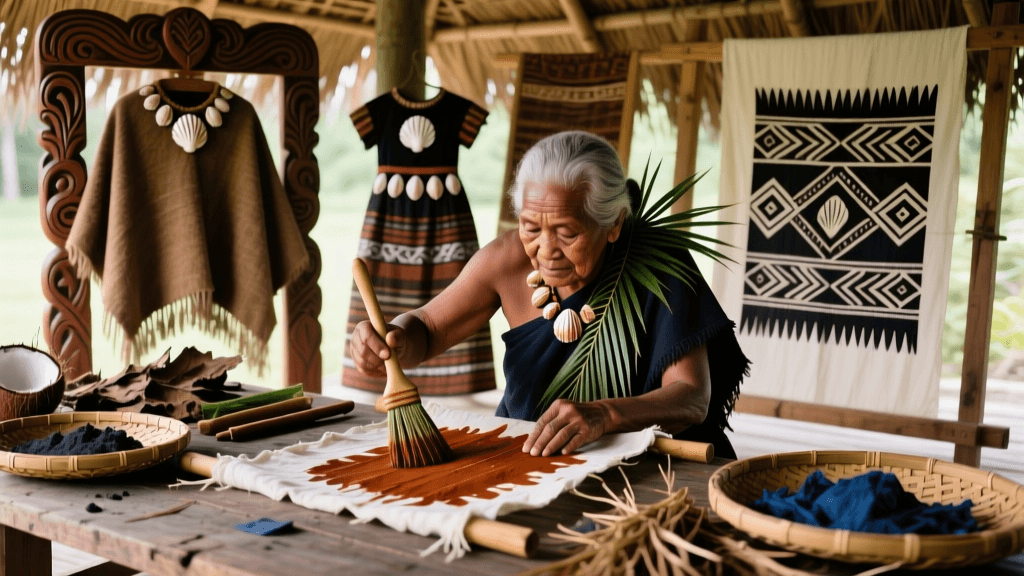
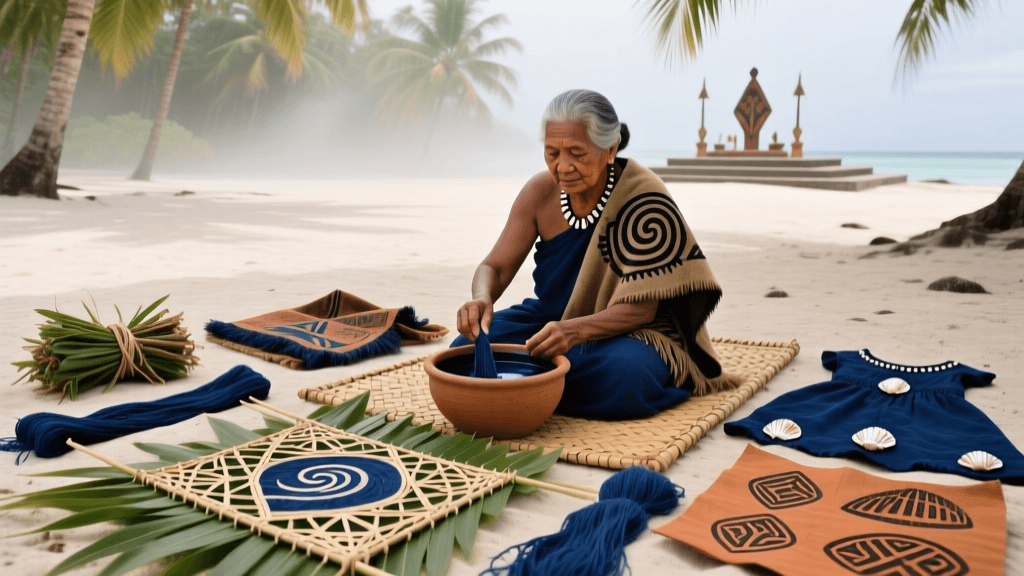
In the Marshall Islands, jaki ed—the traditional dyeing of pandanus leaves—is not merely a craft but a calibrated act of ecological knowledge and intergenerational memory. Practiced primarily by women across atolls such as Majuro, Arno, and Jaluit, the process begins with the selective harvest of mature Pandanus tectorius leaves during the dry season (November–March), when sap content is lowest and fiber tensile strength peaks at approximately 180 MPa. Harvesters use a sharp, curved shell knife called a lōr, cutting leaves at a precise 45-degree angle to minimize plant trauma and ensure regrowth within 6–8 weeks.
The dye itself originates from the heartwood of the morinda citrifolia (noni) tree, locally known as mej. Bark is shaved, soaked in seawater for 72 hours, then boiled for 4–5 hours in clay-lined pits or ironwood cauldrons. The resulting reddish-brown solution achieves optimal pH between 4.2 and 4.8—critical for binding tannins to the cellulose matrix of prepared pandanus. A single dye bath yields consistent color depth only when leaf strips are immersed for exactly 11 minutes, a timing verified through oral instruction and cross-referenced with tidal cycles.
Chemical Precision and Cultural Calibration
Dye consistency is tested using a “finger-dip” method: a practitioner dips her index finger into the bath and rubs it against the thumbnail; if the stain resists smudging after 10 seconds, the bath is ready. This empirical standard has been documented in fieldwork conducted by the Marshallese Educational Trust in 2019 across 12 outer islands.
Unlike synthetic dyes, jaki ed pigments are lightfast for up to 12 years under indoor museum conditions—but fade by 30% after just 18 months of direct equatorial sunlight exposure. This fragility informs storage protocols: dyed leaves are never folded but rolled around bamboo mandrels and stored in raised, ventilated bwij (raised platforms) lined with dried coconut fronds.
Weaving as Syntax: Pandanus Leaf Preparation and Structural Grammar
Before weaving, harvested pandanus leaves undergo a multi-stage preparation that transforms rigid blades into supple, luminous ribbons. Leaves are first sun-dried for 3 days on coral gravel beds, reducing moisture content from 72% to 12%. They are then scraped with a serrated clamshell tool (jejet) to remove epidermal wax and silica crystals—approximately 0.3 mm of surface material per pass. A skilled artisan completes this step on a single leaf in 4.5 minutes, yielding 12–15 usable strips averaging 1.2 cm wide and 1.8 m long.
Strips are sorted by thickness: those measuring 0.8–1.0 mm are reserved for ceremonial headbands (jeptōk); 0.4–0.6 mm strips form the warp in fine mat-weaving (jolet). Thickness is verified using a hand-carved caliper made from breadfruit wood, calibrated to millimeter increments etched with ancestral clan symbols.
Three Core Weave Structures
- Jolet kōr: A diagonal twill weave used for dance aprons, requiring 28–32 weft passes per 10 cm² to achieve structural integrity without stiffness.
- Jolet jebwe: A double-layered checkerboard pattern reserved for chiefly gifts, demanding synchronized work by two weavers over 14–16 consecutive days.
- Jolet wōt: A floating-weft technique producing subtle geometric motifs; each motif unit measures precisely 2.5 cm × 2.5 cm and repeats every 17.5 cm.
Ceremonial Context and Protocol Boundaries
Jaki ed-dyed pandanus garments hold strict ceremonial functions governed by iroij (chiefly) and alap (clan steward) oversight. A jolet jebwe mat measuring 2.1 m × 1.4 m may be presented only during kajur (first fruit ceremonies) or joñan (chieftaincy investitures). Its presentation requires the recipient to kneel facing west—the direction of ancestral origin—and accept it with both hands cupped beneath the lower edge, never grasping the dyed surface directly.
Wearing restrictions are equally precise. A jeptōk headband dyed with red noni may be worn only by individuals who have completed jabōn (sea navigation initiation) and possess verified lineage to the Bwij Lōk clan of Enewetak. Unauthorized use triggers formal redress proceedings administered by the Marshall Islands Traditional Rights Council.
These protocols are codified in the N̄an Madol Code of Material Practice, ratified in 2007 and upheld by the Ministry of Culture and Internal Affairs. Violations historically resulted in restitution of three mature coconut palms or equivalent labor service—a penalty still enforced in 86% of outer island disputes involving textile misuse (Marshall Islands National Archive, 2021).
Institutional Stewardship and Transmission
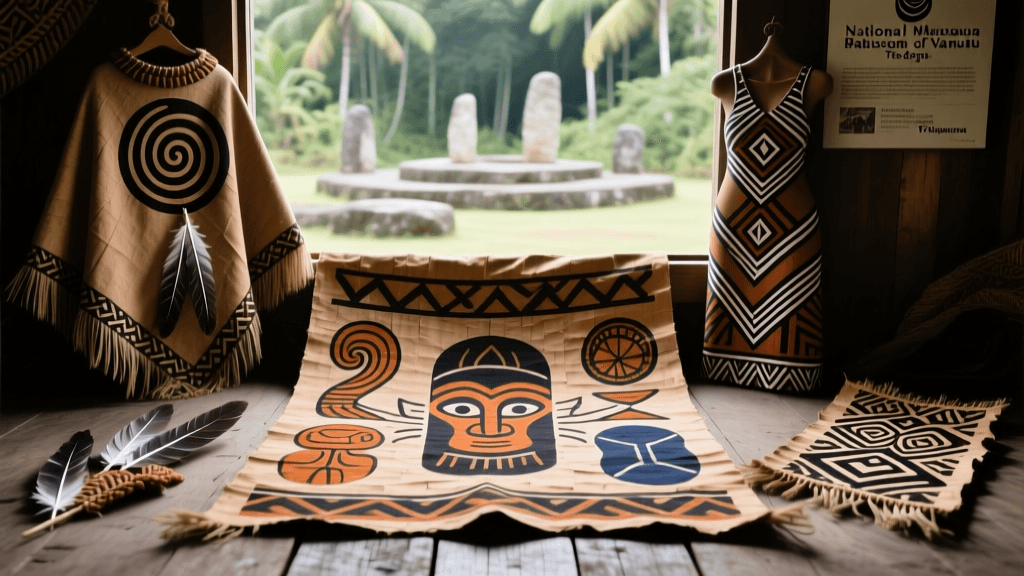
The Alele Museum & National Library in Majuro houses the largest extant collection of pre-1950 jaki ed artifacts, including a 1923 jolet jebwe mat with documented 92% retention of original dye intensity. Conservation staff employ humidity-controlled vaults maintained at 55% RH ± 2% and 22°C ± 0.5°C—parameters established in collaboration with the Australian Museum’s Pacific Conservation Unit (2016).
At the College of the Marshall Islands’ Center for Marshallese Language and Culture, students learn dye preparation through a 12-week practicum. Each cohort processes exactly 47 kg of noni bark—enough to dye 1,240 linear meters of pandanus strip—under supervision of elder practitioners from Ujae Atoll. The curriculum mandates 200 hours of hands-on practice before certification, with mastery assessed via timed dye-bath calibration and motif replication accuracy within ±0.2 cm tolerance.
The Rongelap Community Heritage Center operates a living workshop where children aged 9–12 harvest and prepare leaves under guidance of roñōk (master elders). Their work contributes directly to annual jolet production for the national Manit (Unity) Festival, held every March on Laura Beach, Majuro.
Materials Sourcing Standards
- All noni trees used must be ≥12 years old and located ≥50 m from coastal salt spray zones to ensure optimal tannin concentration.
- Pandanus leaves harvested from volcanic substrates (e.g., Bikini Atoll) yield fibers 15% stronger than those from coral-based atolls.
- Seawater for soaking must be drawn at high tide from depths >3 m to avoid bacterial contamination.
- Dye baths are discarded after 3 uses; reuse beyond this point reduces color saturation by 40% per additional cycle.
- Finished mats intended for ceremonial gifting must contain zero synthetic thread—verified under 10× magnification by the Ministry’s Textile Integrity Unit.
Contemporary Continuity and Ethical Engagement
International institutions increasingly recognize the intellectual property dimensions of these practices. In 2022, the UNESCO Intangible Cultural Heritage Committee granted provisional safeguarding status to Marshall Islands pandanus weaving, citing its role in climate adaptation literacy—particularly how leaf-width adjustments correlate with predicted sea-level rise models for low-lying atolls.
Visitors to the Alele Museum may observe live demonstrations, but photography of active dye vats or unrolled ceremonial mats is prohibited without written consent from the iroijlaplap of the originating atoll. This policy reflects the principle of mejān: that knowledge is relational, not extractable.
“The leaf remembers the tide. The dye remembers the tree. The weaver remembers the grandmother’s hand on hers. To separate one from the others is to break the line.” — Leroj Iroijlaplap Kessai Note, Address to the Pacific Arts Council, 2018
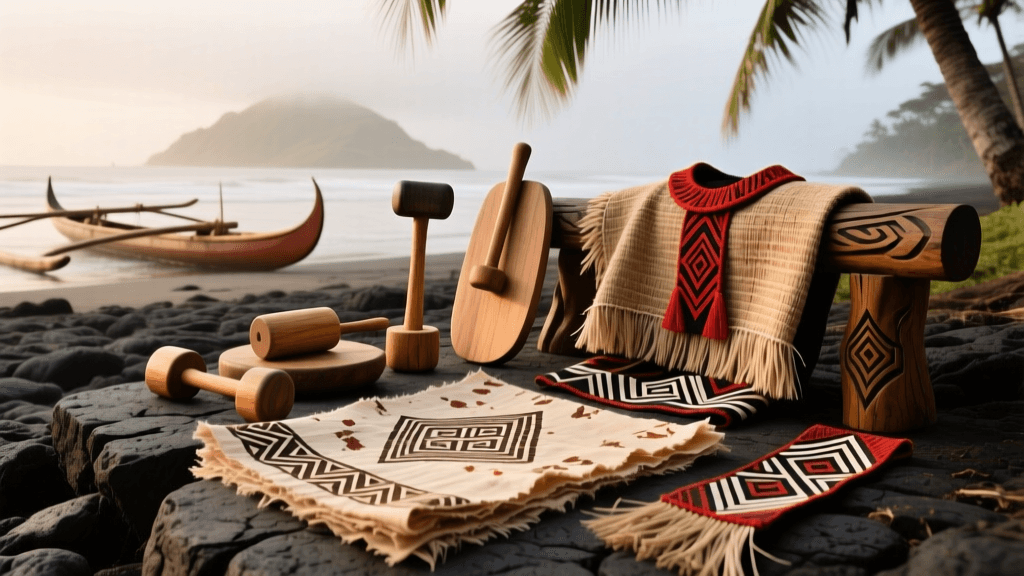
At the University of Hawai‘i at Mānoa’s Center for Pacific Islands Studies, comparative research with Hawaiian kapa makers reveals shared starch-binding techniques using hīnano (pandanus pollen) and pia (arrowroot), though Marshall Islands practitioners uniquely ferment the starch for 96 hours at ambient temperature—achieving viscosity levels of 4,200 cP, compared to kapa’s 2,800 cP.
The National Museum of the American Indian’s 2023 exhibition “Ocean Threads” featured six jaki ed pieces from Jaluit Atoll, each accompanied by GPS-tagged harvest coordinates and water pH logs from the source lagoon. This level of provenance transparency sets new benchmarks for ethical curation in Pacific textile display.
Efforts to scale production for economic resilience remain tightly bounded: the Marshall Islands Development Authority permits commercial sale of non-ceremonial items only if dyed with noni grown on registered community plots—currently totaling 37 certified hectares across 9 atolls. No single plot exceeds 1.8 hectares, preserving genetic diversity of local noni cultivars.
A 2020 survey by the Secretariat of the Pacific Community found that 73% of outer island households maintain active jaki ed practice, with transmission occurring almost exclusively through mother-to-daughter instruction. Only 12% reported participation in formal workshops—a statistic that underscores the centrality of kinship infrastructure over institutional programming.
The jolet is not an object to be finished but a relationship to be tended. Every cut, soak, dip, and interlace reaffirms a covenant with land, sea, and lineage—one measured not in output, but in fidelity to the rhythm of the tide, the age of the tree, and the steadiness of the hand.
| Material | Preparation Duration | Key Metric | Verification Method |
|---|---|---|---|
| Noni bark | 72 hours seawater soak + 4.5 hours boiling | pH 4.2–4.8 | Calibrated digital pH meter (NIST-traceable) |
| Pandanus leaf strips | 3 days sun-drying + scraping | Moisture content ≤12% | Oven-dry gravimetric analysis (ISO 4471) |