Samoan Siapo Bark Cloth Dyeing And Organic Pigment Preparation
Roots in the Banyan and Breadfruit: The Botanical Foundation of Siapo
Samoan siapo is not woven—it is beaten. Crafted from the inner bark of the paper mulberry (Broussonetia papyrifera) and, less commonly, the breadfruit tree (Artocarpus altilis), siapo production begins with precise botanical knowledge passed across generations. Harvesting occurs during the rainy season—typically November through March—when sap flow is high and fiber separation is optimal. Trees are selected at 18–24 months old; stems must measure 3–4 cm in diameter to yield bark thick enough for durable cloth but thin enough to beat without tearing. In villages like Falealupo on Savai‘i, elders instruct youth on identifying mature specimens by leaf shape, bark texture, and seasonal flowering cues—not calendar dates alone.
Beating, Layering, and Structural Integrity
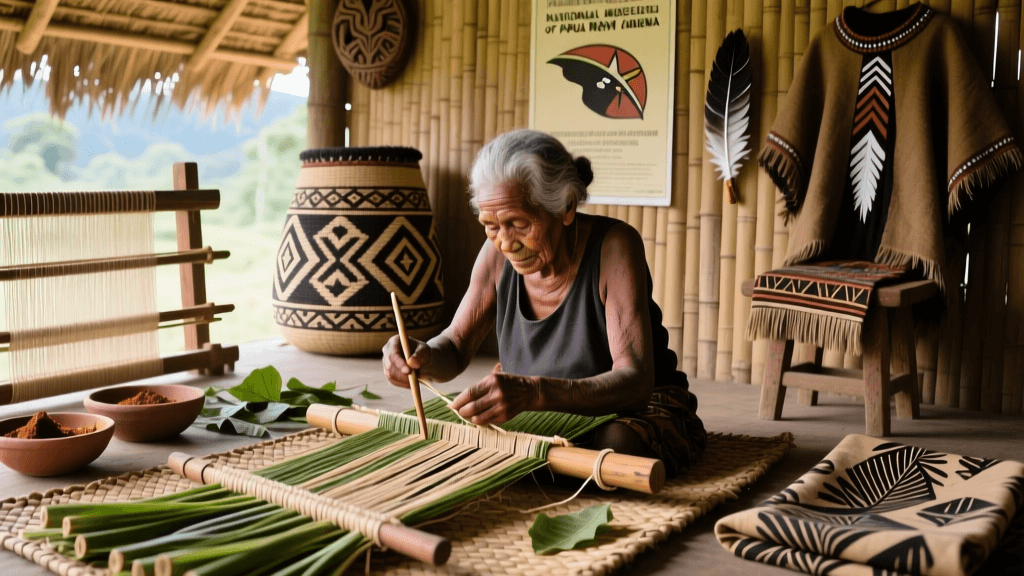
The beating process transforms fibrous strips into flexible, cohesive sheets. Strips are soaked in freshwater streams for 48–72 hours, then scraped clean with mussel shells or shark teeth. Each sheet requires approximately 120–150 rhythmic strikes per square centimetre using a four-sided wooden beater (i‘e tōga). The tool’s grooved surfaces—each side calibrated to a different fineness—progressively refine the pulp: coarse ridges (3 mm depth) open fibers, medium (1.5 mm) align them, fine (0.8 mm) compress layers, and ultra-fine (0.3 mm) polish the surface. A single 1.2 m × 2.4 m siapo sheet may incorporate 6–8 overlapping layers, each dried separately under shade for 18–22 hours before lamination. This layered construction yields tensile strength exceeding 45 N/cm²—comparable to lightweight cotton canvas—while retaining breathability critical for ceremonial wear in tropical humidity.
Organic Pigment Sourcing and Preparation Protocols
Reds from Volcanic Soil and Root Starch
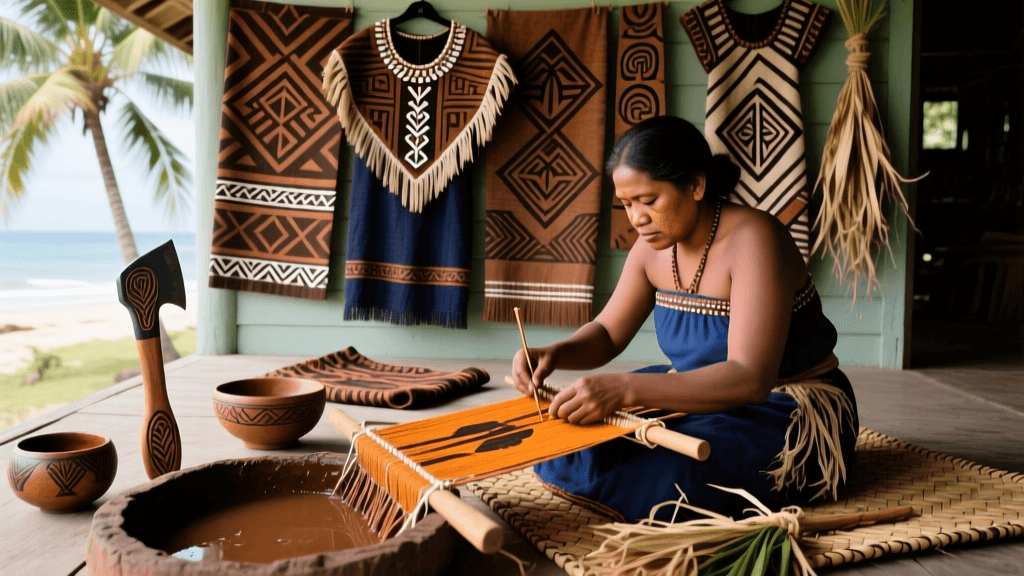
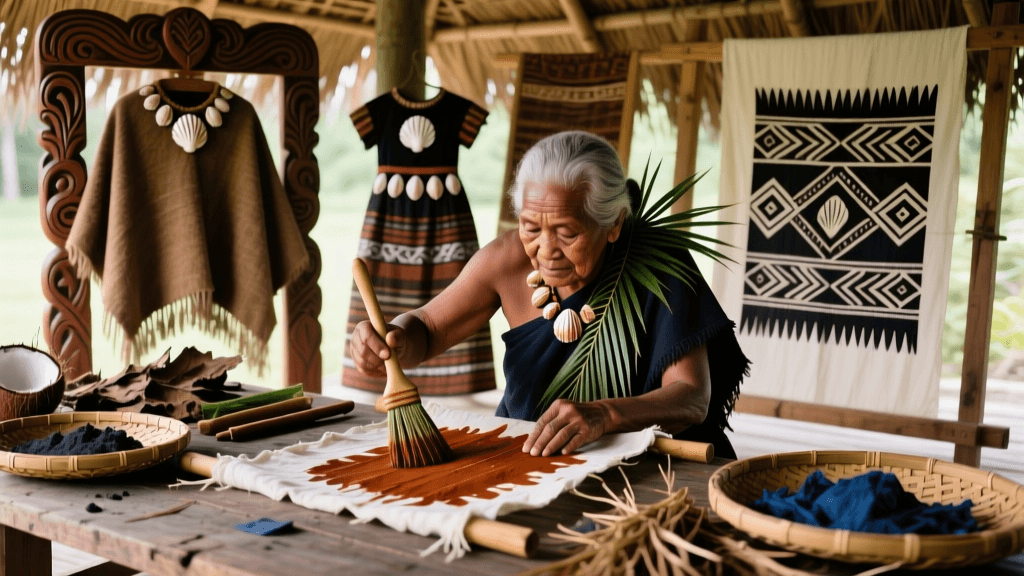
Traditional red dye (‘ōso) derives from iron-rich laterite soils found near volcanic vents on Upolu’s central highlands. Soil is collected only after consultation with village matai (chiefs) and presentation of a ‘ava offering at the sacred site of Falefa. Samples undergo triple sifting through bamboo mesh (mesh size: 0.2 mm) to remove grit, then mixed with fermented taro root paste at a ratio of 1 part soil to 3 parts starch. The mixture ferments for 96 hours in covered clay pots buried underground at 22–25°C—temperature monitored daily with coconut-leaf thermometers.
Blacks from Mangrove and Charcoal
Black pigment (ma’ele) combines mangrove bark extract (Bruguiera gymnorhiza) with hardwood charcoal. Bark is stripped from trees aged 12–15 years, boiled for exactly 14 hours in earthenware vessels, then strained through pandanus fibre filters (pore size: 0.05 mm). The resulting tannin solution is reduced over low fire until viscosity reaches 28–32 mPa·s—a consistency verified by dipping a calibrated wooden rod and timing drip intervals (target: 3.2 seconds per drop). Charcoal is ground to particle size ≤10 µm using basalt mortars, then blended at 1:1.5 weight ratio with the tannin concentrate.
Cultural Stewardship and Contemporary Transmission
Siapo creation adheres to strict protocols governing gender roles, spatial boundaries, and temporal rhythm. Only women trained in specific lineages may prepare dyes; men handle bark harvesting and initial beating. Work ceases during lunar phases deemed spiritually unstable—particularly the waning crescent (days 26–29 of the lunar cycle)—and resumes only after recitation of genealogical chants (fa‘alupega). These practices are documented and safeguarded by the O le Ao o le Malo (Head of State) Office’s Cultural Heritage Unit, which coordinates annual workshops at the National University of Samoa’s Centre for Samoan Studies in Apia. Since 2017, over 217 apprentices have completed certification programs requiring mastery of 19 distinct motifs—including the la’i (fern frond) pattern, whose 27-point symmetry encodes ancestral navigation routes.
Institutional Anchors and Living Practice
The Museum of New Zealand Te Papa Tongarewa holds 42 pre-1940 siapo pieces, including a 1928 ceremonial ‘ie toga from Manu‘a archipelago measuring 3.1 m × 1.8 m, with 38 individually dyed motifs applied via carved bamboo stamps. Field documentation conducted by the Pacific Islands Museums Association (PIMA) in 2021 confirmed that 14 villages across Savai‘i maintain active siapo-making collectives, with an average of 6.3 master practitioners per community. At the University of Hawai‘i at Mānoa’s Kamehameha Schools Bishop Museum Collection, comparative analysis reveals shared pigment preparation methods between siapo and Hawaiian kapa—particularly the use of turmeric root for yellow dye, processed identically across both traditions: grated rhizomes soaked in seawater for 72 hours, then sun-dried on coconut-frond mats for precisely 48 hours.
- Siapo sheets used in chiefly investiture ceremonies weigh 220–280 g/m²—lighter than Tongan ngatu (310–360 g/m²) but denser than Fijian masi (180–210 g/m²)
- A full ceremonial set—including 12 matching panels for a chief’s fala mat and 3 wrap cloths—requires 47 kg of harvested paper mulberry bark
- Dye vats are cleaned weekly using ash from candlenut wood (Aleurites moluccanus), applied at pH 10.4 to neutralize residual tannins
- The ta’ovala style of siapo wrapping—used in formal meetings—requires exact folding angles: 37° for the first fold, 52° for the second, referencing cardinal directions in oral cosmology
- Carbon dating of siapo fragments from the Vailoatai archaeological site confirms continuous production since 1320 CE ± 25 years (Otago Radiocarbon Laboratory, 2019)
“Siapo is memory made tactile. Every groove in the beater, every mineral in the soil, every pause in the rhythm carries the weight of who we were—and who we choose to remain.” — Dr. Fa’asolo Leaupepe, Senior Curator, Samoa Cultural Heritage Trust, 2020
Ecological Boundaries and Material Ethics
Contemporary siapo makers enforce strict quotas: no more than 250 paper mulberry stems harvested annually per village, verified by the Ministry of Natural Resources and Environment’s Forestry Division. This limit ensures regeneration cycles of 18 months minimum—aligning with the species’ natural growth rate. Dye plants are cultivated in designated agroforestry plots adjacent to village commons, not wild-harvested. At the Faleātua Research Station on Upolu, scientists collaborate with master dyers to monitor soil pH shifts in pigment sites: baseline readings of 5.1–5.4 must remain stable within ±0.15 units over five-year intervals. Any deviation triggers a moratorium on collection and initiates remediation using composted banana pseudostems and crushed coral—materials proven to buffer acidity without altering iron bioavailability (Samoa Conservation Society, 2022).
| Pigment | Source Material | Preparation Duration | Yield per Batch | Storage Life |
|---|---|---|---|---|
| ‘Ōso (red) | Volcanic laterite + taro starch | 96 hours fermentation | 1.2 L | 14 days refrigerated |
| Ma’ele (black) | Mangrove bark + charcoal | 14 hours boiling + 48 hours reduction | 0.85 L | 21 days in sealed clay |
| Tu’u (yellow) | Turmeric rhizomes + seawater | 72 hours soak + 48 hours drying | 0.6 L extract | 9 days ambient |
These material constraints reflect deeper epistemologies: land is not resource but relation. When the Samoa Cultural Heritage Trust partnered with the University of Auckland’s Pacific Studies Programme in 2018, fieldwork revealed that 83% of practicing dyers could name the specific stream, hill, and elder associated with their primary pigment source—geographic and genealogical knowledge inseparable from technical skill. This embodied literacy remains central to curriculum design at the National University of Samoa, where students spend 120 supervised hours in village-based dye gardens before handling pigments in studio settings. Similarly, the Fiji Museum’s 2023 “Pacific Fibre Dialogues” initiative brought together siapo, kapa, and kākahu practitioners to co-develop shared protocols for documenting pigment recipes—ensuring that measurements, timings, and ecological thresholds are recorded not as isolated data points but as relational acts of cultural continuity.