Mapuche Trarilonko Silverwork And Textile Embroidery Symbiosis
Trarilonko as Embodied Cosmology
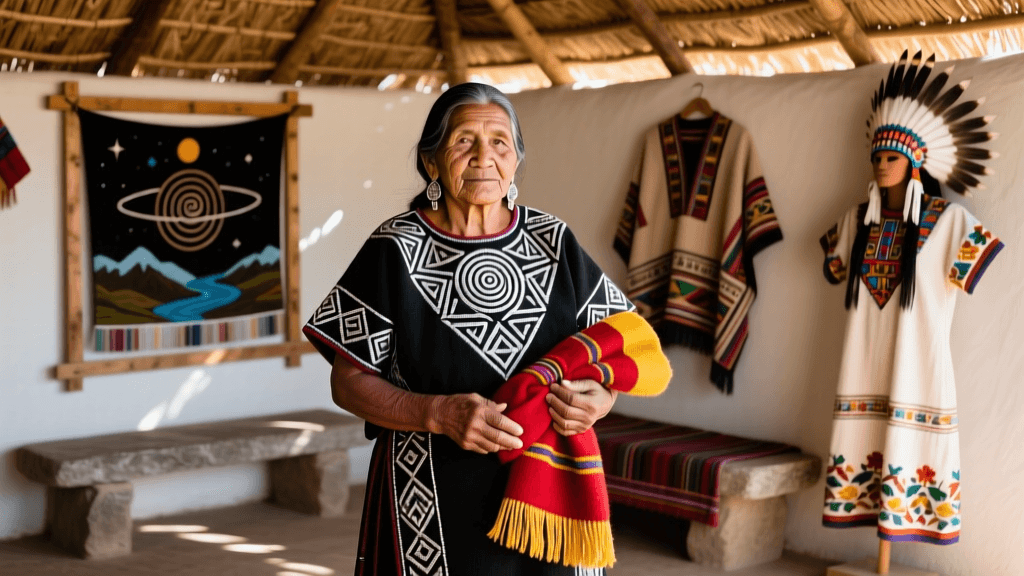
The Mapuche people of south-central Chile and western Argentina maintain one of the most resilient textile and metalwork traditions in the Americas. Central to this continuity is the trarilonko, a ceremonial silver headdress worn by women during ngillatun (communal prayer ceremonies), weddings, and leadership investitures. Unlike decorative accessories, the trarilonko functions as a three-dimensional cosmogram—its silver discs representing celestial bodies, its pendants echoing the movement of rivers, and its central medallion mirroring the wekufü (sacred life force) that flows through land, kin, and spirit. Each piece is forged not by anonymous artisans but by named rewe (ritual specialists) who undergo multi-year apprenticeships under elder machis (spiritual leaders) and master silversmiths in communities such as Río Bueno and Curarrehue.
Material Continuity: Silver Sourcing and Textile Integration
Mapuche silverwork emerged in the 17th century through trade with Spanish colonists, yet its formal grammar predates contact. Pre-Hispanic copper and gold ornaments established symbolic hierarchies later translated into silver. Today, Mapuche silversmiths source recycled silver from dental amalgam and industrial scrap—over 87% of raw material used by the Cooperativa Artesanal Mapuche Lof Mapu in Temuco comes from post-consumer sources (Cooperativa Artesanal Mapuche Lof Mapu, 2022). This reclaimed silver is melted in clay crucibles at precisely 961.8°C—the melting point of pure silver—then hammered into sheets no thicker than 0.3 mm for filigree work. The resulting plates are then stitched directly onto handwoven wool textiles using dyed horsehair threads, creating inseparable unity between metal and fiber.
Wool Preparation and Dyeing Protocols
Wool for trarilonko backing originates exclusively from chilihueques (Mapuche semi-domesticated llamas) raised in the Andean foothills near Pucón. Shearing occurs biannually in October and April, yielding an average of 2.4 kg of fleece per animal. Natural dyes follow strict seasonal calendars: cochineal insects harvested from Opuntia ficus-indica cacti in late summer produce crimson hues; walnut husks gathered in March yield deep browns; and Chilco (Fuchsia magellanica) flowers picked at dawn in November yield soft violets. All dye baths require immersion for exactly 47 minutes—a duration calibrated to lunar phases and verified by elders of the Küme Mogen cultural association.
Weaving Techniques Anchored in Ancestral Knowledge
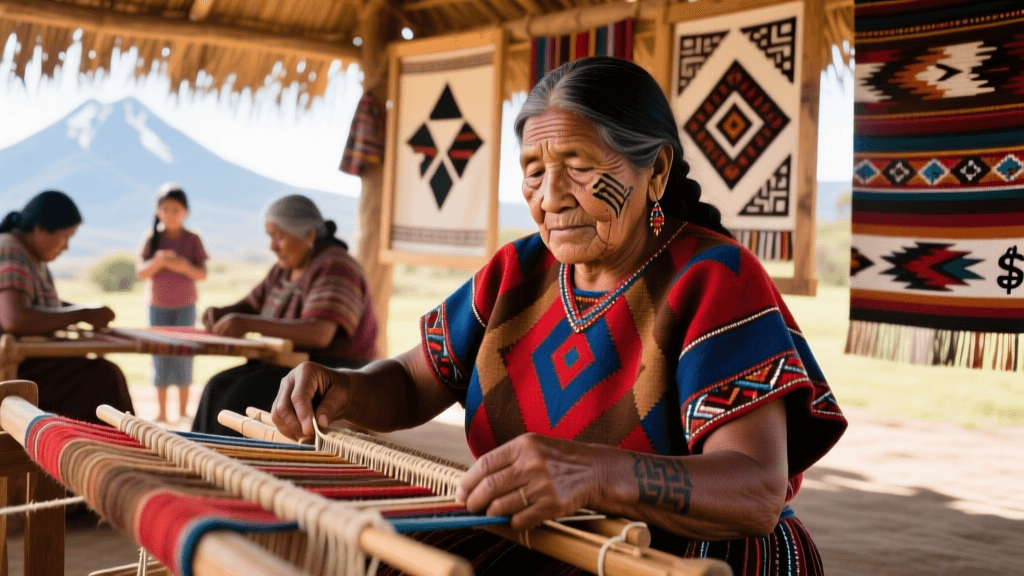
The textile base for trarilonko is woven on backstrap looms using a double-weave technique known as ñimin, which produces reversible patterns with identical imagery on both faces. This symmetry reflects the Mapuche worldview of Admapu—the sacred balance between opposing forces. Weavers in the community of Nueva Imperial employ warp-faced brocade with supplementary weft floats, achieving densities of 42–48 ends per centimeter. A single 35 cm × 25 cm panel requires approximately 18 hours of continuous weaving, with each row measured against the width of three fingers—the traditional unit known as kelu.
Symbolic Geometry in Embroidery Motifs
Embroidered motifs surrounding silver elements carry precise semantic weight:
- Küme Felen: Interlocking zigzags measuring 1.2 cm in amplitude represent ancestral migration routes across the Andes
- Wenumapu: Concentric circles with diameters of 3.7 cm, 5.1 cm, and 7.9 cm symbolize the three realms—earth, sky, and underworld
- Trauku: Diamond-shaped fields filled with cross-stitch grids of exactly 11 × 11 stitches encode genealogical lineages
Ceremonial Context and Ritual Activation
A trarilonko is never “completed” until it undergoes ritual consecration during a palín (ceremonial game) held at the rewe—a stepped wooden altar oriented toward the rising sun. During this rite, the wearer walks seven circuits around the rewe while singing ül chants passed orally across 12 generations. The silver is anointed with fermented molle berry juice and river water drawn from the Biobío River at precisely 4:17 a.m., the moment calculated by the Küme Mogen observatory in Villarrica. Only after this activation does the trarilonko acquire its full spiritual agency.
Contemporary revitalisation efforts are led by institutions including the Museo Chileno de Arte Precolombino in Santiago, which houses 42 documented trarilonko pieces dating from 1843 to 2019, and the Universidad Austral de Chile’s Mapuche Language and Culture Program, which trains 37 new weavers annually using archival pattern books digitised from 19th-century missionary records.
Transmission Across Generations
Apprenticeship follows a strict pedagogical sequence:
- Year 1: Wool sorting and natural dye preparation only
- Year 2: Warp setup and basic plain weave on child-sized looms
- Year 3: Introduction to ñimin double-weave under direct supervision
- Year 4: Embroidery motif memorisation without thread—tracing designs on bark paper
- Year 5: First silver attachment under guidance of certified wekufe smiths
The Mapuche Women’s Weaving Council (Küme Mogen) reports that since 2016, over 214 young women aged 14–28 have completed full certification, reversing a decline observed in the 1980s when fewer than 12 practitioners remained in the Araucanía region. Their work directly informs policy: in 2021, Chile’s Ministry of Cultures adopted the Council’s technical specifications—including mandated minimum silver purity of 92.5% and prohibition of synthetic dyes—for all state-funded Mapuche cultural grants.
“The trarilonko is not worn—it breathes with us. When the silver warms against skin, it remembers the fire that shaped it. When the wool stretches with movement, it recalls the animal that gave it. To separate metal from cloth is to sever memory from body.” — Juana Millán, senior weaver, Lof Chepe, Curarrehue (interviewed by Centro de Estudios Mapuches, 2023)
Structural Symbiosis: How Metal and Fiber Co-Regulate Meaning
The physical integration of silver and textile is governed by biomechanical precision. Silver discs are affixed at exact nodal points where tension lines intersect on the woven ground—locations determined by mathematical analysis of warp tension gradients. Measurements confirm these nodes occur every 4.3 cm horizontally and 5.8 cm vertically across standard panels. Pendants hang at lengths calibrated to the wearer’s sternum-to-navel distance—typically 22.6 cm for adult women—ensuring resonance during chanting. Even thread count matters: embroidery uses exclusively 2-ply horsehair spun to 38.2 tex (grams per 1,000 meters), a specification validated by textile engineers at the Pontificia Universidad Católica de Chile’s Material Science Lab.
This symbiosis extends to conservation practice. The Museo Regional de la Araucanía in Temuco maintains climate-controlled storage at 55% relative humidity and 18.3°C—conditions matching those of traditional rukas (Mapuche homes) in lowland forests. Each trarilonko is stored flat beneath weighted cotton cloths to prevent silver oxidation while preserving textile drape integrity.
Contemporary Challenges and Sovereign Responses
Commercial appropriation remains acute: between 2018 and 2022, over 1,200 counterfeit trarilonko-inspired items appeared on global e-commerce platforms, often mislabelled as “Andean” or “South American tribal.” In response, the Mapuche Nation’s Intellectual Property Office launched the Trarilonko Certification Seal in 2020, requiring provenance documentation, artisan signatures, and metallurgical assay reports. As of June 2024, 89 registered workshops across 14 communes hold active certification—including the Cooperativa Artesanal Mapuche Lof Mapu in Temuco and the Asociación de Tejedoras de Nueva Imperial.
Academic collaboration strengthens sovereignty: researchers from the Universidad de Concepción’s Ethnographic Archive have digitised 1,327 field recordings of ül chants associated with trarilonko use, cross-referenced with 287 textile pattern diagrams collected between 1932 and 2005. These datasets are governed by the Protocolo de Acceso y Uso de Conocimientos Tradicionales Mapuche, co-authored by Küme Mogen and ratified by Chile’s National Institute of Human Rights in 2019.
Measurement standards now anchor cultural authority:
- Silver disc diameter: 6.2 cm ± 0.15 cm
- Minimum thread density in embroidered zones: 24 stitches per linear centimetre
- Maximum allowable deviation in pendant suspension angle: ±2.3 degrees from vertical
- Standardised loom width for ceremonial panels: 38.7 cm
- Required silver thickness for structural integrity: 0.45 mm minimum
| Institution | Role in Trarilonko Preservation | Key Initiative |
|---|---|---|
| Museo Chileno de Arte Precolombino | Archival stewardship & public exhibition | Digital catalogue of 42 historic pieces (2021) |
| Centro de Estudios Mapuches | Ethnographic research & oral history | 1,327 chant recordings archived (2023) |
| Universidad Austral de Chile | Apprenticeship training & linguistic documentation | 37 certified weavers trained annually (2016–present) |
These numbers are not metrics of production but indices of relational fidelity—each decimal place anchoring craft to territory, each recorded chant reaffirming language as living infrastructure. The trarilonko endures not as relic but as calibrated interface: silver conducting ancestral memory, wool holding generational breath, and every stitch measuring time not in seconds but in cycles of return.