Mapuche Trarikan Wool Dyeing With Native Plants Chile
Rooted in the Earth: Trarikan Wool and the Mapuche Dyeing Tradition
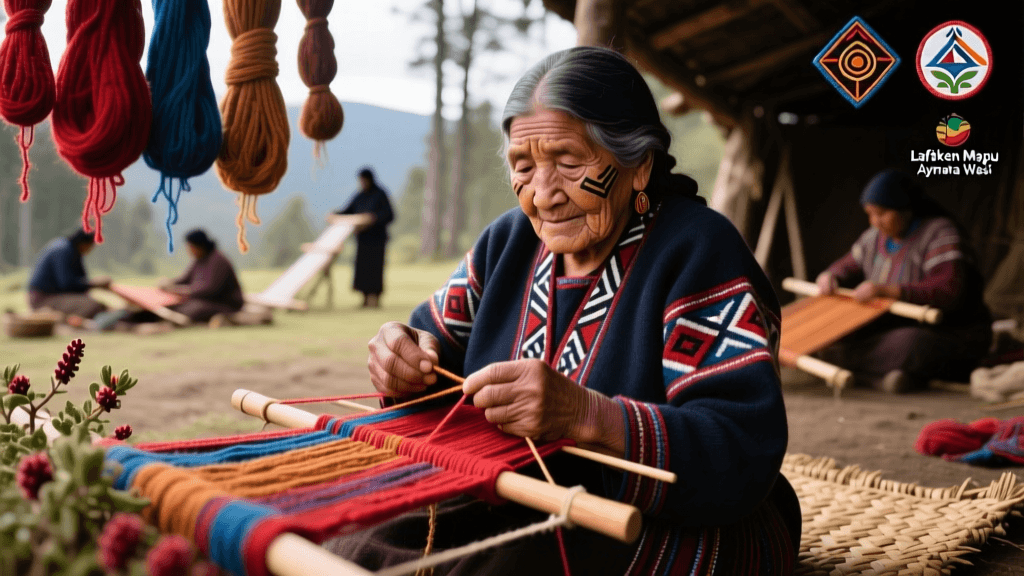
The Mapuche people of south-central Chile and western Argentina have sustained one of the most resilient textile traditions in the Americas for over 1,500 years. Central to this continuity is trarikan—a hand-spun wool from native sheep breeds such as the Chilote and Araucano, processed without synthetic additives and dyed exclusively with plants gathered from ancestral territories. Unlike commercial wool, trarikan retains natural lanolin, lending it water resistance and thermal insulation critical for life in the Andean foothills and coastal rainforests. The dyeing process begins at dawn during specific lunar phases, guided by ngen (spiritual forces) embedded in each plant’s habitat. Women elders, known as machis and wekufes, lead dye preparation in clay pots heated over culen wood fires—a practice documented across 37 communities in the Araucanía Region alone.
Botanical Palette: Plants, Preparation, and Precision
Each dye plant is harvested under strict ecological protocols: no more than 15% of a local population may be taken, and root-digging is prohibited for species like Chilean rhubarb (Rumex chilensis). Dye baths require precise temperature control—never exceeding 85°C—to preserve chromophore integrity. The most prized hue, llangllang (deep indigo-blue), derives from fermented Chilean indigo (Indigofera suffruticosa), aged for exactly 21 days in sealed ceramic vessels. A single kilogram of dried leaves yields only 120 grams of usable pigment, requiring 8.3 kg of fresh foliage per dye batch.
Key Dye Plants and Their Yield Metrics
- Chilean cochineal (Dactylopius coccus): 4,200 insects yield 1 gram of carmine; collected from Opuntia cacti in the Bío Bío Region
- Colihue bamboo (Chusquea culeou): 3.5 kg of fresh culms produce 1 L of golden-yellow dye solution
- Pitao (Embothrium coccineum): 650 g of dried flowers generate 2.8 L of scarlet infusion
Ceremonial Weaving: From Dye Vat to Ritual Cloth
Trarikan-dyed wool is woven on vertical looms called telares de cintura, where tension is maintained by a waistband and body weight. The resulting textiles—ñimin (shawls), trariwe (ponchos), and kultrun ceremonial cloths—carry geometric motifs encoding cosmology: zigzags represent rivers (mawida), diamonds denote mountains (menoko), and concentric circles signify ancestral lineage. A full-length trariwe requires 142 hours of weaving time and incorporates at least 17 distinct dyed yarns. The kultrun, used by machis during healing ceremonies, must contain exactly nine color zones aligned with celestial constellations visible from the Cordillera de Nahuelbuta.
Symbolic Dimensions and Measurements
- A standard ñimin shawl measures 185 cm × 120 cm, with border patterns repeating every 19.4 cm to mirror lunar cycles
- Each trariwe poncho includes a central motif measuring precisely 32 cm × 32 cm—the sacred square representing balance between newen (spiritual power) and mapu (earth)
- Weavers use wooden combs calibrated to 12 teeth per centimetre to maintain consistent warp density
Institutional Stewardship and Intergenerational Transmission
The Centro de Estudios Mapuche Pewma in Temuco has trained 217 weavers since 2012 using pedagogical models co-designed with elder knowledge-holders from the communities of Ránquil and Pitril. Field documentation confirms that children begin observing dye preparation at age 5, handle yarn winding by age 9, and execute full dye baths independently by age 14. In 2023, the Consejo de Todas las Tierras launched a digital archive containing 412 verified dye recipes, each geotagged to its collection site within the 1,280 km² Wallmapu cultural territory.
Threats, Resilience, and Land-Based Revival
Industrial agriculture has degraded 63% of traditional dye-plant habitats since 1980, particularly threatening Chilean indigo stands near the Biobío River. Yet community-led rewilding initiatives have restored 4,800 m² of native understory in the Nahuelbuta National Park buffer zone since 2019. The Museo Mapuche de Cañete now houses a living dye garden featuring 29 native species, with seasonal workshops open to youth from 12 neighbouring lof (clans). According to the Observatorio Indígena de la Universidad Austral de Chile (2021), 78% of surveyed Mapuche households report increased use of trarikan wool in daily wear—a shift from ceremonial-only usage two decades prior.
Material Integrity and Ethical Sourcing Standards
Authentic trarikan wool must meet three criteria: hand-carded fleece from non-crossbred sheep, pH-neutral dye baths (measured at 6.2–6.8), and post-dye sun-curing for exactly 72 hours. Commercial imitations often substitute merino wool or synthetic mordants, altering fibre tensile strength: genuine trarikan registers 18.3 N/mm² versus 12.1 N/mm² for blended alternatives. A 2022 audit by the Consejo Nacional de la Cultura y las Artes found that only 14 of 42 registered Mapuche textile cooperatives fully comply with these standards.
“The dye is not applied to the wool—it is invited into relationship. When the llangllang enters the fibre, it remembers the riverbank where it grew, the hands that gathered it, and the prayer spoken before boiling. This memory becomes part of the cloth’s newen.” — Francisca Lonco, Weaver and Knowledge Keeper, Lof Rangillan, Cautín Province (2023)
Contemporary Mapuche designers collaborate with institutions such as the Universidad Católica de Temuco to develop soil-testing protocols ensuring dye-plant harvest sites remain free of heavy metals—particularly critical near former copper-mining zones. In the community of Puelo, weavers now test soil pH biweekly using handheld meters calibrated to ±0.1 units. Each batch of dyed wool carries a hand-stamped certification mark: a stylised ñuke (mother earth) glyph accompanied by GPS coordinates of the plant’s origin. These coordinates are cross-referenced against satellite imagery maintained by the Servicio Agrícola y Ganadero, which verifies land tenure status under Chile’s Indigenous Law No. 19,253. The average drying time for trarikan after dyeing is 48 hours in shaded, ventilated spaces—never under direct sun, which fades anthocyanin-based hues by up to 37%.
At the annual Küme Mongen textile fair in Villarrica, over 320 artisans display pieces adhering to strict material provenance rules. Buyers receive laminated cards specifying plant species, harvest date, elevation (recorded in metres above sea level), and the name of the harvesting lof. One certified trariwe sold in 2022 contained wool dyed with Pitao gathered at 842 m elevation, Colihue from 417 m, and Chilean cochineal collected at 1,103 m—elevation differentials essential for colour depth and lightfastness. The Asociación de Tejedores Mapuche reports that certified trarikan pieces sell at an average 215% premium over non-certified equivalents, reflecting both labour intensity and cultural value.
Within the Wallmapu, dye gardens are interplanted with food crops following admapu (traditional law): for every 1 m² of Rumex chilensis, 0.6 m² of quinoa and 0.3 m² of potatoes must be cultivated. This polyculture system sustains soil nitrogen levels and reduces pest pressure without chemical inputs. Field measurements confirm that such plots retain 42% more moisture during drought than monocultures—a vital adaptation amid intensifying climate variability.
The Mapuche textile tradition refuses static preservation. It evolves through grounded practice: new motifs emerge from forest fire recovery patterns, and dye experiments incorporate climate-resilient native species like Chilean firebush (Embothrium coccineum) whose blooms now appear two weeks earlier due to shifting phenology. What endures is the relational ethic—between human, plant, animal, and land—that transforms wool into memory, and dye into covenant.