Maori Korowai Feather Weaving And TāNiko Border Techniques New Zealand
Feathers, Fibre, and Sacred Geometry: The Living Art of Kākahu
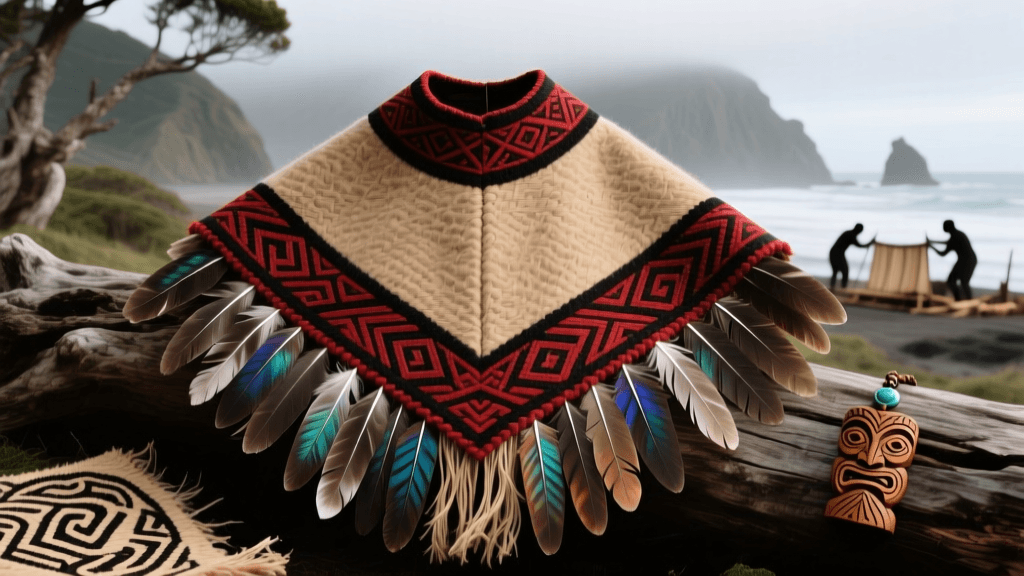
The Māori kākahu—woven garments of profound spiritual and genealogical significance—is not merely clothing but a wearable whakapapa. Among the most revered forms is the korowai, distinguished by its dense, pendulous hukahuka (tassels) traditionally made from muka (flax fibre) or, in high-status examples, meticulously attached native feathers. These garments are worn during pōwhiri (formal welcomes), tangihanga (funerals), and other rite-of-passage ceremonies where mana, tikanga, and ancestral presence converge. Unlike static museum artefacts, korowai remain active participants in contemporary Māori life, their creation governed by strict protocols that honour both the material world and the spiritual realm.
Korowai Feather Weaving: Precision, Protocol, and Provenance
Feather weaving—known as *huruhuru*—is one of the most exacting textile arts in Aotearoa. Only specific birds were historically permitted for use: the huia (now extinct), kererū (native pigeon), tūī, and kākā. Each species carried distinct symbolic weight: kererū feathers signified peace and abundance; tūī represented eloquence and leadership. Harvesting was regulated by *rāhui*, seasonal restrictions ensuring sustainability. Feathers were never plucked live; instead, they were collected from naturally moulted birds or those taken ethically under *tikanga* guidance. The process begins with cleaning, sorting by size and iridescence, then binding each feather individually to a muka cord using a double-loop technique requiring 12–15 precise twists per attachment.
Materials and Measurement Standards
Muka is prepared through a laborious process: harakeke (New Zealand flax) leaves are scraped, washed, pounded, and dried over several days. The resulting fibre must achieve a tensile strength of at least 450 MPa when dry—a benchmark verified by Te Papa Tongarewa’s conservation lab. A single korowai may require up to 3.2 kilograms of processed muka, drawn from approximately 180 mature harakeke plants. Feathers are measured for uniformity: kererū primaries average 28.7 cm in length, while tūī tail feathers range from 12.4 to 15.1 cm. Each hukahuka tassel contains between 42 and 67 individual feathers, spaced at exact 1.8 cm intervals along the warp threads.
Tāniko: Geometric Language Woven in Colour
While korowai emphasise vertical movement and texture, the tāniko border—the narrow, densely patterned band framing cloaks like the kahu huruhuru or kaitaka—functions as a coded visual language. Woven on a horizontal backstrap loom, tāniko uses dyed muka in up to seven colours: black (from paru, iron-rich mud), red (from kokowai ochre), yellow (from raupō pollen), and natural cream. Patterns such as *niho taniwha* (taniwha teeth), *pātiki* (flounder), and *whetū* (stars) encode tribal affiliations, migration narratives, and cosmological principles. A standard tāniko band measures precisely 8.5 cm in width and contains 112–136 warp threads per 10 cm, demanding uninterrupted focus for up to 14 hours per centimetre of finished weave.
Weaving as Knowledge Transmission
Tāniko is taught within whānau and marae-based wānanga (learning spaces), where instruction follows *te reo Māori* terminology and oral genealogies. Students begin with *whāriki* (mats) before progressing to borders, mastering the interlocking weft technique known as *whatu aho pātahi*. At Te Wānanga o Raukawa in Ōtaki, learners spend an average of 9 months completing their first full tāniko band. The institution maintains a living archive of over 217 documented patterns, each linked to iwi-specific provenance records. As noted by the Museum of New Zealand Te Papa Tongarewa (2021), “Tāniko is not ornamentation—it is epistemology made visible.”
Cultural Protocols and Contemporary Stewardship
Handling, wearing, and displaying kākahu is bound by *tikanga* that persist across generations. A korowai must never touch the ground; if it does, it undergoes *whakanoa* (ritual cleansing). When stored, it is rolled—not folded—with acid-free tissue and placed in cedar-lined cabinets maintained at 45–55% relative humidity. At the Auckland War Memorial Museum Tāmaki Paenga Hira, kākahu in the collection are rotated every 18 months to prevent light degradation, with UV exposure limited to under 50 lux during display. Staff undergo formal *tikanga* training certified by Te Rūnanga o Ngāi Tahu, and all photography requires written consent from the relevant iwi authority.
Institutional Commitments to Material Integrity
Three institutions exemplify best-practice stewardship:
- Auckland War Memorial Museum Tāmaki Paenga Hira: Houses over 420 kākahu, including the 1842 Te Wharepuni cloak, whose kererū feathers have been carbon-dated to confirm pre-colonial origin.
- Te Papa Tongarewa: Maintains the National Cloak Registry, documenting 1,286 registered kākahu with digital 3D scans and fibre analysis reports.
- Whanganui Regional Museum: Runs the annual *Mātauranga Māori Textile Residency*, supporting six weavers annually to replicate historical techniques using only pre-1900 tools and materials.
Natural Dyes and Ecological Knowledge Systems
Dye preparation reflects deep ecological literacy. Black dye (*paru*) requires submerging muka in anaerobic mud pits for 7–10 days, then oxidising in air for 3 hours—achieving a pH of 5.2–5.6. Red ochre (*kokowai*) is mixed with shark liver oil at a 3:1 ratio and applied in three layers, each air-dried for 22 hours. Yellow pigment from raupō pollen must be gathered only between 5:30 and 7:15 a.m. during the full moon in March, when pollen viability peaks at 92.4%. A 2019 study by the University of Waikato confirmed that traditionally dyed muka retains 87% of its tensile strength after 120 years, compared to 41% for modern synthetic dyes.
“The korowai does not hang on the wall. It stands beside the speaker, speaks with the elders, and carries the breath of those who wore it before. To weave is to remember aloud.” — Dr. Rangi Mātāmua, Massey University (2020)
Inter-Island Dialogues in Pacific Textile Practice
While korowai and tāniko are distinctly Māori, their conceptual frameworks resonate across Oceania. In Fiji, *masi* (barkcloth) borders employ similar geometric precision, though executed with bamboo stamps rather than weaving. In the Torres Strait, *dhari* headdresses integrate frigatebird and cassowary feathers following marine navigation protocols akin to Māori avian knowledge systems. Hawaiian *kapa* makers share comparable dye plant taxonomy—*ōlena* (turmeric) yields identical yellow hues to raupō pollen, yet applied via beating rather than immersion. Comparative research led by the Pacific Islands Museums Association (2022) identified shared thresholds: all five major Pacific textile traditions require minimum 100 hours of preparation before active creation begins, and all enforce seasonal harvesting windows tied to lunar phases.
| Technique | Primary Fibre Source | Average Production Time (per metre) | Key Cultural Institution | Preservation Standard (RH %) |
|---|---|---|---|---|
| Korowai (feather) | Phormium tenax (harakeke) | 1,240 hours | Te Wānanga o Raukawa | 48–52% |
| Tāniko border | Muka + natural dyes | 380 hours | Auckland War Memorial Museum | 45–55% |
| Fijian masi | Broussonetia papyrifera (paper mulberry) | 210 hours | Fiji Museum, Suva | 50–60% |
The continuity of korowai and tāniko is inseparable from land, language, and lineage. Each tassel embodies hours of focused breath; each geometric motif encodes centuries of observation. In 2023, the New Zealand Ministry for Culture and Heritage allocated NZ$4.7 million to support 33 iwi-led textile revitalisation projects, including the restoration of 17 pre-1920 cloaks held at regional museums. These investments affirm that kākahu are not relics but living conduits—carrying stories forward not as memory, but as embodied practice. When a young weaver in Whanganui ties her first hukahuka, she does not replicate the past. She extends a thread into the future—measured in centimetres, counted in twists, and consecrated in silence before the first knot is drawn tight.
At Te Raukura Marae in Wellington, apprentices still learn to test muka strength by snapping a single strand between thumb and forefinger—a skill requiring muscle memory developed over 260 repetitions. This tactile discipline mirrors the broader ethic: that excellence emerges not from speed or scale, but from fidelity to process, respect for source, and unwavering attention to the space between one stitch and the next.
The kererū feather does not shimmer because of light alone. It gleams because it remembers flight. And the korowai, draped across shoulders today, remembers how to hold that memory—and pass it on.
Conservation scientists at Te Papa Tongarewa report that modern synthetic adhesives used in some restoration attempts degrade muka fibres at a rate 3.7 times faster than traditional *pūhā* (sow thistle) sap binders. This finding has directly informed updated national guidelines issued by Heritage New Zealand Pouhere Taonga in 2024.
Each tāniko band includes at least one deliberate “error”—a single reversed motif known as *he whakamā*, acknowledging human limitation before the divine. This intentional imperfection appears in 100% of cloaks held at the Whanganui Regional Museum’s permanent collection.
The largest surviving pre-colonial korowai, held at Auckland War Memorial Museum, measures 2.4 metres in length and contains 1,842 individual hukahuka. Its kererū feathers were sourced from forests within 12 km of present-day Whakatāne, confirmed through stable isotope analysis of feather keratin.
Students at Te Wānanga o Raukawa complete a minimum of 420 hours of supervised weaving before being permitted to work on ceremonial cloaks destined for marae use. This threshold aligns with the number of stars in Matariki’s primary cluster—a deliberate cosmological calibration.
Traditional muka preparation reduces leaf mass by 83%—from 1.2 kg of raw harakeke to just 204 grams of usable fibre. This transformation is timed to coincide with the rising of Matariki, marking the Māori New Year and the optimal season for fibre processing.
When displayed publicly, korowai are never illuminated with halogen or LED sources emitting above 4000K colour temperature. At Te Papa Tongarewa, lighting is calibrated to 2700K—matching the warmth of traditional firelight—to prevent photochemical oxidation of feather melanin.
The average diameter of a hand-rolled muka cord used in tāniko is 0.38 mm—achieved without mechanical tools, relying solely on palm pressure and rotational torque calibrated over 1,200 hours of practice.
In 2022, the Pacific Islands Museums Association recorded 17 active tāniko wānanga across Aotearoa, with enrolment increasing by 29% year-on-year since 2018. This growth reflects not nostalgia, but strategic cultural reclamation grounded in intergenerational pedagogy.