Mamianqun: Ming Court Skirt Evolution and Modern Hanfu Guide
The Mamianqun: A Masterpiece of Dynasty Evolution
The Mamianqun (马面裙), commonly translated as the 'horse-face skirt,' stands as one of the most iconic and structurally ingenious garments in the history of traditional Chinese clothing. Far from being a mere fashion trend, this pleated wrap skirt represents a profound evolution in Asian court fashion, tracing its lineage from the opulent halls of the Ming Dynasty to the bustling streets of the Qing era, and finally to the global modern Hanfu revival. For contemporary enthusiasts and historians alike, understanding the Mamianqun offers a masterclass in textile engineering, cultural resilience, and dynastic aesthetics.
Ming Dynasty: The Golden Age of Court Elegance
The Mamianqun first rose to prominence during the Ming Dynasty (1368–1644). According to The Metropolitan Museum of Art, the Ming era was a period of immense cultural consolidation and artistic refinement, where court dress codes were strictly regulated to reflect social hierarchy and cosmic harmony. The Mamianqun was a staple for Han Chinese women, particularly those in the imperial court and aristocratic families.
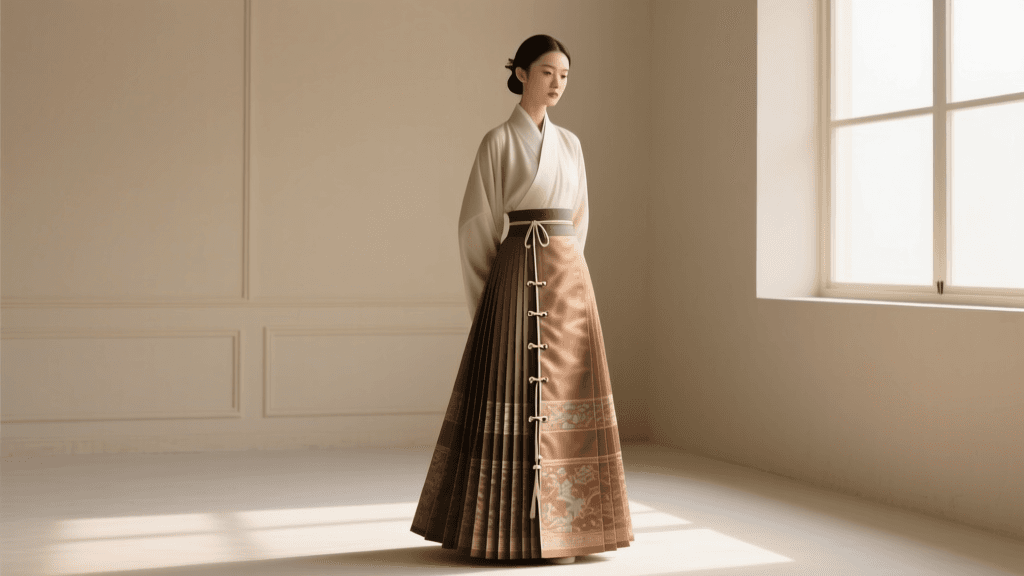
The term 'horse-face' does not refer to the animal. Instead, it borrows from ancient Chinese architectural terminology, where a 'mamian' was a type of defensive tower on a city wall that protruded outward, featuring a flat front and sloped sides. The skirt mimics this structure: it consists of two overlapping panels with flat, unpleated sections (the 'horse faces') at the front and back, while the sides feature deep, structured pleats. This design allowed for modesty and ease of movement, crucial for court women navigating the sprawling pavilions of the Forbidden City.
Ming court Mamianqun were often woven using luxurious techniques like zhuanghua (brocade) or kesi (silk tapestry). The flat front and back panels served as prime canvases for auspicious motifs, such as dragons, phoenixes, and cloud patterns, woven with gold and silver threads to denote the wearer's noble rank.
Qing Dynasty: Survival, Adaptation, and Flourishing
When the Manchu-led Qing Dynasty (1644–1911) took power, they enforced the harsh 'Tifa Yifu' (shave hair, change clothes) edict, mandating Manchu dress for men. However, the policy famously followed the rule of 'ten men, ten women,' which allowed Han Chinese women to retain their traditional Ming-style clothing. Consequently, the Mamianqun survived and evolved from exclusive court wear to ubiquitous daily attire for Han women across all social classes.
During the Qing era, the skirt's structure remained largely intact, but the decorative elements became increasingly elaborate. Embroidery replaced woven brocades as the primary decorative method. Artisans spent hundreds of hours hand-embroidering the flat panels and pleat edges with vibrant silk threads, depicting scenes from folklore, blooming peonies, and bats (symbolizing good fortune). By the late Qing dynasty, the Mamianqun had become an essential component of a woman's dowry and formal ceremonial dress, bridging the gap between Ming heritage and Qing aesthetics.
Anatomy of the Mamianqun: Structure and Measurements
To truly appreciate or purchase a Mamianqun today, one must understand its unique structural anatomy. Unlike Western pleated skirts, the Mamianqun is a wrap skirt consisting of two separate, identical panels attached to a single waistband. When wrapped, the flat panels overlap in the front and back, while the pleated sections align on the hips.
'The Mamianqun is not merely a garment; it is a structural marvel of traditional Chinese tailoring, blending geometric precision with fluid movement, allowing the pleats to flare dramatically only when the wearer walks or turns.'
Getting the correct measurements is critical for the skirt to sit properly and maintain its modesty. Below is a practical sizing and measurement guide for modern buyers.
| Skirt Length | Recommended Height | Waist Measurement | Best Use Case & Styling |
|---|---|---|---|
| 85 cm (Mid-Calf) | 155 - 162 cm | Natural Waist + 10 cm | Casual daily wear, summer outings, paired with modern blouses. |
| 95 cm (Ankle) | 163 - 170 cm | Natural Waist + 10 cm | Standard traditional Hanfu wear, elegant formal events, office wear. |
| 105 cm (Floor) | 171 - 180 cm | Natural Waist + 10 cm | Ceremonial court recreation, winter wear (allows for thermal layers). |
| Waist Tie Length | Universal | Waist x 2.5 minimum | Ensures secure wrapping and allows for traditional bow tying. |
Note: Always measure your natural waist (the narrowest part of your torso) rather than your hips. The skirt is designed to sit at the natural waist to allow the pleats to fall correctly over the hips.
Modern Revival: Actionable Buying and Styling Guide
The 21st century has witnessed a massive resurgence in traditional Chinese clothing, commonly known as the Hanfu movement. As noted by BBC Travel, this revival is driven by younger generations seeking to reconnect with their cultural heritage and express a unique sartorial identity. The Mamianqun, in particular, exploded in global popularity following high-profile fashion controversies in 2022, which brought international attention to its Ming Dynasty origins.
Where to Buy and Expected Costs
For those looking to add an authentic Mamianqun to their wardrobe, the market offers a wide range of options depending on your budget and dedication to historical accuracy.
- Entry-Level / Daily Wear ($25 - $60 USD): Brands like Shisanyu and Luo Han Gu offer machine-washable polyester and jacquard blends. These are excellent for beginners, featuring durable, pre-pressed pleats and vibrant, modern colorways.
- Mid-Tier / Premium Jacquard ($80 - $180 USD): Brands such as Minghuatang and Zhi Yu specialize in historically accurate Ming Dynasty silhouettes. Expect heavy, high-quality woven jacquard fabrics, real metal-thread accents, and meticulous pleat-setting.
- Haute Couture / Silk & Kesi ($300 - $1,500+ USD): For museum-quality garments, bespoke tailors and heritage brands offer skirts made from pure mulberry silk, hand-woven kesi tapestry, and real gold leaf threads. These are investment pieces meant for formal ceremonies or collection.
Actionable Search Tip: When shopping on platforms like Taobao or AliExpress, use the exact Chinese characters 明制马面裙 (Ming-system horse-face skirt) to filter out inaccurate costume reproductions and find dedicated Hanfu merchants.
Practical Styling: Blending Court Fashion with Modern Life
While wearing a full Ming Dynasty Aoqun (jacket and skirt ensemble) is perfect for festivals, the Mamianqun is incredibly versatile for modern wardrobes. According to South China Morning Post, contemporary fashionistas frequently blend Hanfu elements with Western staples.
- The Office Look: Pair a solid-colored, dark-toned Mamianqun (like navy or emerald) with a crisp white button-down shirt or a tailored turtleneck. Tuck the top in to highlight the waistband and belt structure.
- Winter Layering: The voluminous A-line shape of the skirt is perfect for hiding thermal leggings. Pair it with a tailored wool trench coat and leather ankle boots for a sophisticated, culturally rich winter ensemble.
- Securing the Skirt: Modern skirts often come with hidden metal clips or buttons inside the waistband to secure the overlapping panels. If your skirt only has ties, cross the ties in the back, bring them to the front, and tie a firm double-knot, hiding the excess length inside the waistband for a clean silhouette.
Garment Care: Preserving the Pleats
The defining feature of the Mamianqun is its razor-sharp pleats. Improper care can ruin the garment's structure. Follow these strict maintenance rules:
- Washing: Never machine wash a high-quality jacquard or silk Mamianqun. Hand wash in cold water with a mild, pH-neutral detergent. If using a machine for synthetic daily-wear skirts, place the skirt in a fine mesh laundry bag and use the 'delicate' cycle with no spin.
- Drying: Never wring out the fabric. Gently press out excess water and hang the skirt on a multi-clip hanger, ensuring the pleats are aligned and clipped in place while damp.
- Ironing: Use a low-heat steam iron. Lay the skirt flat, fold it along its original crease lines, and press gently. Avoid dragging the iron across the pleats, as this will stretch the fabric and distort the 'horse face' panels.
Conclusion
The Mamianqun is a testament to the enduring brilliance of Asian textile traditions. From its inception as a symbol of Ming Dynasty courtly grace to its adaptation through the Qing era, and its current status as a global fashion statement, the horse-face skirt is a living artifact. By understanding its historical evolution, mastering its measurements, and caring for its intricate structure, modern wearers do more than just put on a beautiful garment—they drape themselves in centuries of dynastic history and cultural pride.