Evolution of the Mamianqun: Ming Court to Modern Hanfu
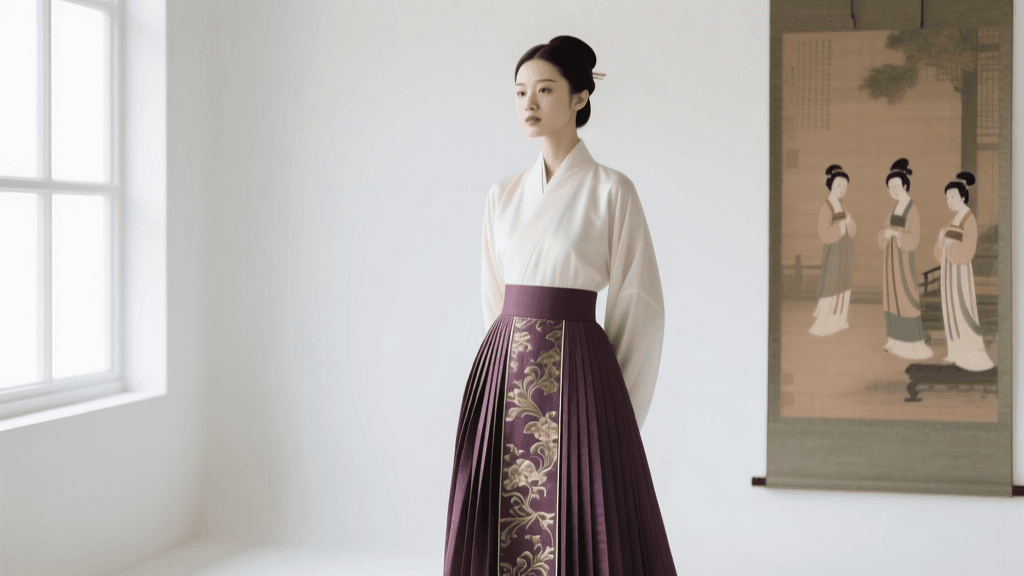
The Mamianqun, commonly translated as the 'horse-face skirt,' is one of the most iconic and enduring garments in the history of Chinese traditional clothing. Characterized by its overlapping panels, flat front and back sections, and intricately pleated sides, the skirt is a masterclass in structural tailoring and cultural symbolism. While it has recently exploded in popularity as a staple of the modern Hanfu revival movement, its roots trace back centuries, serving as a defining element of Ming Dynasty court fashion and everyday wear for Han women. Understanding the evolution of the Mamianqun offers profound insights into Asian textile traditions, sumptuary laws, and the modern reclamation of cultural heritage.
The Origins and Ming Dynasty Court Zenith
The structural origins of the Mamianqun can be traced back to the Song Dynasty (960–1279), where early iterations of overlapping, pleated skirts were developed for ease of movement, particularly for women riding horses or donkeys. However, it was during the Ming Dynasty (1368–1644) that the garment reached its absolute zenith, becoming the undisputed standard for Han women across all social strata, from imperial concubines to commoners.
In the Ming court, fashion was strictly regulated by sumptuary laws that dictated colors, fabrics, and motifs based on social rank. The 'horse-face' (mamian) terminology actually derives from ancient Chinese city wall defense structures—specifically the flat, protruding rectangular towers used for flanking fire, which resembled the flat, unpleated panels of the skirt. According to the Victoria and Albert Museum's archives on Chinese dress, Ming court women paired these voluminous skirts with tailored, high-collared jackets (ao) or short vests (bei), creating a silhouette that emphasized modesty, structural elegance, and hierarchical status.
For royalty and nobility, the flat panels of the skirt were heavily embroidered or woven with metallic threads featuring auspicious motifs. The mang (a four-clawed python-like dragon) was reserved for the highest echelons of imperial women, while phoenixes, peonies, and lotuses were utilized by lower-ranking court ladies and wealthy merchants' wives. The sheer weight of the Ming court Mamianqun, often crafted from heavy silk brocades and lined with cotton, gave the skirt a bell-like swing that commanded physical space and projected authority.
Anatomy of the Horse-Face Skirt
The brilliance of the Mamianqun lies in its deceptively simple geometry. Unlike Western gathered skirts, the Mamianqun is constructed from two identical, overlapping rectangular panels of fabric. When wrapped around the body, these panels create four flat sections (the 'horse faces') at the front and back, while the sides are deeply pleated to allow for a full range of motion.
This overlapping wrap design was highly practical for historical modesty standards. The inner and outer flaps ensured that the wearer's legs were never exposed, even when walking briskly or climbing stairs. The waistband, historically made of a contrasting, durable white cotton or linen, was designed to be tied tightly with long ribbons, securing the heavy silk skirts without the need for buttons or fasteners.
Dynasty Comparison: Ming, Qing, and Modern Eras
| Era | Length & Silhouette | Waistband & Fasteners | Common Fabrics & Motifs |
|---|---|---|---|
| Ming Dynasty | Ankle-length, wide A-line swing | White cotton/linen, extra-long ties | Heavy brocade, python & phoenix motifs |
| Qing Dynasty | Shorter, narrower and denser pleats | Elaborate embroidered silk bands | Silk satin, floral & butterfly borders |
| Modern Revival | Variable (midi to floor-length maxi) | Hidden snaps, velcro, or traditional ties | Jacquard, organza, polyester blends |
Qing Dynasty Adaptations and the Republic Era
When the Manchu-led Qing Dynasty (1644–1912) conquered China, a strict policy of cultural assimilation was enforced, famously summarized by the edict 'men cong nu, nv cong han' (men submit [to Manchu dress], women do not). While Han men were forced to adopt the Manchu queue hairstyle and the changshan, Han women were permitted to retain their traditional Ming-style clothing. Consequently, the Mamianqun survived, though it evolved to reflect changing aesthetics.
During the Qing era, the pleats became narrower and more numerous, sometimes featuring intricate 'fish-scale' pleating that shimmered when the wearer moved. The waistbands became highly decorative, and the hems were often adorned with multiple layers of embroidered borders. By the Republic Era (1912–1949), as Western fashion and the modernized qipao gained dominance, the Mamianqun gradually faded from everyday streetwear, relegated to the wardrobes of older, conservative women and traditional opera costumes.
The Modern Revival and Cultural Reclamation
The 21st century has witnessed a massive resurgence of Hanfu, driven by younger generations seeking to reconnect with pre-Qing Han Chinese heritage. The Mamianqun has emerged as the undisputed 'gateway garment' for Hanfu enthusiasts due to its unparalleled versatility. It can be seamlessly integrated into modern wardrobes, pairing as easily with a traditional silk blouse as it does with a contemporary cashmere sweater or a crisp white button-down shirt.
This revival also sparked intense global conversations about cultural appropriation and intellectual property. In 2022, when a major French luxury house released a mid-length black pleated skirt bearing a striking resemblance to the Ming Dynasty Mamianqun, it ignited widespread protests from the Chinese diaspora and Hanfu communities. As reported by China Daily, the controversy highlighted the urgent need for global fashion institutions to properly credit historical Asian garments rather than presenting them as novel, Western-designed silhouettes. The BBC Travel further documented how this event catalyzed a surge in domestic pride, driving sales for independent Chinese Hanfu brands and pushing traditional textile craftsmanship back into the mainstream spotlight.
Actionable Buying Guide: Sizing, Fabrics, and Costs
If you are looking to add a Mamianqun to your wardrobe, understanding modern sizing, fabric choices, and price points is essential for a flattering and authentic experience.
1. Measurements and Sizing
- Waist: Unlike modern skirts that sit on the hips, a traditional Mamianqun is worn at the natural waist (the narrowest part of the torso). To ensure the overlapping panels do not gap or expose the underskirt, you must add 4 to 6 centimeters (about 2 inches) to your exact natural waist measurement when ordering.
- Length: For a wearer who is 160 cm (5'3") tall, a 95 cm skirt will hit at the mid-calf, while a 105 cm skirt will gracefully brush the ankle. For those 170 cm (5'7") and above, seek out 'floor-length' options (110-115 cm) to maintain the elegant, sweeping silhouette characteristic of Ming court fashion.
2. Fabric Selection by Season
- Spring/Autumn: Woven Jacquard and polyester-silk blends are the industry standard. They hold the sharp knife-pleats beautifully, resist wrinkling, and offer a rich, matte-to-satin sheen that mimics historical brocades.
- Summer: Opt for sheer organza or lightweight chiffon. These fabrics offer a breezy, ethereal look, though they require a separate opaque underskirt (chenqun) for modesty.
- Winter: Look for wool-blend Mamianqun or heavy velvet options. Many modern Hanfu brands now offer lined skirts specifically tailored for cold-weather wear without sacrificing the structural swing of the pleats.
3. Cost Expectations and Brands
The Hanfu market is highly stratified, catering to both casual wearers and strict historical reenactors.
- Entry-Level ($40 – $70 USD / 300 – 500 RMB): Brands like Shisanyu offer machine-washable, durable polyester Jacquard skirts with modernized, subtle patterns. These are perfect for daily wear and travel.
- Mid-Tier ($80 – $150 USD / 600 – 1000 RMB): Here you will find improved hardware (like hidden metal clasps to secure the waist), richer metallic threading, and more accurate historical motifs like the 'peony and butterfly' weaves.
- High-End & Museum Reproductions ($200 – $500+ USD / 1500 – 3500+ RMB): Brands like Minghuatang are renowned for their meticulous, museum-grade reproductions of Ming Dynasty textiles. They use genuine silk, real gold-leaf threading, and traditional hand-looming techniques. These are investment pieces meant for formal ceremonies and collectors.
How to Wear and Care for Your Mamianqun
Wearing a Mamianqun requires a specific wrapping technique. Start by holding the skirt behind you, step into the waistband, and pull the inner ties to the front. Wrap the outer panel across your body, ensuring the flat 'horse face' is perfectly centered on your front. Tie the outer ribbons securely at the side or back. Always wear a snug, breathable underskirt to prevent static cling, which can cause the pleats to wrap awkwardly around the legs.
'The Mamianqun is not merely a piece of cloth; it is an architectural feat of ancient tailoring. To wear it is to carry the weight and grace of Ming Dynasty aesthetics into the modern world.' — Contemporary Hanfu Textile Historian
Proper care is vital to maintain the sharp, knife-edge pleats. Never machine-wash a high-quality Jacquard or silk Mamianqun. Instead, hand-wash in cold water with a pH-neutral silk detergent. When drying, do not wring the fabric. Hang it by the waistband in the shade. If the pleats lose their shape, use a steam iron on a low setting, carefully pressing each pleat flat using a pressing cloth to avoid scorching the metallic threads. Store the skirt on a wide, velvet-lined hanger to prevent the waistband from stretching or developing crease marks.
Conclusion
From the heavily brocaded halls of the Ming imperial court to the bustling, modern streets of Shanghai and global fashion capitals, the Mamianqun has proven its remarkable resilience. It bridges the gap between historical reverence and contemporary utility, offering a tangible connection to Asian traditions. Whether you are a dedicated Hanfu enthusiast or a fashion lover seeking a garment with profound historical depth, the horse-face skirt remains a timeless testament to the enduring power of Chinese textile artistry.