Mamianqun Hanfu in 2026 Global Fashion Media Trends
The 2026 Editorial Renaissance of the Mamianqun
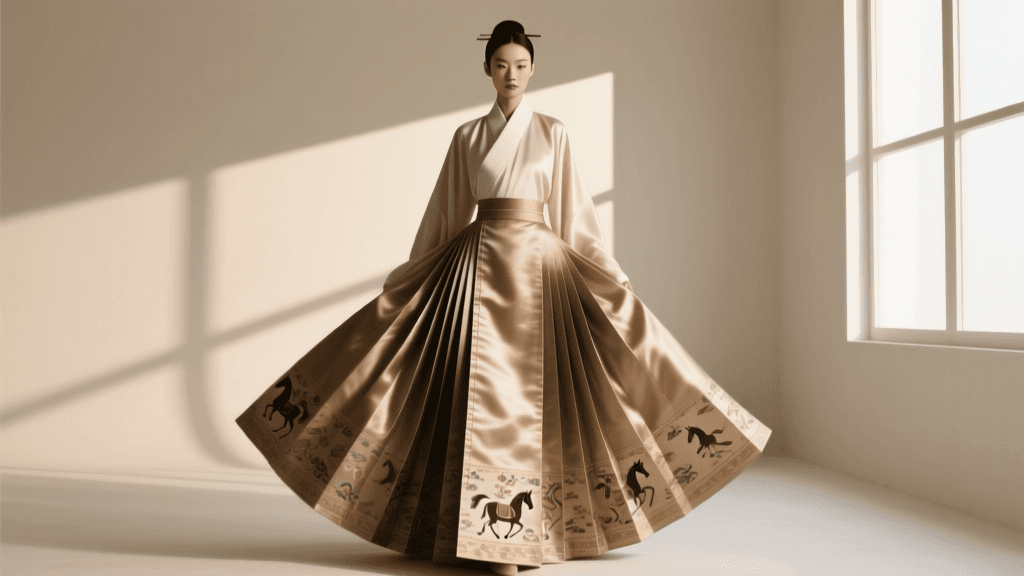
In the landscape of 2026 global fashion media, few garments have commanded as much editorial real estate and high-fashion reverence as the Mamianqun, traditionally known as the 'horse-face skirt.' Once confined to historical reenactments and niche Hanfu subcultures, the Mamianqun has firmly established itself as a cornerstone of luxury street style and avant-garde editorial spreads. Top-tier publications like Vogue, Harper's Bazaar, and Elle have dedicated extensive 2026 spring and autumn issues to the structural brilliance of this Ming dynasty staple, celebrating its architectural pleats and rich textile heritage.
The transition of the Mamianqun from traditional ceremonial wear to a global fashion media darling is not merely a fleeting trend; it represents a profound shift in how Western and Eastern fashion houses collaborate. In 2026, we are witnessing a departure from superficial orientalism toward a deep, structural appreciation of Asian garment engineering. Fashion editors are no longer just looking for 'exotic' prints; they are analyzing the 6-meter hem circumferences, the intricate side-pleating techniques, and the historical significance of the flat front and back panels that define the Mamianqun silhouette.
Deconstructing the Silhouette: What Fashion Media Gets Right in 2026
To understand why the Mamianqun has captivated the 2026 fashion media circuit, one must deconstruct its unique anatomy. Unlike Western pleated skirts that gather uniformly around the waist, the Mamianqun features four distinct flat panels (the 'horse faces') at the front and back, with densely pleated sections hidden at the sides. According to historical textile archives, such as those detailed in the Metropolitan Museum of Art's Ming Dynasty overview, this specific structure was originally designed to allow for ease of movement, particularly for equestrian mobility, while maintaining a modest, dignified drape when standing still.
In 2026, luxury fashion stylists are leveraging this exact duality. The flat front panels provide a pristine, unbroken canvas for elaborate Song brocade weaving or Xiangyunsha (gambiered Canton gauze) textures, making it an ideal centerpiece for high-resolution editorial photography. Meanwhile, the side pleats offer dramatic, kinetic volume that translates beautifully to video and motion-based fashion media. The modern editorial consensus in 2026 dictates that the integrity of these pleats must be preserved; altering the skirt's fundamental geometry to mimic a standard Western midi skirt is now widely criticized by fashion critics as a failure to understand the garment's core identity.
Actionable Styling Guide: Mamianqun for the Modern Editorial Look
For enthusiasts, stylists, and fashion students looking to emulate the 2026 high-fashion editorial aesthetic, styling a Mamianqun requires a deliberate juxtaposition of traditional heritage and contemporary tailoring. Here is the actionable blueprint for achieving the luxury editorial look this year.
1. Proportions and Measurements
While traditional Mamianqun skirts are designed to graze the ankle, the 2026 street-style media trend favors a slightly elevated hemline. Look for a skirt length between 90cm and 95cm (falling mid-calf) to allow for statement footwear. The waistband should sit at the natural waist or slightly above. Avoid skirts with elasticated waistbands; authentic editorial styling requires the traditional cotton or linen tie-waistband, which provides necessary friction to keep the heavy, multi-layered pleats securely in place without bulk.
2. Fabric Selection for 2026 Editorials
- Xiangyunsha (Mud Silk): The undisputed star of 2026 summer editorials. Its crisp, sculptural drape and subtle, dark, earthy sheen photograph beautifully under natural light. Expect to invest between $400 and $800 for authentic, hand-dyed Xiangyunsha.
- Song Brocade (Songjin): Ideal for autumn/winter luxury spreads. The raised, intricate jacquard patterns catch studio lighting, adding depth to editorial portraits. Look for metallic thread accents that nod to historical Ming dynasty luxury.
- Heavy Tencel Blends: For daily street-style media coverage, high-quality Tencel-cotton blends offer the necessary weight to swing dramatically while remaining breathable and affordable ($80–$150).
3. The Art of the Top Pairing
The 2026 media standard rejects the head-to-toe historical costume approach in favor of cross-cultural tailoring. Pair a heavy brocade Mamianqun with a crisp, oversized white poplin button-down shirt, leaving the top three buttons undone and the cuffs rolled. Alternatively, a sharply tailored, boxy wool blazer worn over a fitted silk camisole creates a striking silhouette that balances the skirt's voluminous lower half.
Traditional vs. 2026 Global Media Styling: A Comparison
| Element | Traditional Ming/Qing Styling | 2026 Global Editorial Styling |
|---|---|---|
| Top Pairing | Ao (padded jacket) or Shan (narrow-sleeved top) | Oversized tailored blazers, crisp poplin shirts, structured corsets |
| Footwear | Embroidered cloth shoes, wooden clogs | Chunky leather loafers, knee-high riding boots, architectural heels |
| Outerwear | Pifeng (cloak) or Bizi (vest) | Wool trench coats, cropped leather moto jackets, cashmere capes |
| Waist Cinching | Hidden ties, natural waistband placement | Exposed leather obi belts, chain-link hardware over the waistband |
| Hair & Makeup | Elaborate updos, traditional hairpins | Sleek low buns, wet-look textures, minimalist 'no-makeup' makeup |
Cultural Appreciation and Media Attribution in 2026
The integration of the Mamianqun into global fashion media has not been without its historical friction. Following the industry-wide reckoning regarding uncredited cultural borrowing in the early 2020s—most notably when a major French luxury house faced severe backlash for releasing a skirt that closely mimicked the Mamianqun silhouette without attribution—the 2026 media landscape has adopted strict standards of cultural provenance.
Today, leading fashion publications mandate that editorial credits explicitly name the garment's historical origins. The evolution of Asian garments in Western media was notably mapped out during landmark exhibitions like China: Through the Looking Glass, but the 2026 landscape has shifted from viewing these garments through a lens of exoticism to one of structural and historical reverence. Modern editorials now frequently feature sidebars or digital companion pieces that interview Hanfu historians and traditional textile artisans, ensuring that the narrative of the Mamianqun is told by the culture that engineered it.
'The Mamianqun is not merely a pleated skirt; it is a masterclass in zero-waste textile engineering and kinetic design. To feature it in a 2026 editorial without acknowledging its Ming dynasty roots is to strip it of its architectural genius.' — 2026 Global Fashion Media Editorial Guidelines on Cultural Heritage.
Sourcing Authentic Pieces for Your 2026 Wardrobe
As demand surges, the market has bifurcated into fast-fashion imitations and authentic, artisan-crafted Hanfu. For those seeking to build a wardrobe that aligns with the luxury editorial standards of 2026, sourcing is critical. Avoid mass-market platforms that use the term 'pleated midi skirt' interchangeably with Mamianqun. Instead, seek out specialized Hanfu boutiques that provide detailed breakdowns of their weaving techniques.
When evaluating a piece, check the pleat density. A high-quality editorial-grade Mamianqun will feature hundreds of micro-pleats that are heat-set or traditionally pressed to remain razor-sharp even after movement. The hem should be weighted, often with a subtle internal binding, to ensure the skirt swings with the heavy, deliberate momentum seen on 2026 runways.
Care and Maintenance for Editorial-Grade Hanfu
Preserving the structural integrity of a Mamianqun requires specialized care. Never machine wash an authentic Xiangyunsha or Song brocade piece; the agitation will destroy the pleat structure and damage the delicate metallic threads. Dry cleaning is recommended for heavy brocades, while Xiangyunsha can be gently hand-washed in cool water with a pH-neutral silk detergent. To store the skirt, do not hang it by the waistband for long periods, as the weight of the fabric will stretch the ties. Instead, fold the flat panels inward, align the side pleats meticulously, and store it flat in a breathable cotton garment bag with cedar blocks to protect the natural fibers.