Inclusive Kimono Guide: Styling for All Body Types and Genders
The Evolution of Kimono Inclusivity
For centuries, the kimono has been celebrated as a masterpiece of Japanese textile art and cultural heritage. However, as global interest in traditional Japanese clothing has surged, so too has the demand for inclusivity. Historically, the kimono was custom-tailored to the individual, meaning it inherently accommodated diverse body shapes. According to the Encyclopedia Britannica, the garment's straight-line construction was designed to be wrapped and adjusted, making it remarkably versatile. Yet, modern mass production and standardized rental shops have often perpetuated a 'one-size-fits-most' mentality that caters primarily to petite, cisgender female frames.
Today, a cultural renaissance is underway. From the bustling streets of Kyoto's Higashiyama district to modern fashion runways, kimono stylists, artisans, and wearers are reclaiming the garment's inherent adaptability. Whether you are tall, plus-sized, masculine-presenting, or non-binary, understanding the mechanics of kimono dressing—known as kitsuke—allows you to honor tradition while expressing your unique identity.
'The kimono is not merely a garment; it is an architectural structure of fabric that adapts to the human form, rather than forcing the human form to adapt to it.' — Traditional Kitsuke Proverb
Understanding Kimono Sizing and Measurements
Unlike Western clothing, which relies on bust, waist, and hip measurements, kimono sizing is determined primarily by height and arm span. The two most critical measurements are Mitake (the back length from the base of the neck to the ankle) and Yuki (the sleeve span, measured from the center of the back of the neck, over the shoulder, to the wrist).
For individuals outside the standard Japanese sizing chart, finding the right fit requires understanding these metrics. Below is a comprehensive sizing guide to help you identify your kimono category.
| Size Category | Height (cm / in) | Yuki (Sleeve Span) | Mitake (Length) | Best For & Adjustments |
|---|---|---|---|---|
| Standard (S/M) | 150-160 cm / 4'11'-5'3' | 62-64 cm | 120-125 cm | Petite to average frames; widely available in rental shops. |
| Tall (L/LL) | 165-175 cm / 5'5'-5'9' | 66-69 cm | 130-138 cm | Taller individuals; may require custom ordering or vintage oban sizes. |
| Plus-Size Wrap | Varies | 68-72 cm | 125-135 cm | Broader shoulders/hips; requires wider okumi (overlapping panels). |
| Men's Standard | 170-180 cm / 5'7'-5'11' | 70-74 cm | 135-145 cm | Masculine styling; features shorter sleeves and subdued patterns. |
Styling for Different Body Types
Tall and Plus-Size Figures
One of the most common challenges for tall or plus-size individuals is the lack of fabric in the overlapping front panels, known as the okumi. If the overlap is too shallow, the kimono may pull open at the hips or legs. To solve this, seek out kimonos labeled as hiroyuki (wide sleeve span) or habahiro (wide width). Modern brands like Wakorudo and Jotaro Saito have pioneered stretch-fabric and denim kimonos that offer greater flexibility and broader sizing, often accommodating hip measurements up to 120 cm (47 inches) comfortably.
For tall wearers, the mitake (length) is the primary hurdle. A standard kimono will end awkwardly at the mid-calf. When renting, call ahead to shops in areas like Asakusa or Arashiyama and specifically request a 'tall-size' (tall-size is commonly understood in tourist hubs) or a vintage kimono, as antique garments from the Taisho and early Showa eras were often cut longer and wider to accommodate different historical undergarments.
The Art of Padding and Silhouette Shaping
Traditional kimono aesthetics favor a cylindrical, column-like silhouette, which minimizes the appearance of curves. This is achieved through strategic padding, a technique that is incredibly beneficial for plus-size, pear-shaped, or apple-shaped bodies, as it creates a smooth canvas for the obi (sash) to sit flat against.
- Hip and Waist Padding: Wrap a sarashi (traditional cotton binding cloth) or specialized kimono towels around the hips and waist to fill in the natural dip of the lower back and smooth the hip line.
- Bust Minimization: For those with larger busts, a tight-fitting hadajuban (under-kimono) with built-in compression, or a traditional sarashi wrap, prevents the collar from gaping and keeps the eri (neckline) flat against the collarbone.
- Datejime: Use a wide, elastic datejime (under-sash) to secure the padding and the kimono fabric firmly before tying the main obi.
Gender-Inclusive and Non-Binary Kimono Fashion
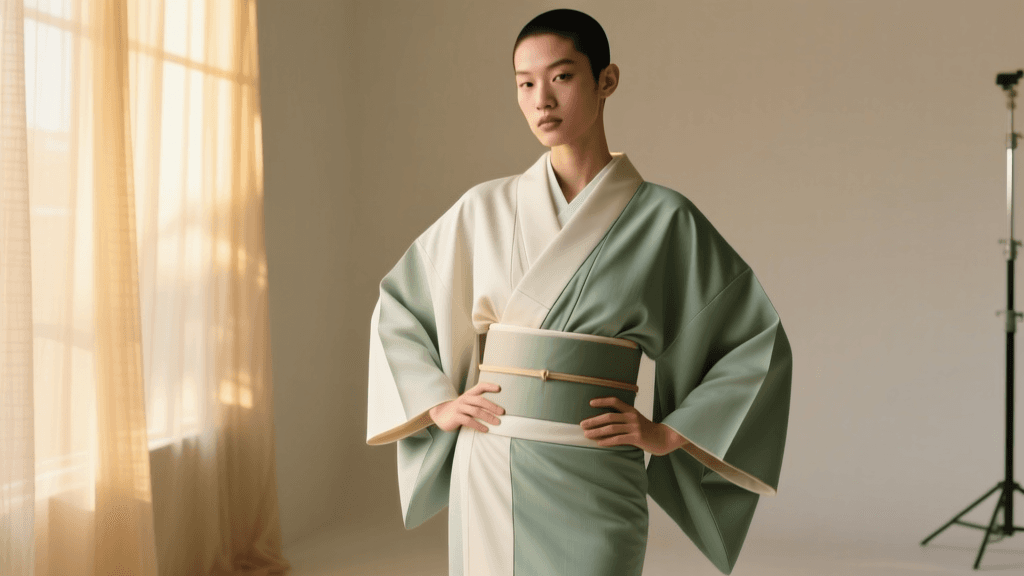
The Victoria and Albert Museum notes that while modern kimono is heavily gendered, historical garments were often far more fluid, with color and pattern dictating status rather than strict binary gender lines. Today, the rigid divide between onna-gi (women's wear) and otoko-gi (men's wear) is being beautifully dismantled by a new generation of wearers.
Hakama and Androgynous Styling
For non-binary, gender-fluid, or masculine-presenting individuals, the hakama is an exceptional choice. Traditionally worn by samurai and later adopted by female university students in the Meiji era, the hakama is a pleated, wide-legged trouser-skirt worn over the kimono. It provides a striking, structured silhouette that obscures the lower body's natural curves, making it highly favored for gender-neutral styling. Pairing a muted, geometric-patterned kimono with a solid-colored hakama and a haori (jacket) creates a dignified, androgynous look that commands respect at tea ceremonies, graduations, and festivals.
Crossing Traditional Gender Lines
There are no legal or cultural laws preventing individuals from wearing across traditional gender lines. Men who wish to wear vibrant, floral furisode (long-sleeved kimonos) or women who prefer the subdued, geometric komon of men's fashion are increasingly visible in Tokyo's Harajuku and Kyoto's Gion districts. The key to pulling off cross-gender styling lies in the obi knot and the collar. Men's collars are typically worn higher and tighter at the back of the neck, while women's collars are pulled slightly lower to expose the nape. Adjusting these subtle details allows the wearer to control the gender expression of their outfit.
Practical Guide: Renting vs. Buying Inclusive Kimonos
Navigating the economics of inclusive kimono fashion requires knowing where to invest your time and money. According to the Metropolitan Museum of Art, the preservation and creation of these garments is a meticulous craft, which is reflected in their cost.
Renting for Tourists and Short-Term Wear
Most standard rental shops in Japan charge between ¥4,000 and ¥8,000 ($25–$55 USD) for a basic package, which includes dressing, a standard-sized kimono, and basic accessories. However, these shops often lack extended sizing.
- Plus-Size & Tall Rentals: Expect to pay a premium of ¥2,000 to ¥5,000 extra for extended sizes, as these require more fabric and specialized dressing time. Always book at least two weeks in advance and email your exact height, shoulder width, and hip measurements.
- Hair and Makeup: Add ¥3,000 to ¥5,000 for professional styling. For gender-inclusive styling, communicate your preferred aesthetic (e.g., sharp and masculine vs. soft and feminine) to the stylist beforehand.
Buying and Bespoke Tailoring
If you plan to wear a kimono regularly, investing in your own garment is highly recommended. Vintage kimono markets, such as the Toji Temple flea market in Kyoto, are treasure troves for tall and plus-size individuals. Vintage garments can be purchased for as little as ¥3,000 to ¥10,000 ($20–$70 USD) and later altered by a professional osaiya (kimono tailor) to fit your exact yuki and mitake.
For bespoke, modern kimonos designed specifically for diverse body types and gender expressions, expect to invest between ¥100,000 and ¥300,000 ($650–$2,000 USD). This process takes 3 to 6 months but results in a garment that honors your unique proportions perfectly.
Conclusion
The kimono is a living, breathing garment that has survived centuries by adapting to the times and the people who wear it. By understanding the mechanics of mitake and yuki, utilizing traditional padding techniques, and embracing gender-fluid styling options like the hakama, anyone can experience the profound elegance of Japanese traditional dress. True cultural appreciation lies not in conforming to a rigid standard, but in wrapping yourself in the rich, inclusive history of the textile arts.