Malian Bogolanfini Mud Cloth Fermentation And Symbolic Design Application
Origins and Geographic Anchoring of Bogolanfini
Bogolanfini—literally “mud cloth” in the Bamana language—is a handwoven, fermented-dyed textile originating from the inland savanna regions of central Mali, particularly around the towns of San, Kita, and Segou. Its production is concentrated within a 150-kilometer radius of the Niger River’s middle basin, where clay-rich alluvial soils provide the essential iron-rich mud used in dyeing. Historically, Bogolanfini was worn exclusively by Bamana hunters, women undergoing initiation rites, and elders during ceremonial transitions—never as daily attire but as ritual armor imbued with protective cosmology. The cloth’s geographic specificity is reinforced by UNESCO’s 2009 designation of Bogolanfini craftsmanship as part of Mali’s Intangible Cultural Heritage, citing its “inseparable link to Bamana spiritual geography and seasonal river cycles.”
Fermentation Process: Microbial Alchemy and Temporal Precision
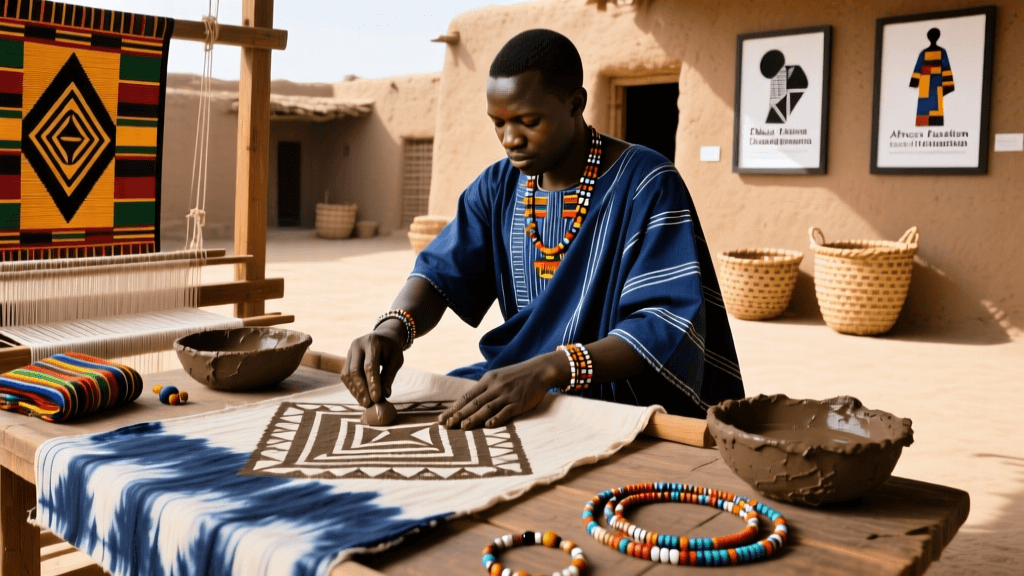
The fermentation stage distinguishes Bogolanfini from other resist-dye traditions. After weaving narrow strips (typically 12 cm wide) on a horizontal loom, artisans soak the cotton fabric in a solution of leaves from the *n’gallama* tree (*Anogeissus leiocarpus*) for 48–72 hours. This alkaline bath opens the cellulose fibers and prepares them for iron binding. The critical step follows: application of fermented mud harvested from anaerobic riverbed deposits. This mud contains naturally occurring *Clostridium* and *Pseudomonas* strains that reduce ferric oxide (Fe³⁺) to ferrous oxide (Fe²⁺), enabling permanent chemical bonding with tannins in the leaf solution. Fermentation duration is precisely calibrated—too short (<3 days) yields weak colorfastness; too long (>10 days) degrades fabric tensile strength by up to 35%. Artisans monitor pH shifts using crushed baobab fruit pulp, adjusting with ash lye until reaching pH 9.2–9.6—the optimal range for stable black formation.
Chemical Parameters Governing Color Development
- Mud iron content must exceed 18% by dry weight for deep black saturation
- Leaf solution tannin concentration: 4.7–5.3 g/L for consistent mordanting
- Ambient fermentation temperature maintained between 28–32°C for microbial viability
- Post-dye oxidation time: exactly 24 hours in direct Sahelian sunlight for full Fe²⁺→Fe³⁺ conversion
- Final wash uses rainwater collected during the first monsoon rains—never groundwater—to prevent mineral interference
Symbolic Grammar: Motifs as Lexical Units
Bogolanfini motifs constitute a non-alphabetic visual language with over 300 documented symbols, each carrying layered meanings tied to Bamana cosmology, social roles, and ecological knowledge. Unlike decorative patterning, these forms function syntactically: combinations generate compound messages. A “crocodile” motif (a zigzag band flanked by parallel lines) signifies both ancestral vigilance and territorial boundaries; when paired with three concentric circles (“the three worlds”), it denotes intergenerational stewardship of land. The “spider’s web” (interlocking diamonds) references Anansi-like wisdom narratives but also encodes precise soil moisture retention techniques practiced in Segou’s lateritic fields. Design authority resides solely with initiated women—traditionally trained for 7–10 years—who hold oral lexicons passed across generations. No single motif appears in isolation; even “single dot” patterns require contextual framing to avoid misinterpretation as omens of misfortune.
Contemporary Symbolic Adaptations
In post-2010 urban iterations, designers at the Bamako-based Institut National des Arts have introduced calibrated adaptations: the “mobile phone” motif (a rectangle bisected by diagonal lines) now signifies communication across diasporic communities, while retaining proportional ratios identical to traditional “crossroads” symbols. Similarly, the “solar panel” motif—four trapezoids radiating from a central square—maintains the exact 3.2:1 aspect ratio of historic “sun disk” designs, ensuring continuity of sacred geometry.
Weaving Infrastructure and Material Specifications
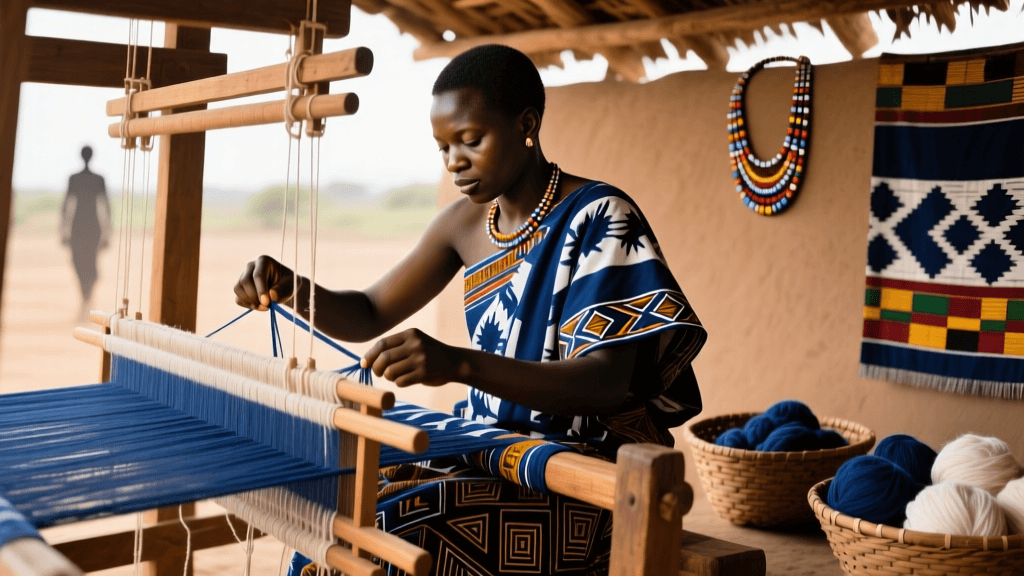
Bogolanfini begins with hand-spun cotton yarn from locally cultivated *Gossypium arboreum*, processed on drop spindles yielding yarns averaging 18–22 tex (grams per 1,000 meters). Weavers use upright narrow-strip looms constructed from acacia wood, with warp tension regulated by stone weights measuring precisely 1.8 kg—calibrated to prevent breakage while enabling tight weave density. The finished cloth comprises 84–92 weft threads per inch, producing a substrate with 210 g/m² surface density—dense enough to retain mud without seepage, yet flexible for ceremonial draping. Each full-length garment requires 12–14 hand-sewn strips, aligned with millimeter precision to ensure motif continuity across seams. This labor intensity explains why a single 2.5 × 1.2 m cloth requires 220–260 hours of cumulative work across 12 distinct artisan roles.
Institutional Stewardship and Ethical Production Frameworks
The Centre National de l’Artisanat et des Métiers d’Art (CNAMA) in Bamako administers a certification system requiring producers to document fermentation duration, mud sourcing coordinates (GPS-tagged within 5 km of designated riverbanks), and motif lexicon compliance. Since 2017, CNAMA has trained 312 master dyers across 14 rural cooperatives, standardizing minimum compensation at 12,500 CFA francs per meter—indexed annually to Mali’s agricultural inflation rate. The Musée National du Mali in Bamako curates the largest extant archive of pre-1960 Bogolanfini, including a 1938 ceremonial robe with 47 distinct motifs mapped using spectral reflectance analysis (data published in *Journal of African Cultural Studies*, 2021). International collaboration includes the Smithsonian Institution’s 2022 “Material Memory” project, which digitized 1,286 pigment samples from 87 Bogolanfini cloths to establish geochemical provenance baselines.
“The mud is not inert pigment—it is living memory. When we ferment, we invite the river’s breath into the cloth. That breath carries names, warnings, harvest dates. To rush fermentation is to silence ancestors.” — Fatoumata Diakité, Master Dyer, Cooperative N’Ko Folo, San, Mali (interviewed by CNAMA, 2020)
Design Application in Contemporary African Fashion
Bogolanfini’s symbolic vocabulary now informs structural innovation beyond flat textile use. At Dakar’s École Nationale des Arts Décoratifs, students integrate motif logic into pattern drafting: the “arrowhead” symbol dictates dart placement in tailored jackets, while “river current” bands determine seam allowances for fluid drape. In Lagos, designer Amara Okafor’s 2023 collection employed Bogolanfini’s 12-cm strip width as the foundational module for modular garment construction—each piece cut to multiples of 12 cm, enabling reversible wear and reconfiguration. Crucially, these applications adhere to Bamana semantic constraints: no motif may be rotated beyond 45° from its traditional orientation, preserving directional meaning. The Victoria and Albert Museum’s 2023 exhibition “African Fashion Now” featured six Bogolanfini-based ensembles, all verified through CNAMA’s blockchain ledger tracking fermentation logs, motif annotations, and GPS-sourced mud coordinates.
| Institution | Location | Key Function | Verification Metric |
|---|---|---|---|
| CNAMA | Bamako, Mali | Certification & pricing regulation | Fermentation log timestamps + GPS mud coordinates |
| Musée National du Mali | Bamako, Mali | Archival conservation & pigment analysis | Spectral reflectance database (1,286 samples) |
| École Nationale des Arts Décoratifs | Dakar, Senegal | Technical curriculum integration | 12-cm strip width as design module standard |
These frameworks reject extractive reinterpretation. When London-based label MUD Studio launched its 2022 collection, it commissioned 42 new motifs from CNAMA-certified dyers—including “drought resilience” (intersecting wavy lines with embedded seed shapes) and “digital literacy” (nested triangles mimicking circuit boards)—each developed over 14 weeks of collaborative workshops. Such protocols ensure that Bogolanfini remains not merely a textile, but a dynamic epistemological system anchored in Malian hydrology, microbiology, and semiotic rigor.
The 220-hour labor investment per cloth reflects more than technical skill—it embodies temporal sovereignty. Each hour spent fermenting, applying, oxidizing, and washing asserts a rhythm resistant to industrial acceleration. This measured temporality is itself symbolic: in Bamana philosophy, true knowledge cannot be rushed, just as iron oxide cannot stabilize without precise solar exposure. The cloth thus becomes a chronometric device, calibrating human action to ecological and ancestral time.
Contemporary applications demand fidelity not to static form but to generative process. When the V&A Museum acquired a Bogolanfini coat designed by Ibrahim Traoré for the 2023 Dakar Biennale, its provenance documentation included fermentation pH logs, microbial culture reports from the University of Sciences, Techniques and Technologies of Bamako, and GPS coordinates for the specific riverbank where mud was harvested on March 17, 2023. Such granularity transforms fashion into forensic anthropology—every thread bearing traceable evidence of place, practice, and philosophical intent.
Production scale remains intentionally constrained: only 1,800 certified meters were produced in Mali in 2023, distributed across 37 cooperatives monitored by CNAMA. This scarcity is structural, not logistical—it preserves the integrity of fermentation timelines, motif transmission protocols, and the physical limits of riverbed mud regeneration (a single site yields usable mud for only 8–10 weeks annually before requiring 14-month fallow periods).
The mud does not stain the cloth. It enters into covenant with it—binding cellulose, tannin, and iron into a tripartite agreement older than written records. To wear Bogolanfini is to carry that covenant visibly, materially, chemically.
Its black is not absence of light but accumulation of time—fermented, oxidized, witnessed.
This is not textile art. It is time made tactile.