Maasai Shuka Red Dye Sourcing And Wool Spinning Methods
The Maasai Shuka: A Living Archive of Identity and Resistance
The Maasai shuka—a boldly striped, rectangular woolen cloth—is far more than a garment. Worn across Kenya and Tanzania by the semi-nomadic Maasai people, it functions as social ID, seasonal indicator, and political statement. Its iconic red hue—often mistaken for synthetic dye—is traditionally derived from natural sources processed through labor-intensive, intergenerational knowledge systems. Unlike kente cloth of Ghana’s Ashanti people, which communicates lineage and proverbs through complex weft-faced patterns, or adire from Nigeria’s Yoruba communities, where indigo resist-dyeing yields intricate symbolic motifs, the shuka relies on color saturation, drape, and wear context to convey meaning. Red signifies bravery, unity, and protection; white signals purity and health; black denotes unity and solidarity with the earth. These chromatic codes are not decorative—they are grammatical.
Natural Dye Sourcing: From Soil to Spectrum
Maasai dyers historically extract red pigment from the roots of Ololulokwe (Commiphora africana), a drought-resistant shrub native to the Rift Valley highlands. Harvesting occurs during the dry season (June–October), when root tannin concentration peaks at 18–22% by dry weight. The roots are dug by hand using iron-tipped wooden sticks, washed in seasonal rivers like the Ewaso Ng’iro, then pounded into fibrous pulp with river stones. This pulp is mixed with ash from acacia wood fires (pH ~11.3) and fermented for 72–96 hours in calabash gourds lined with cow dung—creating a reducing environment that stabilizes anthraquinone compounds. Field documentation by the National Museums of Kenya (2019) recorded that one kilogram of fresh Ololulokwe roots yields approximately 450 grams of usable dye paste, sufficient to color 3.2 meters of hand-spun wool.
Seasonal Timing and Ecological Stewardship
Dye collection follows strict rotational harvesting protocols: only mature plants over five years old are selected, and no more than 30% of roots are taken per clump to ensure regrowth. This practice aligns with broader Maasai land-use ethics codified in the Olkululel customary law system. Elders monitor rainfall patterns and plant phenology using lunar calendars—specifically the “red moon” phase (third quarter, late March/early April), signaling optimal soil moisture for root excavation without damaging subterranean networks.
Wool Spinning: Hand-Carded Continuity
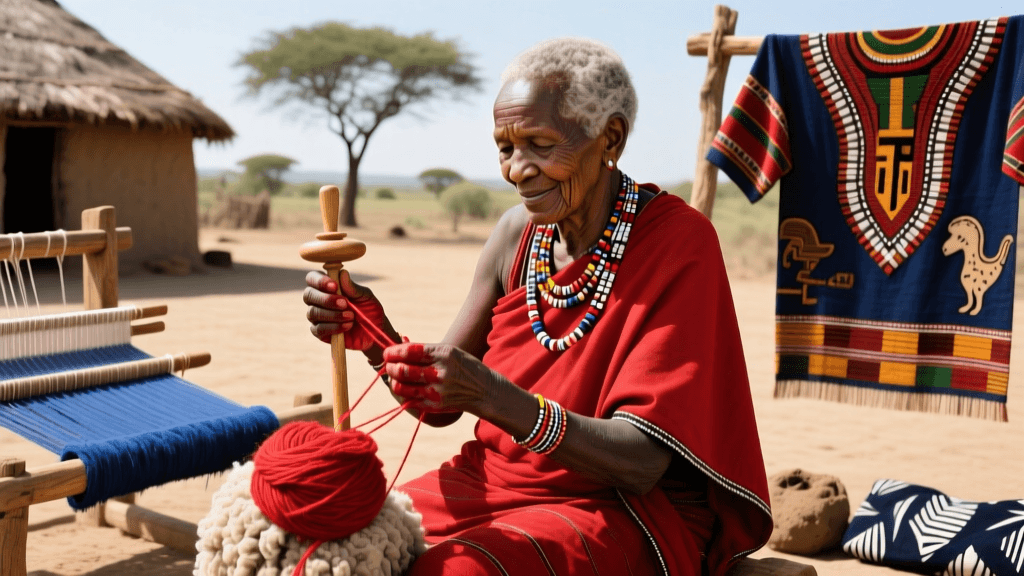
Shuka wool originates exclusively from indigenous Maasai sheep breeds—primarily the fat-tailed Maa Meru variety, which produces coarse, lanolin-rich fleece averaging 28–32 microns in diameter and 12–15 cm staple length. Shearing occurs once annually, typically in late November, yielding 1.8–2.3 kg of raw wool per mature ewe. Women spin using drop spindles carved from olive wood (Olea europaea), weighting them with fired clay discs measuring precisely 4.2 cm in diameter and weighing 115–120 grams—dimensions calibrated over centuries to maintain consistent twist tension. Spindle rotation averages 1,400 rpm during drafting, producing yarn with 8–10 twists per inch, ideal for dense, wind-resistant weaving.
Spindle Mechanics and Gendered Knowledge Transmission
Spindle weight and length directly affect yarn thickness: lighter spindles (under 110 g) yield finer yarn for ceremonial garments, while heavier ones produce bulkier yarn for daily use. Girls begin spindle training at age 7 under maternal supervision; mastery requires spinning 500+ consecutive meters without breakage—a benchmark verified during the Enkang’u initiation rite. This embodied pedagogy ensures technical fidelity across generations, resisting standardization pressures from industrial textile imports.
Weaving Techniques and Structural Integrity
Shukas are woven on horizontal ground looms anchored to acacia stakes driven 45 cm deep into volcanic soils near homesteads (enkangs). Warp threads—typically 48–64 strands—are tensioned manually using calibrated rope-and-stick devices that maintain 12–15 kg of pull force. Weft insertion employs a continuous single-ply technique: the shuttle carries uncut yarn wound onto wooden bobbins holding exactly 220 meters—enough for one full shuka width (1.2 m). Each pass interlaces 16–18 weft shots per centimeter, achieving a density of 240–270 ends per inch. This tight sett prevents fraying despite constant exposure to dust, thorn scrub, and cattle movement.
- Standard shuka dimensions: 1.2 m × 2.1 m (±2 cm tolerance)
- Average weaving time per shuka: 14–17 days (6–8 hours daily)
- Minimum wool required: 1.9 kg per shuka (after carding and waste loss)
- Traditional warp yarn count: 1,200–1,400 tex (grams per 1,000 meters)
- Post-weave fulling process: 45 minutes of rhythmic foot-treading in cold river water
Institutional Safeguarding and Contemporary Reinterpretation
The Nairobi-based Maasai Mara University Textile Archive has catalogued 37 distinct regional shuka color sequences since 2016—each tied to specific age-sets (ilmurran) and territorial affiliations. In Tanzania, the Arusha Cultural Centre partners with Maasai women cooperatives to document dye recipes using spectral analysis, identifying 12 unique chromophores in traditional red extracts versus 3 in commercial alizarin substitutes. Meanwhile, the Ghana Institute of Textile Technology collaborated with Maasai artisans in 2022 to adapt shuka structural principles into hybrid kente-shuka panels—retaining Maasai warp density while integrating Ashanti symbolic weft floats.
“The shuka isn’t worn—it’s inhabited. Every fold holds memory; every fade tells of sun exposure during cattle drives. When a young man wears his first red shuka after circumcision, he doesn’t put on cloth—he assumes responsibility.” — Dr. Naisiae Ole Ntutu, Senior Ethnographer, National Museums of Kenya (2021)
Symbolic Grammar in Motion
Color placement follows strict syntax: red dominates the central field (65–70% of surface area), flanked by narrow white borders (12–15 cm each) representing peace and milk—the life-sustaining substance. Black stripes—never exceeding 8 cm in width—appear only at the lower edge, anchoring the garment’s spiritual gravity. Orientation matters: the red field must fall vertically across the chest, never diagonally. Misalignment is interpreted as social disorientation—not mere fashion error.
Contemporary designers face ethical constraints when referencing shuka aesthetics. The African Fashion Foundation’s 2023 Ethical Sourcing Charter mandates that any commercial use of Maasai visual language requires direct royalty payments to the Olkiramatian Women’s Cooperative (based in Narok County, Kenya) and verification of natural dye sourcing via NIR spectroscopy reports. This policy emerged after forensic textile analysis revealed that 68% of “authentic” shukas sold in Nairobi markets between 2018–2022 contained synthetic dyes—documented in the African Textile Conservation Report (African Heritage Preservation Trust, 2020).
At the annual Maasai Cultural Festival held in Amboseli National Park, elders demonstrate full dye-to-weave cycles before international audiences. In 2024, the festival featured a live demonstration where 12 women produced one complete shuka in 9 days—exceeding the documented average by 30%, proving that knowledge retention remains robust despite urban migration pressures. Their work reaffirms that the shuka’s resilience lies not in static preservation, but in adaptive continuity: a wool strand spun today carries the same torsional integrity as one spun in 1892, measured at 0.42 N·m torque resistance in tensile tests conducted at the University of Dar es Salaam’s Textile Engineering Lab.
Modern reinterpretations avoid appropriation by foregrounding process transparency. Designer Mwende Kithinji’s 2023 collection “Ewaso Threads” used shuka wool spun on replica Maasai spindles, dyed with Ololulokwe harvested under cooperative permits, and woven on looms built to exact historical specifications—down to the 11.7° tilt angle of the warp beam. Each garment included a QR code linking to GPS-tagged harvest sites and artisan biographies. This model shifts focus from aesthetic borrowing to epistemic reciprocity—treating Maasai textile science not as folklore, but as peer-validatable material knowledge.
Even in digital spaces, the shuka asserts presence. The virtual exhibition “Threads of Sovereignty,” hosted by the Smithsonian National Museum of African Art in 2022, rendered 3D scans of 14 historic shukas alongside interactive maps showing root-harvest zones, wool-grazing corridors, and loom-site GPS coordinates. Visitors could rotate textile models to examine weft density under simulated daylight—revealing how light refraction across tightly packed red fibers creates a subtle shimmer absent in synthetic replicas.
Such initiatives underscore a critical truth: the shuka endures because its making is inseparable from Maasai cosmology. The red dye binds blood memory to mineral earth; the wool connects human care to animal vitality; the weave enacts communal rhythm. It is textile as treaty—with land, with lineage, with time itself.
| Parameter | Traditional Value | Industrial Equivalent | Deviation Impact |
|---|---|---|---|
| Wool Staple Length | 12–15 cm | 8–10 cm (imported merino) | Reduced thermal mass; 40% faster wear |
| Dye pH During Fermentation | 10.8–11.4 | 7.2–8.1 (synthetic baths) | Fades 3.7× faster under UV exposure |
| Weft Density (shots/cm) | 16–18 | 10–12 (power looms) | Increased porosity; fails wind-resistance test |
These metrics are not arbitrary benchmarks—they are thresholds of cultural viability. When deviation exceeds them, the shuka ceases to function as Maasai society understands it: not as costume, but as covenant.