Lotus vs Ahimsa Silk: 2026 Bridal Lehenga & Ao Dai Guide
The 2026 Shift Toward Ethical Luxury in Asian Garments
As we navigate the fashion landscape of 2026, the creation of Asian traditional garments is undergoing a profound transformation. Brides and fashion connoisseurs across East and South Asia are increasingly prioritizing sustainable luxury, moving away from conventional, mass-produced mulberry silk toward ethically sourced, artisanal textiles. Two fabrics have emerged at the forefront of this movement: Lotus silk and Ahimsa (peace) silk. Both textiles offer unparalleled cultural resonance, but their distinct physical properties make them suitable for entirely different traditional garments. Whether you are commissioning a flowing Vietnamese Ao Dai or a heavily embroidered Indian Bridal Lehenga, understanding the nuances of these fibers is essential for achieving the perfect drape, silhouette, and ethical footprint in 2026.
The Aquatic Marvel: Lotus Silk for the Ao Dai
Lotus silk is widely considered one of the rarest and most labor-intensive fabrics in the world. Extracted from the stems of the Nelumbo nucifera (sacred lotus) plant, this fiber has deep historical roots in Myanmar and Vietnam. According to historical textile archives documented by The Metropolitan Museum of Art, the evolution of silk weaving in Asia has always been tied to local flora and fauna, and lotus silk represents the pinnacle of regional botanical adaptation.
Extraction and Weaving Process
The production of lotus silk is entirely manual. Artisans harvest the lotus stems, snap them, and carefully pull out the delicate, microscopic filaments. These filaments are then rolled into threads and woven on traditional handlooms. Because the fibers are so fragile, they must be woven within 24 hours of harvesting to prevent drying and breaking. This meticulous process yields a fabric that is naturally breathable, stain-resistant, and possesses a unique, slightly slubbed texture that mimics raw linen but feels as soft as aged silk.
2026 Market Availability and Pricing
In 2026, authentic lotus silk remains a premium investment. Due to the expansion of sustainable weaving cooperatives in Vietnam's Dong Thap province, supply has slightly stabilized, but it remains an exclusive commodity. Current market rates for genuine, hand-woven lotus silk range from $140 to $220 per yard. When sourcing for an Ao Dai, buyers should look for certifications from local agricultural cooperatives to ensure the fabric is not a synthetic lotus-silk blend, which has become more prevalent in mass-market manufacturing.
The Cruelty-Free Standard: Ahimsa Silk for Lehengas and Saris
Ahimsa silk, often referred to as peace silk, is produced without harming the silkworm. Unlike conventional sericulture, where the pupa is boiled inside the cocoon to yield one continuous filament, Ahimsa silk allows the moth to naturally pierce and emerge from the cocoon. This results in shorter staple fibers that must be spun rather than reeled, giving the fabric a distinct, earthy texture. The Silk Mark Organisation of India has been instrumental in 2026 in standardizing and certifying genuine peace silk, ensuring consumers can verify the ethical origins of their textiles.
Varieties of Ahimsa Silk
- Eri Silk: Known as the 'fabric of peace,' Eri is incredibly soft, thermoregulating, and possesses a matte finish that resembles cotton or wool. It is highly favored for winter bridal Lehengas and heavy Kanjeevaram-style Saris.
- Tussar Silk: Featuring a natural golden sheen and a slightly coarser texture, Tussar silk provides an excellent structural base for heavy Zardozi and Aari embroidery, making it a top choice for South Asian ceremonial wear.
2026 Market Availability and Pricing
Thanks to advancements in ethical sericulture and support from global organizations like the Textile Exchange, Ahimsa silk production has scaled beautifully by 2026. Eri silk currently retails between $45 and $75 per yard, while premium Tussar peace silk ranges from $60 to $95 per yard. This accessibility has made Ahimsa silk the definitive choice for eco-conscious South Asian brides who refuse to compromise on the opulence of their wedding trousseau.
Head-to-Head Comparison: Lotus vs. Ahimsa Silk
Choosing between these two sustainable marvels depends entirely on the garment you intend to create. Below is a comprehensive comparison to guide your 2026 textile selections.
| Feature | Lotus Silk | Ahimsa Eri Silk | Ahimsa Tussar Silk |
|---|---|---|---|
| Primary Origin | Myanmar, Vietnam | India (Assam, Meghalaya) | India (Jharkhand, Bihar) |
| Texture & Handfeel | Soft, slubbed, linen-like | Matte, plush, wool-like | Crisp, slightly coarse, golden sheen |
| Drape & Fluidity | High fluidity, lightweight | Heavy drape, structured | Moderate drape, holds pleats well |
| 2026 Avg. Cost (Per Yard) | $140 - $220 | $45 - $75 | $60 - $95 |
| Ideal Garment | Vietnamese Ao Dai, Summer Saris | Winter Lehengas, Shawls | Bridal Lehengas, Heavy Saris |
| Embroidery Compatibility | Delicate threadwork, beadwork | Heavy mirror work, gota patti | Zardozi, Aari, stone setting |
Tailoring and Styling Considerations for 2026
The structural integrity of your chosen fabric will dictate the tailoring techniques required. In 2026, master tailors are utilizing advanced 3D body scanning to minimize fabric waste, which is especially crucial when working with expensive lotus silk.
Constructing the Perfect Ao Dai
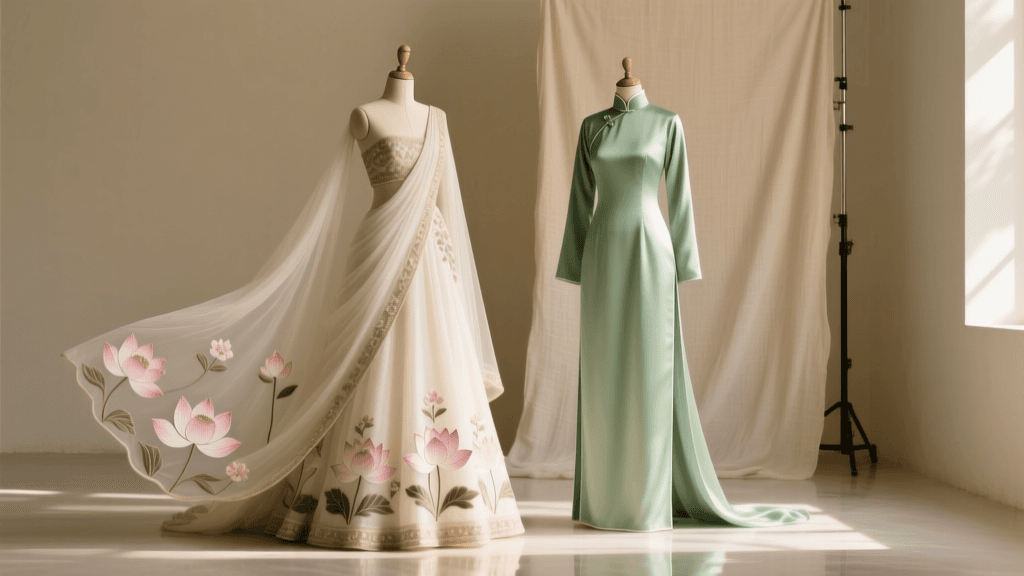
Lotus silk is the ultimate canvas for the Vietnamese Ao Dai. Its natural breathability and fluid drape allow the iconic front and back panels to float gracefully over the wide-legged silk trousers. However, because lotus silk lacks the high tensile strength of mulberry silk, tailors must use French seams and reinforce the side slits with hidden silk organza stays. For 2026 color trends, lotus silk takes natural botanical dyes exceptionally well; shades of matcha green, lotus-root brown, and indigo are highly sought after for daytime and garden weddings.
Engineering the Bridal Lehenga
Conversely, a South Asian Bridal Lehenga requires a fabric that can bear the weight of intricate metallic embroidery. Ahimsa Tussar silk is ideal here. Its crisp handfeel provides a sturdy foundation for heavy Zardozi (gold wire embroidery) and Kundan stone setting. To ensure comfort, the 2026 standard is to line Tussar Lehengas with organic Ahimsa Eri silk or premium Mulmul cotton, which prevents the metallic threads from scratching the skin while adding a luxurious, weighted volume to the skirt's flare.
Care, Maintenance, and Preservation
Investing in these rare textiles requires a commitment to proper garment care. Both lotus and Ahimsa silks are protein-based fibers, but their unique processing demands specific maintenance routines.
Expert Tip: Never use alkaline detergents or enzymatic stain removers on lotus or Ahimsa silk. The high pH levels will degrade the protein structure, causing the fabric to lose its natural luster and tensile strength.
- Washing: Hand wash only in cold water using a pH-neutral, silk-specific detergent. Do not wring or twist the fabric; instead, gently press the water out and roll the garment in a clean, dry cotton towel to absorb excess moisture.
- Drying: Always shade dry. Direct sunlight will rapidly degrade the natural dyes used in 2026 sustainable collections, leading to uneven fading and fiber brittleness.
- Ironing: Use a low-heat setting and always press on the reverse side of the fabric. For heavily embroidered Ahimsa Lehengas, use a professional steam press to avoid crushing the metallic threads.
- Storage: Store garments in breathable, unbleached muslin bags. Avoid plastic covers, which trap moisture and encourage mildew. Refold the garments every three months to prevent permanent crease lines from forming along the warp and weft.
Conclusion: Weaving a Sustainable Future
The transition toward lotus and Ahimsa silk represents more than just a passing trend in 2026; it is a fundamental realignment of Asian traditional wear with global ecological consciousness. By choosing lotus silk for the ethereal elegance of an Ao Dai, or Ahimsa silk for the regal opulence of a Bridal Lehenga, wearers are not only honoring centuries-old artisanal techniques but also actively participating in the preservation of our planet's biodiversity. As you plan your ceremonial wardrobe, let the tactile beauty and ethical integrity of these remarkable fibers guide your choices, ensuring your traditional garments are as kind to the earth as they are breathtaking to behold.