Authentic Linen Chiton & Roman Stola Draping Guide 2026
The 2026 Revival of Classical Mediterranean Dress
As we navigate the 2026 European heritage festival season, the revival of ancient Mediterranean garments has reached unprecedented levels of historical accuracy. No longer are reenactors and historical enthusiasts relying on cheap, synthetic costume shop approximations. Today's classical antiquity community demands authentic drape, historically accurate textile weights, and precise draping techniques that honor the ancient Greek and Roman origins of European folk dress. Whether you are preparing for the Mediterranean Heritage Festival circuit this summer or engaging in academic living history, mastering the chiton and the stola is essential.
This comprehensive guide will walk you through sourcing the correct materials, calculating precise measurements, and executing the complex draping techniques required for the Greek chiton (both Doric and Ionic) and the Roman stola. We will also explore the socio-historical context of these garments, ensuring your 2026 wardrobe is both beautiful and educational.
Sourcing Authentic Linen in 2026
The foundation of any classical Mediterranean garment is the fabric. While wool was heavily used in antiquity, medium-to-lightweight linen remains the most practical and popular choice for modern spring and summer festivals. According to the World History Encyclopedia, the Greeks highly valued linen for its breathability and elegant drape, especially in the warmer Aegean climate.
When sourcing linen in 2026, look for European flax, specifically from Lithuania or Belgium. The current market standard for a historically accurate chiton is an enzyme-washed, medium-weight linen ranging from 150 to 190 GSM (grams per square meter). This weight provides the necessary opacity while allowing the fabric to cascade in the distinctive, fluid folds seen in classical statuary. Avoid stiff, unsoftened craft linens; they will not hold the kolpos (the bloused overhang) correctly and will cause the fibulae (brooches) to tear the fabric under tension.
The Greek Chiton: Doric vs. Ionic
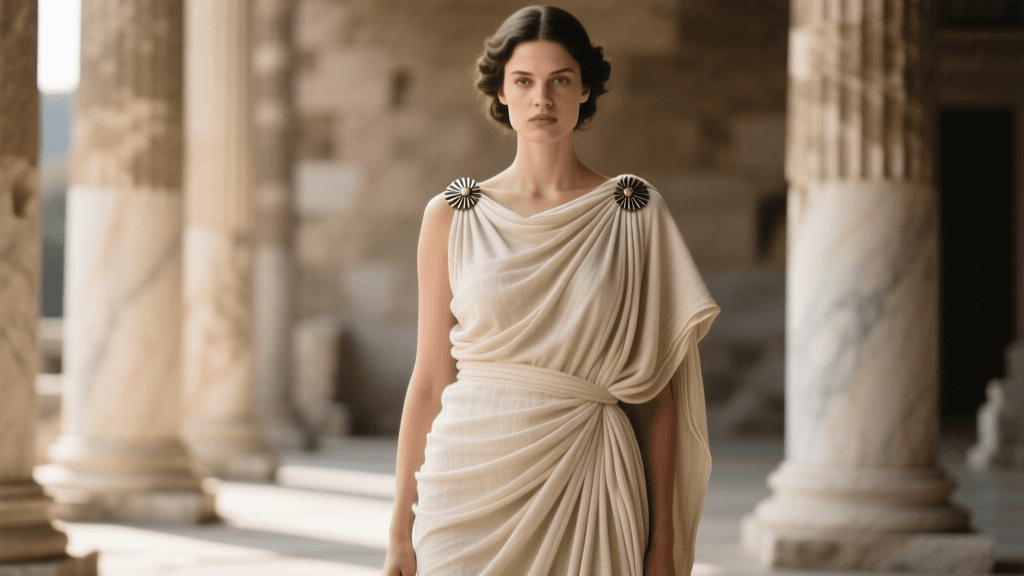
The chiton was the foundational tunic of ancient Greece. The Metropolitan Museum of Art notes that the Doric chiton was traditionally simpler, often made of heavier wool or linen, and pinned at the shoulders with a single fibula. The Ionic chiton, by contrast, featured multiple pins or sewn seams along the upper arm, creating a delicate, sleeve-like effect, and was almost exclusively made of lightweight linen.
Calculating Your Measurements
To draft a historically accurate chiton, you must abandon modern tailored patterns. The garment is entirely draped from a single rectangular piece of cloth. Use the following formulas for your 2026 commission or DIY project:
- Width: Measure your wingspan (fingertip to fingertip with arms outstretched) and add 12 inches. This allows for the necessary volume and the side overlap.
- Height: Measure from the top of your shoulder down to your ankle bone, then add 15 to 18 inches. This extra length is crucial for creating the apoptygma (the overfold) and the kolpos (the bloused section above the belt).
Step-by-Step Draping: The Ionic Chiton
- The Overfold: Fold the top edge of the fabric down by 12 to 15 inches. This creates the apoptygma. Pin this fold at the top corners to secure it temporarily.
- Shoulder Pinning: Drape the fabric around your body. Bring the front and back top corners together at your outer shoulders. Secure them with a pair of bronze or silver fibulae. For the Ionic style, continue pinning or lightly stitching the front and back layers together at 3-inch intervals along the upper arm, stopping before the elbow.
- Belt and Blousing: Wrap a woven wool or leather cord belt around your natural waist. Pull the fabric up and over the belt to create the kolpos, allowing the overfold to cascade over the belt. Adjust the blousing until it hangs evenly around your hips.
The Roman Stola: Symbol of the Matron
While the Greek chiton influenced Roman dress, the Roman Empire developed its own distinct garments. For freeborn, married Roman women, the stola was the ultimate symbol of modesty and social standing. As detailed by the World History Encyclopedia's section on Roman Clothing, the stola was worn over a base layer tunica and was characterized by its length, its voluminous drape, and the distinctive instita (a decorative woven border) at the hem.
Constructing the Stola
Unlike the entirely draped Greek chiton, the Roman stola often featured sewn side seams and shoulder straps, though early Republican versions were still pinned. For a 2026 reenactment, sewing the side seams from the waist down provides a more stable garment for active festival environments.
- Base Layer: Always wear a simple, knee-length linen tunica underneath. The stola is meant to be layered.
- The Straps: Instead of pinning the fabric directly at the shoulder, the stola often utilized sewn fabric straps or a knotted cord system to hold the garment up, allowing the neckline to drape in a wide, modest scoop.
- The Instita: To signify patrician or wealthy plebeian status, attach a 2-inch wide band of contrasting fabric (such as a Tyrian purple dyed linen or a gold-threaded trim) to the bottom hem. In 2026, natural madder root or weld dyes are highly sought after for these borders to maintain historical color accuracy.
Garment Comparison Chart
Understanding the nuances between these classical garments is vital for accurate historical portrayal. Use the table below to determine which garment best fits your specific reenactment persona.
| Feature | Doric Chiton | Ionic Chiton | Roman Stola |
|---|---|---|---|
| Primary Fabric | Heavy Linen or Wool | Lightweight Linen | Medium Linen or Silk |
| Fasteners | Single large fibula per shoulder | Multiple small pins or sewn seams | Sewn straps or knotted cords |
| Construction | Completely draped, open side | Draped, often sewn at side seams | Sewn side seams, layered over tunica |
| Distinctive Trim | None (relied on drape and dye) | None | Instita (woven border at hem) |
| Social Signifier | Standard citizen dress (Greece) | Standard citizen dress (Greece) | Married, freeborn Roman women |
Essential Accessories and Footwear
No classical ensemble is complete without the proper accessories. In 2026, the reenactment community has moved away from mass-produced brass castings, favoring hand-forged bronze and ironwork.
- Fibulae (Brooches): For the Doric chiton, invest in a hand-forged bronze omega or penannular brooch. Ensure the pin is thick enough (at least 2mm) to support the weight of medium-weight linen without bending.
- The Himation and Palla: In cooler weather or for added modesty, drape a himation (Greek) or palla (Roman) over the chiton or stola. This is a large rectangular cloak, usually 4 yards by 2 yards, draped over the left shoulder and wrapped around the body.
- Footwear: Avoid modern gladiator sandals that wrap up the calf. Authentic krepides (Greek) or soleae (Roman) consist of a thick leather sole with simple leather thongs laced across the instep and around the ankle. Many bespoke leatherworkers in the European heritage community now offer custom-molded soleae that provide the arch support needed for walking on cobblestone festival grounds.
2026 Fabric Care and Maintenance
Maintaining the crisp, elegant drape of your linen requires specific care. After a long weekend at a heritage festival, hand-wash your chiton or stola in cool water with a pH-neutral detergent. Never wring the fabric; instead, roll it in a clean towel to press out excess water. Hang the garment to dry in the shade—direct sunlight can prematurely fade natural plant dyes like woad or madder. Once slightly damp, iron the linen on a high-heat setting with heavy steam. This process realigns the flax fibers, ensuring that the next time you drape your garment, the folds will fall in sharp, statuesque lines reminiscent of the Parthenon friezes.
Conclusion
The transition from modern clothing to ancient Mediterranean dress is an exercise in geometry, textile appreciation, and historical empathy. By sourcing the correct weight of European linen, calculating your measurements based on the wingspan rather than modern sizing, and mastering the art of the fibula and belt, you elevate your historical portrayal from a simple costume to a living piece of European folk heritage. As the 2026 festival season unfolds, let your chiton and stola speak to the enduring elegance of the classical world.