Authentic Viking Smokkr and Kyrtill Garment Guide 2026
The 2026 Standard for Norse Historical Garments
The landscape of historical European folk dress has undergone a massive transformation over the last decade. As we move through 2026, the global historical reenactment community and contemporary folk fashion enthusiasts have largely abandoned the inaccurate, leather-clad stereotypes of the past. Today, the focus is squarely on archaeological precision, sustainable textile production, and authentic construction techniques. According to the Metropolitan Museum of Art's Heilbrunn Timeline of Art History, the Norse people were sophisticated traders and artisans whose textiles rivaled the best in Europe. In 2026, major European heritage festivals, such as the Moesgård Viking Moot, have implemented strict authenticity guidelines that ban synthetic dyes and machine-stitched visible seams in premium camping areas, pushing artisans to master traditional Norse tailoring.
This comprehensive guide will walk you through the construction of the two most iconic garments of the Viking Age: the Smokkr (apron dress) and the Kyrtill (tunic). We will explore historically accurate fabric choices, loom-width pattern drafting, and the modern revival of natural dyeing techniques that comply with 2026 environmental standards.
Deconstructing the Smokkr (Apron Dress)
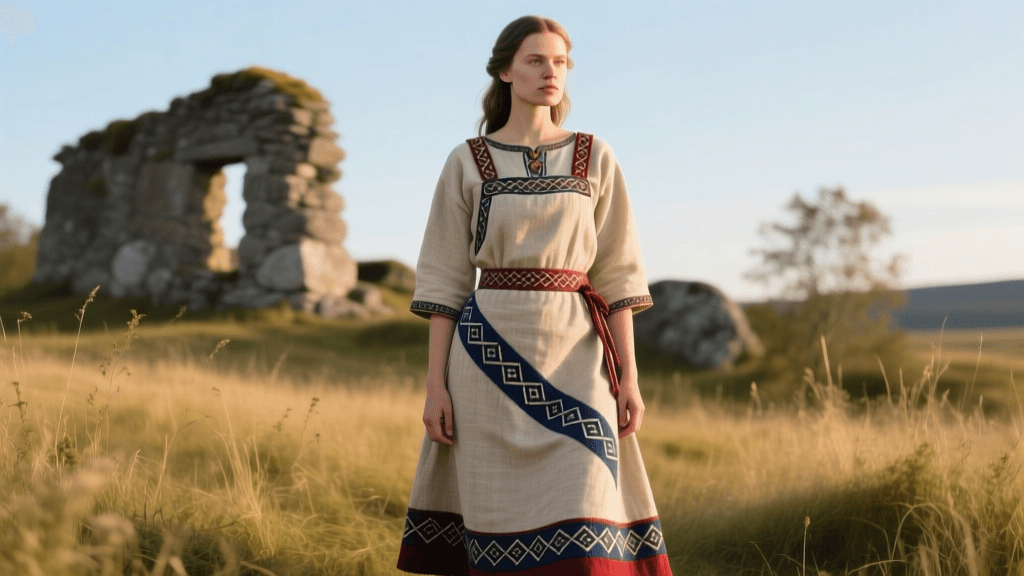
The Smokkr is arguably the most recognizable garment in the Norse female wardrobe. Worn over a linen underdress (serk), the Smokkr was a sleeveless, tube-like or wrapped garment suspended from the shoulders by a pair of oval brooches, often colloquially called tortoise brooches. The National Museum of Denmark notes that textile fragments found in graves across Scandinavia reveal a complex layering of wool, linen, and silk, indicating a highly stratified society where clothing communicated wealth and status.
The Tubular vs. Rectangular Wrap Debate
For years, reenactors debated whether the Smokkr was a closed tube or an open rectangular wrap. The 2026 consensus, heavily influenced by the Hedeby harbor finds and the Køge burial analysis, leans toward a tailored, closed tubular design for high-status women, utilizing gores to create a flared hem. To draft a historically accurate tubular Smokkr, you must respect the constraints of the historical warp-weighted loom. Fabric was typically woven in narrow widths, usually between 60 and 80 centimeters. Therefore, a modern maker should avoid cutting large, sweeping circles from wide commercial fabric. Instead, construct the dress using two rectangular front and back panels (approx. 65 cm wide) joined at the sides, with triangular gores inserted to allow for walking and movement.
Securing the Garment: Oval Brooches and Strap Loops
The structural integrity of the Smokkr relies entirely on the strap loops and the oval brooches. In 2026, master bronze casters produce highly accurate replicas of the P51 and P37 brooch types. However, pinning heavy bronze directly into handwoven wool will tear the fabric. The historically accurate solution is to sew a small, reinforced patch of linen on the inside of the dress at the strap attachment points. The wool strap loops themselves should be made of folded, whip-stitched fabric tubes rather than modern ribbon, ensuring they can bear the weight of the brooches and any suspended tools, such as weaving tablets or keys.
Tailoring the Kyrtill (Tunic)
The Kyrtill was the foundational outer garment for Norse men, and a longer variant was worn by women. It was typically pulled over the head and featured a keyhole or slit neckline, often fastened with a small bone or bronze bead. As detailed in Encyclopedia Britannica's comprehensive guide on Viking culture, the tunic was a versatile garment, adapted for both the harsh Nordic winters and the maritime expeditions of the era.
Pattern Drafting and Loom Width Constraints
Just like the Smokkr, the Kyrtill must be drafted with historical loom widths in mind. The most accurate method for cutting a Kyrtill in 2026 involves using the full width of the narrow fabric for the main body panels, avoiding shoulder seams entirely. The garment is essentially a large rectangle folded over the shoulders, with a slit cut for the neck. This zero-waste approach to pattern cutting is not only historically accurate but aligns perfectly with the sustainable fashion movements dominating the 2026 textile industry.
Gores, Gussets, and Mobility
To allow for the physical demands of Norse life—whether rowing a longship or working the fields—gussets and gores were essential. Underarm gussets (square or diamond-shaped pieces of fabric) provide crucial mobility for the arms, preventing the shoulder seams from ripping. Side gores, starting from the waist or the hip, flare the hem of the tunic. When sewing these panels, historical accuracy demands the use of flat-felled seams or overcast edges, finished with a fine wool or linen thread. Machine top-stitching is strictly avoided in high-level reenactment circles today.
The Art of Tablet Weaving and Trim
No Viking garment is complete without intricate trim. Tablet weaving (or card weaving) was the premier method for creating strong, decorative bands used to edge necklines, cuffs, and hems. The Oseberg ship burial yielded some of the most spectacular examples of brocaded tablet weaving, utilizing silk and metallic threads. In 2026, the availability of high-quality, historically spun silk and fine wool yarns has made it easier than ever for artisans to recreate these complex geometric and animal-motif patterns. When applying tablet-woven bands to a Kyrtill, the band should be hand-sewn using a blind stitch so that the attachment thread is invisible on the exterior of the garment.
Natural Dyeing: Woad and Madder in the Modern Era
The vibrant colors of the Viking Age were achieved through complex natural dyeing processes. Woad (Isatis tinctoria) provided rich blues, while Madder (Rubia tinctorum) yielded deep reds and oranges. In 2026, strict European environmental regulations regarding textile wastewater have forced modern dyers to abandon heavy metal mordants like chrome and tin. Instead, the contemporary historical dyeing community relies on eco-friendly mordants such as aluminum potassium sulfate (alum) combined with tannins extracted from oak galls. This 2026-standard mordanting process not only protects local waterways but also produces colors that are remarkably lightfast and identical to those found in museum-preserved textile fragments.
2026 Material Sourcing and Cost Comparison
Sourcing historically accurate textiles remains the most significant hurdle for modern makers. The market in 2026 offers a spectrum of choices, from artisanal handwoven wools to commercial approximations. Below is a comparative guide to help you budget and select the right materials for your Smokkr and Kyrtill.
| Material Type | Weave Structure | Approx. Cost per Meter (2026) | Historical Accuracy Rating |
|---|---|---|---|
| Artisanal Handwoven Wool | 2/2 Diamond Twill | €95 - €140 | 100% (Museum Quality) |
| Machine-Woven Heritage Wool | 2/2 Herringbone / Twill | €45 - €65 | 85% (Excellent for Reenactment) |
| Unbleached Plain Weave Linen | 1/1 Plain Weave | €25 - €35 | 95% (Ideal for Serk/Undergarments) |
| Commercial Wool Blend | Plain / Unspecified Twill | €15 - €25 | 20% (Not recommended for strict accuracy) |
When purchasing diamond twill, always verify the thread count. Historical Viking textiles often featured a high thread count in the warp and a lower count in the weft, creating a distinct ribbed texture that modern commercial mills frequently fail to replicate. Seeking out specialized weavers in the Baltic states or Iceland remains the best strategy for acquiring true museum-grade diamond twill in 2026.
Final Thoughts on Authenticity
Constructing a historically accurate Viking Smokkr and Kyrtill is a deeply rewarding endeavor that connects the modern maker to the sophisticated textile traditions of the Norse people. By respecting historical loom widths, utilizing zero-waste pattern drafting, mastering flat-felled seams, and embracing eco-friendly natural dyes, you can create garments that are not only beautiful but deeply rooted in archaeological truth. As the standards for historical accuracy continue to rise in 2026, the dedication to these traditional techniques ensures that the true legacy of European folk dress is preserved for future generations.