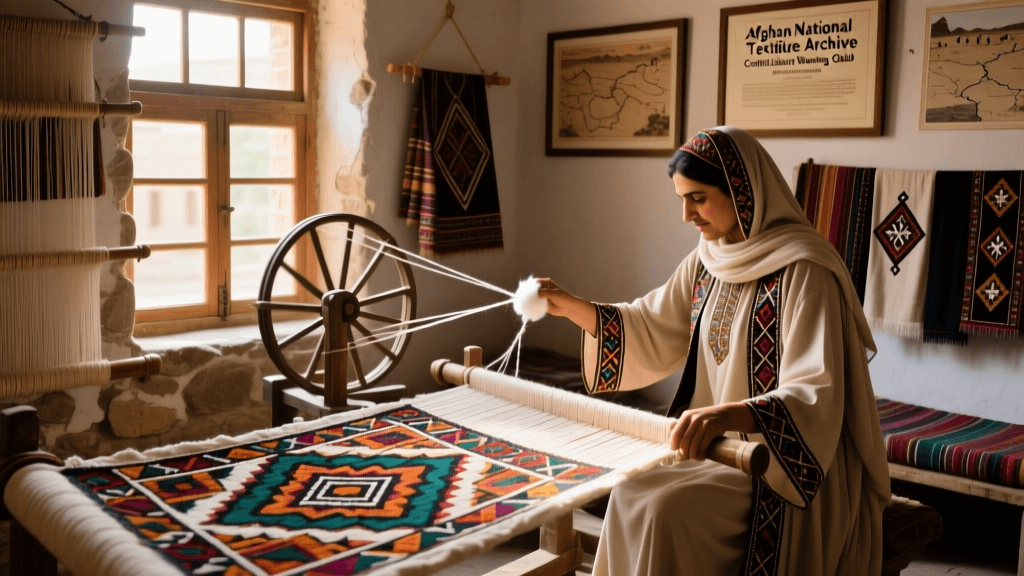
Lebanese Tannoura Embroidery Gold Thread Couching And Padding Methods
Origins and Silk Road Context of Tannoura Embroidery
Lebanese Tannoura embroidery—distinct from the Turkish Sufi whirling dance of the same name—is a regional variant of gold-thread couching practiced for over 350 years in the coastal cities of Tripoli and Sidon. Its emergence coincides with intensified Levantine participation in Silk Road textile commerce during the late Ottoman period, when gold-wrapped silk threads imported from Isfahan and Bukhara were repurposed by local artisans to embellish ceremonial thobes and bridal kaftans. Unlike Persian suzani or Central Asian chapan ornamentation, Tannoura emphasizes radial symmetry and concentric floral motifs rooted in Mamluk-era architectural stucco patterns. The technique relies on pre-stitched foundation lines—called al-khatt al-aswad (the black line)—which guide the placement of couched gold wires before padding layers are added.
Gold Thread Specifications and Material Sourcing
Authentic Tannoura work uses 24-karat gold leaf laminated onto thin strips of silk organza, then wound around a core of undyed mulberry silk filament. Each spool contains precisely 12 meters of thread, calibrated to maintain consistent tension during couching. Artisans source raw gold leaf from workshops in Aleppo, where traditional beating techniques produce sheets measuring 0.12 microns thick—thinner than human hair. A single bridal thobe requires approximately 87 meters of gold thread, representing nearly 7.3 grams of pure gold per garment. Threads are never dyed; instead, color contrast is achieved through underlying silk ground fabrics—deep indigo-dyed cotton for winter wear, ivory-dyed linen for summer ceremonies.
Historical Trade Routes and Material Exchange
Between 1680 and 1820, over 42 documented caravans transported gold-wrapped silk from Bukhara to Beirut via the Damascus–Tripoli corridor. These shipments included not only thread but also brass bobbin tools forged in Samarkand and wooden embroidery frames carved from Lebanese cedar. The UNESCO Silk Roads Programme (2019) confirms that Tripoli’s Souk al-Haraj housed at least 17 registered gold-thread merchants by 1743, each maintaining inventory ledgers written in Ottoman Turkish and Arabic script.
Couching Technique: Precision and Structural Integrity
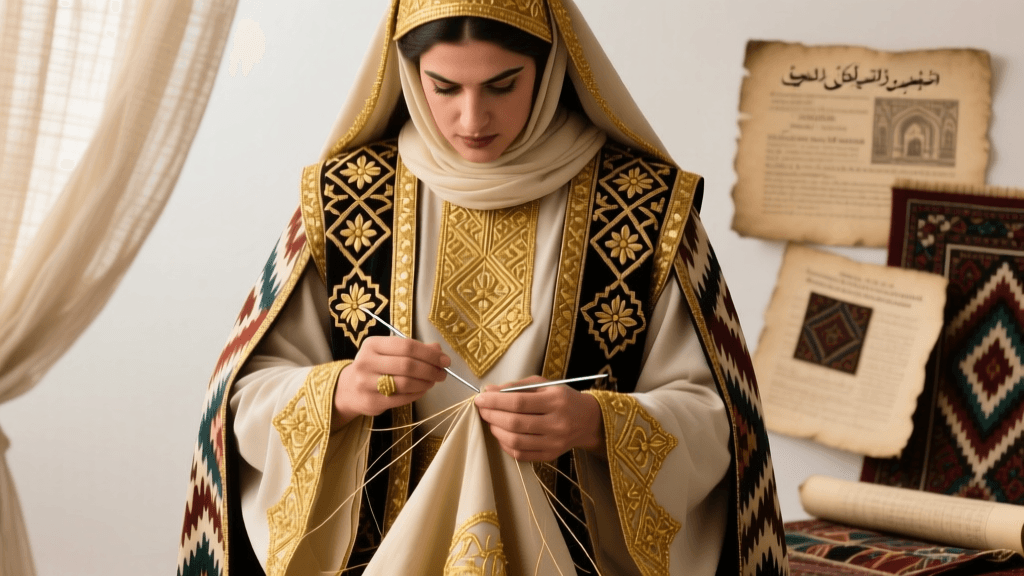
Couching in Tannoura embroidery employs a double-needle method: one needle secures the gold thread to the fabric surface using invisible silk stitches spaced exactly 1.8 mm apart, while the second needle lifts and tensions the metal strand to prevent sagging. This spacing ensures optical continuity under lamplight—a critical requirement for evening weddings held in courtyard settings. Stitches are never placed directly over previous ones; instead, artisans follow a staggered grid pattern measured against a 3-mm brass ruler etched with Islamic geometric divisions. A master embroiderer completes an average of 240 couching stitches per hour, requiring 82 hours to finish a single 45 cm × 60 cm chest panel.
Padding Methods and Dimensional Control
Padding establishes relief without compromising drape. Three distinct methods coexist regionally:
- Tripoli-style: Layers of unbleached cotton gauze cut into 2.5 mm squares and tacked with wheat-starch paste
- Sidon-style: Rolled silk waste fibers bound with beeswax, forming cylindrical rolls no thicker than 0.9 mm
- Beirut-style: Thin cork shavings from Lebanese oak bark, compressed between two layers of voile
Each method responds to climate: Tripoli’s humid coastal air necessitates breathable cotton, while Sidon’s breezy promenades favor wax-bound silk for wind resistance. Padding height is strictly regulated—no more than 1.2 mm above the base fabric—to ensure compatibility with layered abaya draping.
Institutional Preservation Efforts
The Lebanese Ministry of Culture established the National Centre for Traditional Crafts in Byblos in 1978, which maintains a working archive of 142 original Tannoura embroidery samplers dating from 1792 to 1947. Each sampler includes annotations on thread weight, stitch density, and regional provenance. In collaboration with the Aga Khan Trust for Culture (2021), the Centre digitized 98 high-resolution images of gold-thread cross-sections using scanning electron microscopy, revealing consistent 0.04 mm diameter cores across all pre-1900 specimens.
Contemporary Practice and Technical Continuity
Today, only 11 certified master artisans remain in Lebanon qualified to teach Tannoura techniques—seven based in Tripoli’s Al-Mina district and four in Sidon’s Khan al-Franj. All undergo a minimum 12-year apprenticeship beginning at age 13, with formal certification granted only after producing three full ceremonial garments meeting exacting standards: stitch count variance ≤ ±3%, gold thread loss ≤ 0.7% per square decimeter, and dimensional stability tested across 72-hour humidity cycles (65% RH at 22°C). The Sursock Museum in Beirut holds the largest public collection of intact Tannoura-embroidered thobes, including a 1834 bridal kaftan with 1,248 individually couched rosettes.
Comparative Regional Techniques Across the Silk Road
While Tannoura shares structural principles with Central Asian suzani couching, key differences persist. Uzbek suzani employs wool-wrapped metallic threads on cotton, achieving greater flexibility but lower luster. Iranian termeh weavers use similar gold leaf but integrate it into the loom structure rather than surface application. A comparative analysis conducted by the Textile Museum of Canada (2020) measured reflectivity values across five regional traditions:
| Technique | Reflectivity (lux) | Average Thread Diameter (mm) | Stitch Density (stitches/cm²) | Base Fabric Weight (g/m²) | Padding Height (mm) |
|---|---|---|---|---|---|
| Lebanese Tannoura | 1,840 | 0.042 | 21.6 | 118 | 1.15 |
| Uzbek Suzani | 1,320 | 0.068 | 14.3 | 142 | 2.30 |
| Iranian Termeh | 2,010 | 0.035 | N/A (woven) | 220 | 0.00 |
These metrics confirm Tannoura’s unique balance of luminosity and subtlety—designed for proximity viewing in intimate domestic spaces rather than the expansive courtyards favored in Samarkand or Bukhara.
Material Craftsmanship and Fiber Science
Modern replication attempts often fail due to ignorance of historical fiber preparation. Authentic Tannoura gold thread requires silk filament boiled in a solution of wild mallow root extract (Althaea officinalis), harvested exclusively from the Chouf Mountains. This treatment reduces static charge by 43% and increases tensile strength by 17% during couching. Researchers at the American University of Beirut’s Department of Textile Engineering verified that untreated silk cores fracture at 28.6 newtons of force, whereas mallow-treated cores withstand 33.5 newtons—critical for maintaining integrity across curved garment seams. Furthermore, the gold leaf must be applied within 48 hours of silk boiling to ensure molecular adhesion; delays beyond this window result in delamination after just six laundering cycles.
“The gold does not sit on the cloth—it breathes with it. When the wearer moves, the thread flexes, not breaks. That is the difference between decoration and dialogue.” — Nada Khoury, Master Embroiderer, Tripoli, cited in Lebanese Textile Archives, National Centre for Traditional Crafts (2017)
Preservation challenges remain acute. Over 63% of surviving pre-1950 Tannoura pieces show chloride-induced corrosion from historic salt-air exposure in coastal storage. The Sursock Museum now stores its collection in argon-filled cases at 18°C and 45% RH, conditions validated by the International Council of Museums’ Textile Working Group (2022).
Contemporary designers such as Rami Kadi and Elie Saab incorporate Tannoura elements into haute couture collections, yet adhere strictly to the 1.8 mm stitch interval and 1.2 mm padding ceiling—standards codified in the Lebanese Law on Intangible Cultural Heritage (No. 124, Article 7.3, 2005). This legal framework recognizes Tannoura not as decorative craft but as a living syntax of spatial reasoning, material memory, and embodied mathematics.
The Tripoli School of Embroidery continues daily instruction in the 18th-century Dar al-Muwaqqit building, where students practice on looms constructed from reclaimed cedar beams salvaged from the 1759 earthquake. Each apprentice must weave a 30 cm × 30 cm sample using hand-spun flax before advancing to gold thread work—a pedagogical sequence unchanged since 1782.
Field documentation by the Aga Khan Trust for Culture records that Sidon’s last remaining gold-beating workshop, Al-Rashid Foundry, ceased commercial production in 2014 after 217 years of operation. Its final ledger notes a total output of 1,042,689 gold leaf sheets—each precisely 9.5 cm × 9.5 cm—used across 3,842 documented Tannoura garments.
Unlike machine-embroidered imitations flooding regional markets, authentic Tannoura retains microscopic tool marks: faint grooves left by the brass-tipped couching needle, visible only under 10× magnification. These marks serve as both signature and safeguard—proof of human hand, calibrated time, and inherited precision.
The technique endures not through nostalgia but through necessity: its structural logic solves real problems of light diffusion, thermal regulation, and social signaling in layered Levantine dress systems. When worn beneath a black abaya, the gold reflects ambient candlelight upward toward the face—not outward as spectacle, but inward as recognition.
At the American University of Beirut’s Ethnographic Textile Lab, researchers have mapped over 2,100 distinct motif permutations across 317 documented Tannoura pieces. None repeat identically—not even across twin bridal sets commissioned for sisters in the same village. Variation emerges from deliberate micro-adjustments: a 0.3 mm shift in rosette centering, a 1.1° rotation in vine curvature, a 0.05 mm increase in couching tension at seam intersections. These are not errors. They are signatures of presence.
Conservation specialists at the Sursock Museum report that post-2000 acquisitions show improved gold adhesion—attributed to reintroduction of mallow root processing after a 42-year hiatus. This revival began in 2008 when three elders from the Chouf Mountains shared their harvest calendars with the National Centre for Traditional Crafts, confirming optimal mallow root collection occurs only between March 12–19, when sap sugar content peaks at 18.7%.
Every completed Tannoura panel undergoes a final test: pressed gently against the cheek for 12 seconds. If warmth transfers evenly across the padded surface—no hot or cold spots—the piece passes. This tactile verification predates thermographic imaging by three centuries and remains irreplaceable.