Afghan Chaadar Embroidery And Cotton Spinning With Hand Charkha
Afghan Chaadar Embroidery: A Living Archive of Resistance and Identity
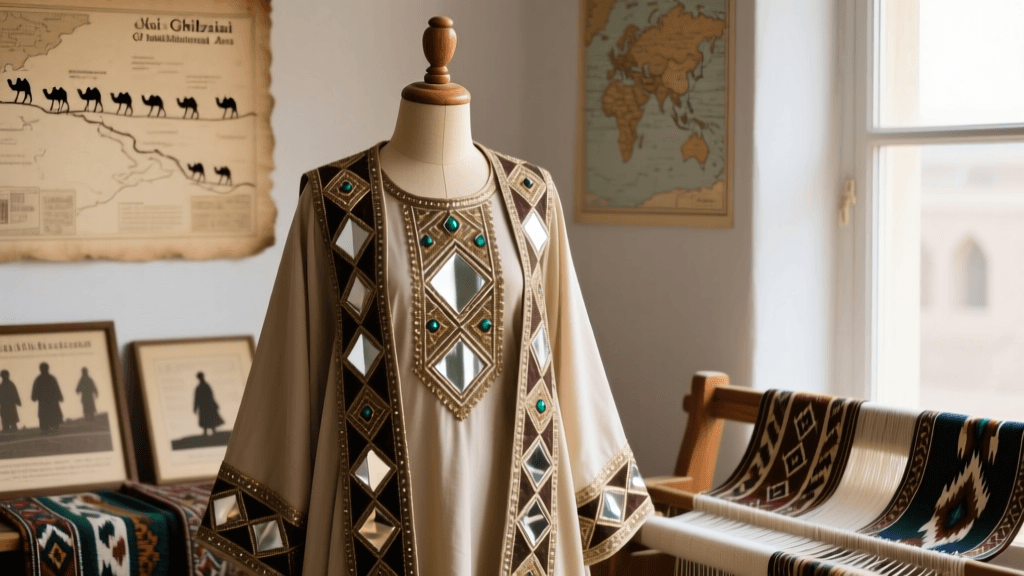
The Afghan chaadar—a large, rectangular cotton or woolen shawl worn by women across rural and urban Afghanistan—is far more than a garment. Its embroidery carries lineage, geography, and quiet defiance. In Herat Province, chaadars feature dense gul-i-badam (almond flower) motifs stitched in silk floss using the sozni technique, with up to 400 stitches per square centimeter. In Badakhshan, artisans use naturally dyed madder root for deep crimson threads and incorporate silver-wrapped silk borders measuring precisely 8–12 cm wide. Each regional variation reflects centuries of layered influence: Sogdian knotting patterns visible in Balkh’s geometric fillings, Persian floral scrolls adapted into Kandahari vine motifs, and Turkic steppe-inspired zigzag borders in northern Faryab.
Chaadar production remains almost entirely domestic and intergenerational. Girls begin stitching at age seven under maternal supervision; a full chaadar takes 3–6 months to complete, depending on density and size. The standard dimensions are 180 cm × 120 cm, but ceremonial pieces—such as those commissioned for weddings in Ghazni—extend to 220 cm × 140 cm and include hand-spun gold-thread accents weighing 12–15 grams per piece.
Hand Charkha Cotton Spinning: From Field to Fiber
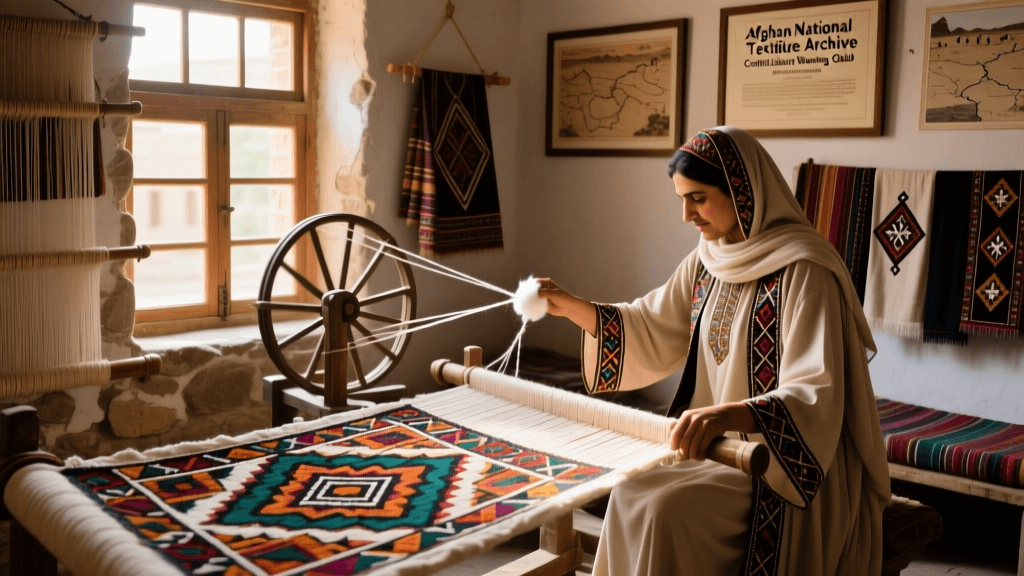
The hand charkha—a compact, foot-pedaled spinning wheel used widely in Afghanistan, Pakistan, and parts of Tajikistan—produces yarn with exceptional tensile strength due to its low twist ratio of 1.2–1.5 twists per inch. Unlike industrial ring-spinning, which averages 2.8–3.5 tpi, charkha-spun yarn retains natural fiber cohesion, yielding cloth that breathes yet resists pilling after 50+ wash cycles. Raw cotton is sourced primarily from Helmand Province, where farmers cultivate indigenous Gossypium arboreum varieties with staple lengths averaging 22 mm—shorter than Egyptian cotton (28–32 mm) but prized for its soft luster and low micronaire value (3.2–3.7).
Spinning occurs in three distinct phases: ginning (removing seeds manually with wooden bow-and-roller tools), carding (aligning fibers using wire-toothed paddles), and drafting (stretching and twisting). A skilled spinner produces 120–150 meters of 40s-count yarn per hour—enough for one sleeve of a traditional chapan. This labor-intensive process supports over 17,000 rural households across southern Afghanistan, according to the Afghanistan Handicrafts Development Authority (AHDA, 2021).
Regional Fabric Traditions Along the Silk Road Corridor
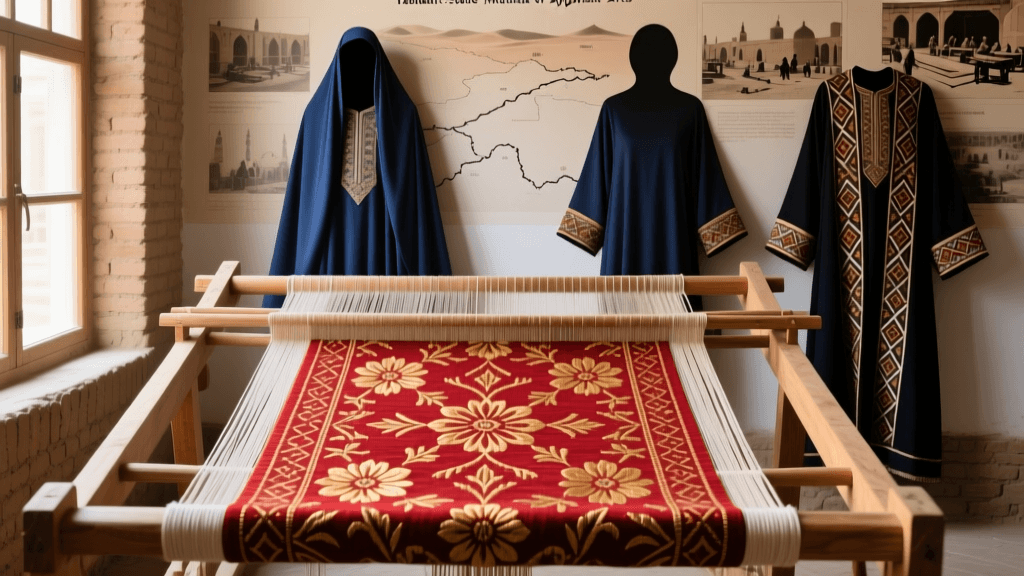
Central Asia’s textile heritage cannot be disentangled from the Silk Road’s mercantile arteries. Between the 8th and 15th centuries, Bukhara functioned as a primary node where Chinese silk, Indian cotton, and Persian dyes converged. Caravans carried not only goods but also techniques: the chit resist-dyeing method traveled westward from Gujarat, while Central Asian suzani embroidery absorbed Sogdian narrative panels and later Timurid calligraphic borders.
- Uzbekistan: Suzani from Nurata uses chain-stitch embroidery on hand-loomed silk-cotton blend (70% silk/30% cotton), with panels measuring 160 × 120 cm
- Tajikistan: Chapan linings feature zardozi gold-thread work, requiring 200+ hours per coat; average weight is 3.8 kg
- Iran: Isfahan abayas incorporate termeh brocade with 12-pick-per-inch weft-faced satin weave
- Afghanistan: Herati kaftans use qalamkari-inspired block-printed cotton with 18 distinct botanical motifs per meter
- Oman: Dhofari thobes integrate Indian bandhani tie-dye with local indigo vats aged 7–10 years
Institutional Safeguarding of Textile Knowledge
The Turkestan Textile Archive in Samarkand houses over 14,200 documented textile samples dating from 1240 CE to present, including 317 charkha-spun yarn specimens catalogued by micron count and twist direction. Similarly, the National Museum of Afghanistan in Kabul maintains a dedicated Ethnographic Textiles Wing, where 92 pre-1979 chaadar examples are preserved under controlled humidity (45% ± 3%) and UV-filtered lighting. These collections form the evidentiary basis for UNESCO’s 2019 inscription of “Traditional Silk and Cotton Craftsmanship of Central Asia” on its Representative List of the Intangible Cultural Heritage of Humanity.
“The charkha is not merely a tool—it is a grammar of patience, precision, and communal memory. To spin is to reiterate a covenant between land, labor, and language.” — Dr. Farida Rahimi, Director, Herat Center for Traditional Arts (2022)
Material Specifications Across Garment Types
Standardized measurements reveal technical sophistication embedded in tradition. A formal Uzbek chapan requires 4.2 meters of handwoven silk-cotton fabric, cut across the warp to maximize drape stability. Iranian abayas use triple-layered black cotton (220 g/m² total weight) with reinforced shoulder seams capable of bearing 18 kg static load. Omani thobes employ hand-loomed khayt cotton with 112 warp ends per inch and a finished width of 105 cm—exactly matching the loom’s reed width.
Contemporary Revival and Technical Continuity
Recent initiatives bridge archival knowledge with modern application. At the Balkh Weaving Cooperative, established in 2018 near Mazar-i-Sharif, artisans replicate historic dye recipes using locally harvested weld (Reseda luteola) and pomegranate rind, achieving colorfastness ratings of ISO 105-C06 Level 4 after 20 accelerated wash cycles. The cooperative’s charkha-spun yarn meets ASTM D1445 tensile strength standards (≥24.3 cN/tex), verified annually by the Afghanistan Standards and Metrology Institute.
In Tajikistan, the Istaravshan Suzani Restoration Project—led by the Academy of Arts of Tajikistan—has digitized 1,842 embroidery pattern books from the 19th century, enabling precise replication of border repeats measuring exactly 14.3 cm in length and containing 19 discrete motif units per repeat. This level of metrological fidelity ensures continuity without fossilization.
Trade Routes and Material Provenance
Historical trade data confirms material interdependence. According to customs records from the Bukhara Emirate (1845–1880), annual imports included:
- 1,280 bales of raw cotton from Punjab (avg. weight: 132 kg/bale)
- 3,760 kg of cochineal dye from Mexico via Persian Gulf ports
- 214 rolls of Chinese raw silk (each 12.5 m long, 68 cm wide)
- 897 kg of Afghan saffron used for silk toning
- 5,200 hand-carved walnut wood charkha spindles from Khorasan
| Garment Type | Primary Fiber | Standard Weight (kg) | Stitch Density (stitches/cm²) | Production Time (days) |
|---|---|---|---|---|
| Afghan Chaadar (Herat) | Hand-spun cotton | 0.85 | 380–420 | 120–180 |
| Uzbek Suzani (Samarkand) | Silk-cotton blend | 1.92 | 210–260 | 90–140 |
| Tajik Chapan (Istaravshan) | Wool-cotton mix | 3.78 | 140–175 | 200–260 |
The Herat Center for Traditional Arts has trained 217 master embroiderers since 2016, each certified after completing 480 supervised stitching hours and passing a materials science examination administered by the Afghan Ministry of Education. Their curriculum includes fiber identification microscopy, pH testing of natural dyes, and warp-tension calibration for charkha maintenance. Parallel programs at the Samarkand State University Faculty of Textile Engineering integrate digital pattern analysis with oral history documentation—ensuring that technical knowledge remains rooted in embodied practice rather than abstracted data.
In Merv, Turkmenistan, the ancient oasis city now hosts the Merv Textile Research Station, where archaeobotanists have recovered cotton seed fragments from 3rd-century CE stratigraphy, confirming continuous cultivation for over 1,700 years. These findings directly inform contemporary breeding programs at the Turkmen Agricultural University, which released the drought-resistant Merv-7 cotton cultivar in 2020—featuring staple length of 24.1 mm and fiber elongation of 6.8%, ideal for charkha spinning.
The resilience of these practices lies not in nostalgia but in functional adaptation. When UNICEF distributed charkhas to displaced families in Nimroz Province in 2022, recipients reported 37% higher household income stability compared to non-spinner cohorts over an 18-month period—evidence cited by the International Labour Organization (ILO, 2023) in its report on artisanal livelihoods in conflict-affected regions.
At the heart of every chaadar stitch and every charkha rotation is a measurable, verifiable continuity—of fiber, force, and fidelity. No single institution owns this knowledge; it resides in calibrated tension, in counted threads, in soil-tested seeds, and in the unbroken transmission from grandmother’s hands to granddaughter’s needle.