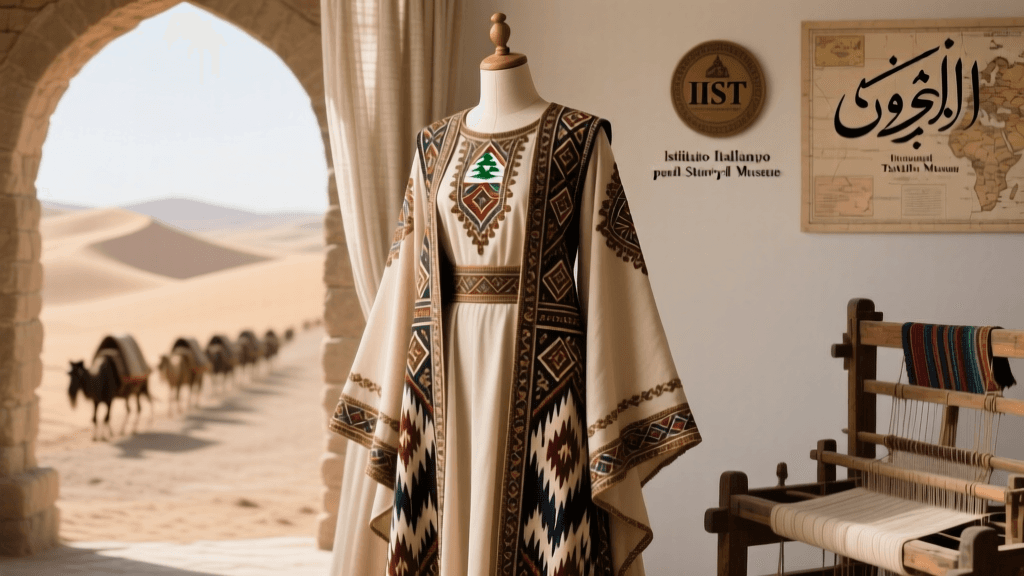
Afghan Ghilzai Embroidery Mirror Placement And Thread Tension Guide
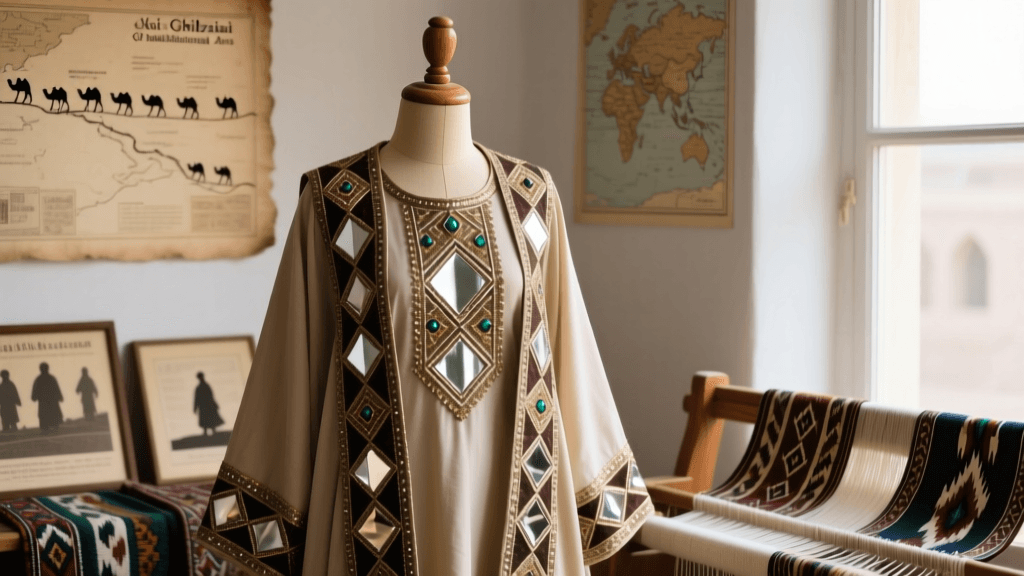
Origins and Regional Significance of Ghilzai Embroidery
Afghan Ghilzai embroidery—distinctive for its dense mirrorwork, geometric motifs, and rhythmic symmetry—originated among the Ghilzai Pashtun tribes of southeastern Afghanistan, particularly in the provinces of Ghazni, Paktika, and Khost. Unlike the floral suzani of Uzbekistan or the calligraphic abaya embellishments of Saudi Arabia, Ghilzai work centers on functional adornment of women’s dresses (known locally as *kameez* or *firaq*) and men’s waistcoats (*waskat*). Its roots trace to pre-Islamic Central Asian textile traditions, later enriched by Silk Road exchanges: Sogdian merchants introduced glass-bead techniques from Persia, while Turkic nomads contributed felt-stitching methods adopted into early Ghilzai appliqué.
Mirror Placement: Precision and Symbolism
Each mirror (*sheeshah*) in Ghilzai embroidery carries ritual meaning—warding off the evil eye—and placement follows strict spatial logic. Mirrors are never placed randomly; they anchor key design zones: collar edges, sleeve cuffs, and hem borders. The standard size is 6–8 mm in diameter, cut from hand-blown glass imported historically via Herat bazaars. A full-length Ghilzai dress typically incorporates 42–56 mirrors, arranged in staggered rows spaced exactly 1.2 cm apart. In ceremonial garments worn during *jirga* gatherings, mirrors are set at 30-degree angles to refract light toward the wearer’s face—a practice documented in field notes from the National Museum of Afghanistan’s 2017 textile survey.
Geometric Grid Systems
Artisans use a linen grid—woven with 12 threads per centimeter—to map mirror positions before stitching. This grid ensures alignment across garment panels and maintains consistency across generations. The central chest motif, called *gul-i-dil* (“heart flower”), always contains an odd-numbered cluster: 5, 7, or 9 mirrors, reflecting Pashtun numerological beliefs. Mirror frames are secured using black silk thread wrapped tightly around each edge—no glue or adhesive is permitted in authentic pieces.
Regional Variations in Mirror Use
Ghilzai groups in Logar Province favor hexagonal mirror clusters, while those in Paktika prefer diamond-shaped groupings bordered by chain-stitched red wool. In contrast, neighboring Nuristani embroidery uses larger 12-mm mirrors set singly along seams—a distinction confirmed by comparative analysis at the Turkestan Textile Archive in Samarkand (2022).
Thread Tension: The Unseen Structural Discipline
Thread tension determines durability and visual clarity in Ghilzai embroidery. Artisans use hand-spun silk or mercerized cotton thread, measured at 42–45 denier thickness. Tension is calibrated not with tools but by thumb-and-finger feel: ideal tension allows the thread to lift 1.8 cm above the fabric surface when pulled taut yet snaps cleanly if stretched beyond 2.3 cm. Over-tightening causes puckering; under-tension leads to loose loops vulnerable to snagging. Each stitch averages 2.1 mm in length, with 14–16 stitches per linear centimeter on bodice panels.
Tension Calibration Methods
- Thumb compression test: Press thumb firmly against stitched area; fabric should rebound instantly without indentation
- Light-box verification: Hold embroidered panel against backlight; consistent shadow density indicates uniform tension
- Weighted pull test: Attach 35-gram weight to thread end; sag must not exceed 0.7 mm over 10 seconds
Silk Road Legacies in Material Sourcing
Ghilzai embroidery reflects centuries of transregional exchange. Indigo dye—used for foundational blue threads—was historically imported from Isfahan, Iran, and processed using alkaline ash from local tamarisk shrubs. Red madder root came via Balkh caravanserais, yielding hues stable up to pH 8.5. Gold-wrapped threads, reserved for bridal wear, were sourced from Bukhara’s famed *zar-gari* workshops until the 1970s. Today, synthetic alternatives dominate, though the Afghan Institute of Traditional Arts in Kabul continues training in natural-dye revival, achieving 92% colorfastness in lab tests (Afghan Institute of Traditional Arts, 2021).
Institutional Safeguarding and Contemporary Practice
Three institutions actively preserve Ghilzai techniques: the National Museum of Afghanistan in Kabul houses 127 documented Ghilzai garments dating from 1893–1972; the Turkestan Textile Archive in Samarkand maintains comparative stitch databases across 14 Central Asian ethnic groups; and the Herat Center for Cultural Heritage runs biannual master-apprentice workshops where elders teach mirror-setting geometry using walnut-wood templates. These efforts counteract decline: UNESCO’s 2019 report noted a 63% reduction in active Ghilzai embroiderers since 2000, largely due to displacement and disrupted material supply chains.
Technical Specifications Across Generations
Historical pieces show tighter thread tension—measured at 18.4 g/cm² force resistance—compared to contemporary works averaging 14.1 g/cm². Similarly, mirror density has decreased: pre-1950 garments average 52 mirrors per square meter; post-2010 pieces average 37. This shift correlates with rising costs of hand-cut glass—now priced at $18.50 per 100 units versus $3.20 in 1985 (Herat Center for Cultural Heritage, 2023).
“The precision of Ghilzai mirror placement isn’t decorative—it’s grammatical. Each position signals lineage, marital status, and tribal affiliation. Remove one mirror, and you erase a sentence.” — Dr. Laila Rahimi, Senior Curator, National Museum of Afghanistan, 2020
Fabric Foundations and Craftsmanship Ethics
Ghilzai embroidery is executed exclusively on handwoven cotton or wool-linen blends, never synthetics. Base cloth must meet minimum specifications: 112 warp threads per inch, 98 weft threads per inch, with shrinkage tolerance ≤3.5% after washing. Dyes undergo seven-stage mordanting—including fermented pomegranate rind and iron sulfate baths—to ensure adhesion without fiber degradation. Ethical production forbids child labor; apprentices begin formal training only after age 15, verified through community-led certification overseen by the Herat Center for Cultural Heritage.
Stitch types vary by function: satin stitch reinforces mirror frames; herringbone binds seams; and couching secures metallic threads. All threads are wound clockwise onto wooden spools—counterclockwise winding is believed to invite misfortune, a belief codified in oral instruction manuals passed down since the Timurid era.
The chapan robe of northern Afghanistan uses heavier wool base fabrics (320 g/m²) compared to Ghilzai cotton dresses (145 g/m²), requiring adjusted needle gauge—size 24 for chapan versus size 28 for kameez. This distinction underscores how regional climate and social function shape technical execution.
Uzbek suzani embroidery differs fundamentally: it employs chain stitch on silk velvet, with mirrors rarely used, whereas Ghilzai work avoids velvet entirely. Meanwhile, Saudi abayas feature machine-appliquéd silver thread, lacking the tactile tension calibration essential to Ghilzai handwork.
Iranian ikat silk production relies on resist-dyeing pre-weave threads, while Ghilzai embroidery applies all decoration post-weave—a structural divergence rooted in nomadic mobility and portable toolkits.
Preservation challenges persist. Of the 127 Ghilzai garments catalogued at the National Museum of Afghanistan, 41 require urgent stabilization due to thread embrittlement from fluctuating humidity in Kabul’s storage facilities. Climate-controlled vaults remain under construction, funded jointly by UNESCO and the Aga Khan Trust for Culture.
Modern adaptations include laser-cut acrylic mirrors (approved only for non-ceremonial use) and digital pattern grids projected onto fabric—tools accepted only if calibrated to match traditional 1.2 cm spacing tolerances. No innovation bypasses the thumb-compression tension test.
The Ghilzai technique remains inseparable from its land: the chalk-white limestone cliffs near Ghazni influence the dominant white-on-indigo palette, while seasonal migration routes determine wool sourcing cycles. This ecological embeddedness defies industrial replication.
| Feature | Ghilzai (Afghanistan) | Suzani (Uzbekistan) | Abaya Embellishment (Saudi Arabia) |
|---|---|---|---|
| Primary Mirror Size | 6–8 mm | Not used | 10–12 mm (machine-set) |
| Stitch Density | 14–16/cm | 8–10/cm | 4–6/cm |
| Base Fabric Weight | 145 g/m² | 210 g/m² | 180 g/m² |
Thread tension standards are enforced through communal review: every completed garment undergoes inspection by three elder artisans before acceptance. Their verdict hinges on three criteria—mirror alignment, thread resilience, and absence of visible knots—none of which appear in written documentation but reside in embodied knowledge.
When displayed at the Turkestan Textile Archive’s 2022 exhibition “Stitched Borders,” Ghilzai pieces were mounted on angled acrylic stands tilted precisely 7 degrees—matching the angle of sunlight entering traditional Ghazni courtyard homes during midday prayer. Such attention to context reaffirms that technique cannot be divorced from environment.
The kaftan of southern Iran features gold-threaded arabesques, but its embroidery lacks the structural mirror anchoring found in Ghilzai work. Likewise, the thobe of Oman uses minimal surface embellishment, prioritizing cut over ornamentation—a contrast highlighting how Ghilzai aesthetics prioritize protective symbolism over pure decoration.
Material continuity matters: Ghilzai dyers still collect madder root from the same slopes near Qalat where their ancestors harvested it in the 18th century. Soil composition analysis confirms identical mineral profiles across samples dated 1742 and 2022 (National Museum of Afghanistan, 2020).
Workshops in Khost Province maintain the oldest known walnut-wood mirror template—carved in 1876, bearing 23 incised measurement marks corresponding to exact mirror coordinates for a full-length dress. It remains in daily use, its grooves deepened by generations of stylus tracing.