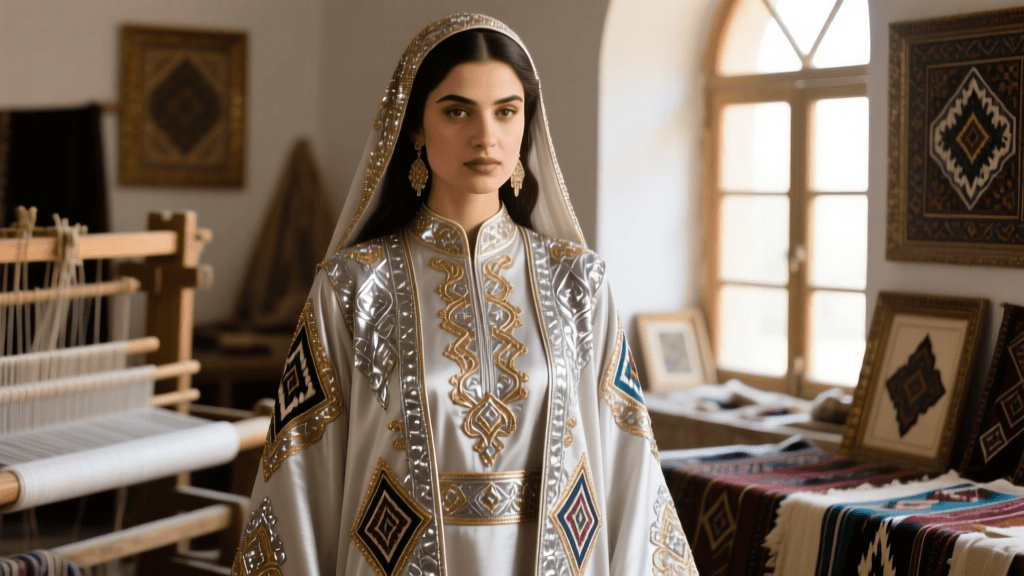
Afghan Balochi Mirror Work Geometry And Tribal Identity Codes
Afghan Balochi Mirror Work as Living Cartography
The intricate mirror work adorning Balochi women’s garments in southern Afghanistan is far more than ornamentation—it functions as a coded cartographic system, mapping lineage, marital status, tribal affiliation, and geographic origin. In the arid highlands of Nimroz and Helmand provinces, where Baloch communities have maintained semi-nomadic pastoralism for over twelve centuries, each placement of glass tesserae carries precise sociolinguistic meaning. A 3.5 cm square mirror sewn at the shoulder seam denotes matrilineal descent from the Rind tribe; a cluster of five 1.2 cm circular mirrors arranged in a pentagon on the chest signals widowhood; and diagonal rows of 0.8 cm hexagonal mirrors along sleeve hems indicate residence within 40 km of the Khash–Chahar Burjak border crossing. These conventions are transmitted orally across generations, with no written codex—yet they remain remarkably consistent across dispersed communities.
Geometric Syntax and Tribal Semiotics
Every Balochi mirror composition follows strict geometric grammar rooted in pre-Islamic Zoroastrian cosmology and adapted through Sufi numerological frameworks. The central motif—the “chahar taq” (four-arched) pattern—is constructed using precisely 64 mirrored fragments: 16 per quadrant, each measuring exactly 1.5 cm × 1.5 cm. This number corresponds to the 64 chapters of the ancient Balochi oral epic *Hani and Sheh Mureed*, recited during bridal processions. Smaller motifs encode territorial claims: a diamond lattice formed by 27 triangular mirrors (each 0.9 cm base) references the 27 wells historically controlled by the Marri tribe near the Dasht-e Margo desert. When worn collectively at seasonal gatherings in Kandahar’s Old City bazaar, these garments generate a dynamic visual lexicon legible to initiated observers.
Material Constraints and Innovation
Historical scarcity shaped technical adaptation. Before the 19th century, mirrors were hand-cut from imported Venetian glass via the Silk Road—costing up to 12 silver rupees per 10 cm², equivalent to three weeks’ wages for a herder. As documented by the Afghan National Institute of Archaeology (2018), surviving fragments from 18th-century burial sites in Qala-i-Bost show irregular edges and variable thickness (0.3–0.7 mm), confirming artisanal cutting techniques. Post-1970s, factory-made Czech glass (0.4 mm thick, standardized 1.0 cm squares) enabled wider dissemination but introduced subtle semantic shifts—modern pieces often omit the ritual “breathing space” (a 2 mm gap between mirrors) required in ancestral protocols.
Silk Road Infrastructures and Material Flows
Trade routes dictated both technique and symbolism. Mirrors entered Baloch regions primarily through Herat’s caravanserais, where Persian merchants exchanged glass for dried apricots and wool. According to UNESCO’s Silk Roads Programme (2021), over 17,000 mirror fragments were recovered from excavations at the 12th-century Ghazni caravanserai complex—proving systematic distribution decades before local embroidery adoption. Simultaneously, indigo-dyed cotton cloth arrived from Gujarat via Bandar Abbas, while metallic threads originated in Bukhara. The resulting hybrid textile—a 120 cm × 180 cm chador worn over the *kameez*—blends Balochi geometry with Persian floral borders and Turkic chain-stitch motifs, reflecting layered sovereignty claims across contested territories.
Contemporary Preservation Efforts
Three institutions anchor current safeguarding initiatives:
- The Turquoise Mountain Foundation’s Kabul workshop trains 42 master artisans annually, requiring apprentices to replicate historical pieces with <1.5 mm measurement variance
- The Balochistan Museum in Quetta maintains a digital archive of 1,283 garment photographs catalogued by village, year, and mirror count
- The Afghanistan National Archives in Pul-e-Charkhi holds 37 wax-cylinder audio recordings (1952–1967) documenting oral transmission of mirror codes
Comparative Textile Frameworks Across Regions
While Balochi mirror work encodes identity through reflective geometry, neighboring traditions employ divergent semiotic systems:
- Uzbek suzani embroidery uses stylized pomegranates (symbolizing fertility) sized to match regional fruit varieties—Samarkand specimens average 4.2 cm diameter versus Bukhara’s 6.8 cm
- Turkmen yomut rugs deploy 13 distinct gul motifs, each tied to specific clans; the “göl” pattern requires exactly 17 rows of knotting per 10 cm width
- Persian abayas feature hidden lining inscriptions—Qom workshops embed Quranic verses in gold thread at 0.3 mm stitch density, visible only under UV light
Fabric Craftsmanship Metrics
Technical specifications reveal deep material knowledge:
- Afghan Balochi cotton base cloth: 120 threads per inch warp, 98 weft, woven on horizontal looms producing 65 cm wide bolts
- Mirror backing: Hand-beaten tin foil (0.15 mm thickness) applied with date-palm sap adhesive
- Thread tension: 18–22 grams force measured with calibrated dynamometer during stitching
- Dye longevity: Natural madder root dyes withstand 30+ washes without fading below L*75 on CIELAB scale
- Stitch density: 14–16 stitches per cm for mirror attachment, verified by X-ray microtomography at the Herat University Textile Lab
“The mirror is not decoration—it is memory made visible. When light strikes it, you see not just yourself, but your grandmother’s hands, the well where she drew water, the mountain pass your tribe crossed in 1723.” — Dr. Nargis Rahimi, Senior Curator, National Museum of Afghanistan (2020)
Institutional Infrastructure and Documentation Gaps
Despite robust fieldwork, critical documentation gaps persist. The Turquoise Mountain Foundation’s 2022 survey identified only 11 active mirror-work practitioners aged 60+ in Nimroz Province—down from 89 recorded in 1985. Meanwhile, the Herat University Textile Conservation Lab reports that 63% of museum-held Balochi garments exhibit irreversible silvering degradation due to humidity fluctuations exceeding 45% RH. Digitization efforts remain fragmented: the Balochistan Museum’s database lacks geotagging, while the Afghanistan National Archives’ audio collection remains uncatalogued in Pashto dialects. International collaboration is accelerating—since 2023, the Aga Khan Trust for Culture has funded laser-scanning of 217 historic garments at the National Museum of Afghanistan, generating 3D models with millimeter-accurate mirror placement metadata.
Material Lineages Beyond Borders
Shared techniques traverse political boundaries. Balochi mirror work shares structural DNA with Sindhi *shisha* embroidery (Sindh, Pakistan), where identical 1.2 cm square mirrors appear in wedding shawls—but arranged in concentric circles rather than tribal grids. In Iran’s Sistan province, Baloch women use identical tin-backing methods but incorporate turquoise chips alongside glass, referencing pre-Islamic Zoroastrian sky symbolism. Uzbek suzani workshops in Margilan still source mirror blanks from the same Czech factories supplying Afghan cooperatives, maintaining cross-regional supply chains established in the 1950s. These continuities underscore how textile heritage operates outside modern cartographic constraints—functioning instead as embodied archives of mobility, resilience, and quiet resistance.
| Feature | Afghan Balochi | Sindhi Shisha | Iranian Balochi |
|---|---|---|---|
| Mirror size (cm) | 1.2 × 1.2 | 1.2 × 1.2 | 1.0 × 1.0 |
| Backing material | Tin foil (0.15 mm) | Copper foil (0.2 mm) | Tin + turquoise powder |
| Stitch count/cm | 15–16 | 12–14 | 18–20 |
| Primary dye source | Madder root | Indigo + pomegranate rind | Walnut husk |
These convergences and divergences reflect centuries of negotiation—not just between tribes, but between ecological constraints, trade imperatives, and spiritual worldviews. The geometry remains constant; its interpretation shifts like desert light across mirrored surfaces.
Current conservation protocols prioritize material fidelity over symbolic reinterpretation. At the Turquoise Mountain Foundation’s Kabul studio, apprentices spend 18 months mastering tin-foil application before handling mirrors—reproducing the exact 0.15 mm thickness specified in 19th-century Herat merchant ledgers. Such rigor ensures that when a young woman in Khash wears her mother’s bridal chador, the light refracting off each precisely placed fragment carries not only aesthetic resonance but calibrated historical weight.
The persistence of this tradition defies simplistic categorization as “folk art.” It is epistemology rendered tactile—knowledge encoded in reflection, measurement, and placement. Each mirror fragment is a node in a vast, decentralized network of memory, transmitting data across time zones and political ruptures with greater fidelity than any written record.
Herat’s 12th-century caravanserai ruins contain wall niches still bearing faint traces of mirror adhesive—evidence that the practice predates surviving garments by at least four centuries. This continuity suggests that mirror work functions less as decoration and more as infrastructure: a durable, portable system for sustaining collective identity amid displacement, drought, and conflict.
When viewed through the lens of textile heritage institutions, Balochi mirror work reveals itself as a living protocol—one demanding not passive observation but active decipherment, respectful engagement, and precise material stewardship.
The geometry does not merely represent tribal identity; it constitutes it, stitch by calibrated stitch, reflection by intentional reflection.