2026 Guide: Crafting Late Medieval Hennins & Renaissance Hoods
The Evolution of European Headwear (1400–1550)
The transition from the towering, gravity-defying hennins of the Burgundian court to the structured, jewel-encrusted hoods of the Tudor era represents one of the most fascinating shifts in European folk and courtly dress. For historical reenactors, costumers, and textile historians operating in 2026, achieving accuracy in these garments requires a deep understanding of both historical context and modern material science. As the global historical reenactment community continues to grow, with major European heritage festivals in 2026 enforcing stricter authenticity guidelines, mastering the architecture of Late Medieval and Renaissance headwear is more important than ever. This comprehensive guide explores the construction, materials, and modern adaptations required to craft authentic hennins, English Gable hoods, and French hoods.
Constructing the Late Medieval Hennin
The hennin, popularized in the 15th century across France, Flanders, and the Burgundian territories, remains an iconic symbol of Late Medieval fashion. According to Britannica's historical overview of the hennin, these headdresses were primarily worn by aristocratic women and were characterized by their steeple or heart-shaped silhouettes, often accompanied by flowing veils that trailed down the back. While peasant and working-class folk dress of the era favored simple linen coifs and wimples, the hennin's influence trickled down into regional festival wear, where simplified versions were crafted from starched linen and woven reeds.
The Framework: Beyond Traditional Buckram in 2026
Historically, the rigid structure of a steeple hennin was achieved using heavily starched linen, wire, or hardened leather. Today, the standard for high-end historical costuming has evolved. In 2026, the most reliable method for creating a lightweight yet durable hennin cone is utilizing thermoplastic millinery buckram combined with a 3D-printed internal armature.
- Base Measurements: A standard steeple hennin requires a base circumference of 21 to 23 inches to sit securely just behind the hairline, tapering to a height of 14 to 18 inches.
- Wire Armature: Use 16-gauge aluminum millinery wire for the base ring, and 12-gauge wire for the central spine. Aluminum is preferred in 2026 over steel due to its resistance to rust from sweat during long summer reenactment events.
- Thermoplastic Buckram: Modern thermoplastic buckram (130gsm weight) can be molded over a 3D-printed PLA cone. This allows for a perfectly symmetrical steeple that traditional hand-rolling struggles to achieve.
Draping the Veil and the Cornet
The veil, or cointoise, was the defining feature of the hennin. For a steeple hennin, you will need approximately 2.5 to 3 yards of lightweight silk organza or finely woven linen. The fabric must be hemmed with a narrow 1/8-inch rolled hem. To attach the veil, a small loop of silk ribbon is sewn to the apex of the wireframe, allowing the veil to cascade naturally. The 'cornet'—the stiffened, butterfly-wing-like wire frame that supported the veil in heart-shaped hennins—requires a delicate touch. Modern costumers use laser-cut brass wire to replicate the intricate, filigree-like bends seen in 15th-century portraiture, ensuring the wire holds its shape without snapping under the weight of the silk.
The Architecture of Renaissance Hoods
As the Renaissance took hold in the 16th century, the verticality of the hennin gave way to the horizontal, framing silhouettes of the Tudor and French hoods. These garments were deeply integrated into the folk and courtly dress of England and France, serving as markers of marital status, wealth, and regional identity.
The English Gable Hood
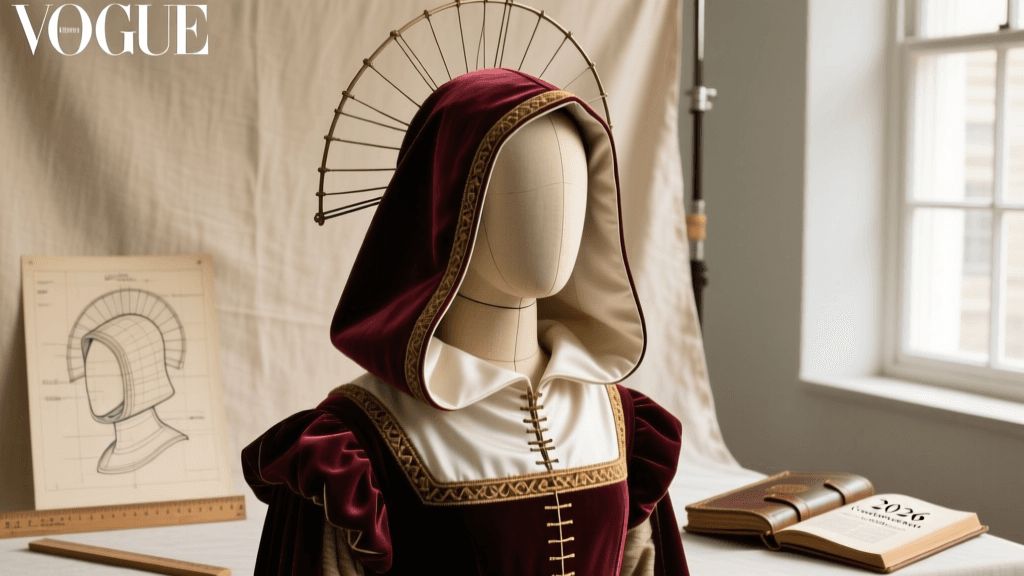
The Gable hood, named for its resemblance to the architectural gable of a house, was the quintessential English headdress of the early 16th century. It featured a rigid, diamond-shaped frame that sat flat against the head, with two long lappets (fabric strips) that could be pinned up or left to hang over the shoulders. The front edge was heavily decorated with a 'biliment'—a band of jewels, pearls, and goldwork.
Constructing a Gable hood in 2026 requires precision woodworking or advanced 3D modeling. The internal 'pasteboard' is now frequently replaced by lightweight, laser-cut MDF (Medium-Density Fibreboard) sealed with archival-grade PVA glue to prevent moisture warping. The outer shell is typically covered in black silk velvet. The biliment, which historically required immense wealth, can now be recreated using flexible, silicone-cast metallic resins that mimic the weight and luster of gold without the prohibitive cost of precious metals.
The French Hood
Introduced to the English court by Anne Boleyn and Mary Tudor, the French hood offered a softer, more rounded alternative to the severe Gable hood. As noted in Britannica's guide to the French hood, this style featured a rounded, crescent-shaped brim that sat further back on the head, revealing more of the hair, which was typically parted in the center and braided or coiled beneath the hood. The defining feature of the French hood is the 'crescent' or 'billiment' that curves along the top edge, and the black velvet veil that falls down the back.
To draft a French hood pattern, start with a crescent-shaped base that measures roughly 14 inches across the front curve and 8 inches from front to back at the center. The internal structure is best supported by a double layer of heavy-duty millinery buckram, wired along the outer edge with 18-gauge millinery wire. In 2026, ethical sourcing of textiles is a major priority for reenactors; therefore, peace silk (Ahimsa silk) and cruelty-free velvet are highly recommended for the outer layers, providing the same historical drape and light-absorption qualities as traditional silk velvet.
Material and Construction Comparison Chart
When planning your historical wardrobe, it is essential to understand the distinct requirements of each headwear style. The table below outlines the core differences to help you allocate your time and budget effectively for the 2026 reenactment season.
| Feature | Steeple Hennin (c. 1460) | English Gable Hood (c. 1520) | French Hood (c. 1540) |
|---|---|---|---|
| Primary Silhouette | Tall, conical, vertical | Diamond, angular, framing | Rounded, crescent, soft |
| Base Material (2026) | Thermoplastic buckram, 3D-printed PLA | Laser-cut MDF, sealed pasteboard | Heavy millinery buckram, wired edges |
| Outer Fabric | Silk brocade or plain linen | Black silk velvet | Black silk velvet or taffeta |
| Veil Requirements | 2.5 - 3 yards silk organza | 1 yard black velvet (back drape) | 1.5 yards black silk taffeta |
| Estimated 2026 Cost | $85 - $140 | $150 - $220 (due to biliment) | $110 - $160 |
| Construction Difficulty | Moderate (focus on draping) | Advanced (focus on rigid geometry) | Intermediate (focus on smooth curves) |
Sourcing Authentic Textiles and Trims
The success of any historical garment relies heavily on the authenticity of its materials. In 2026, the market for historical textiles has expanded, but it is also flooded with inaccurate synthetic blends. When sourcing fabrics for Renaissance and Medieval headwear, avoid polyester velvets and nylon organzas at all costs. These materials reflect light in a distinctly modern, plastic manner and do not drape with the historical weight required.
For the best results, consult specialized historical textile vendors. Look for 100% mulberry silk charmeuse, silk dupioni (which provides a historically accurate slubbed texture), and rayon-silk blend velvets if pure silk velvet is outside your budget. Rayon-silk velvets offer a much more convincing historical sheen than polyester. For trims, the Victoria and Albert Museum's Medieval and Renaissance collections provide excellent high-resolution reference images of surviving 16th-century goldwork and pearl embellishments, which can be used as direct templates for modern embroidery or 3D-printed jewelry components.
Conclusion
Whether you are constructing a towering Burgundian hennin for a Late Medieval festival or a jewel-encrusted French hood for a Tudor court reenactment, the key to success lies in respecting the historical architecture while leveraging the best material innovations of 2026. By combining traditional hand-finishing techniques with modern structural supports like thermoplastic buckram and laser-cut armatures, you can create headwear that is not only visually stunning and historically accurate but also comfortable enough to wear through a long day of heritage celebrations. Understanding the evolution of these garments provides a profound connection to the women of the past, whose folk and courtly dress continues to inspire and captivate us today.