Discover Kyo-Yuzen: Kyoto's Traditional Kimono Dyeing Workshops
The Heritage of Kyo-Yuzen Silk Dyeing
When discussing the pinnacle of Japanese textile arts, few techniques command as much reverence as Kyo-Yuzen. Originating in Kyoto during the late 17th century, this intricate resist-dyeing method transformed the kimono from a simple garment into a sprawling canvas of fine art. The craft is named after Miyazaki Yuzensai, a legendary fan painter whose innovative techniques allowed for the creation of vibrant, pictorial designs on silk that were previously impossible with traditional weaving or tie-dyeing methods. Today, Kyo-Yuzen is officially recognized as a Traditional Craft by Japan's Ministry of Economy, Trade and Industry (METI), a designation that protects and promotes the rigorous standards of the artisans who keep this heritage alive. According to the METI's Traditional Crafts designation, a craft must possess a history of over 100 years, be primarily handmade, and utilize traditional materials to earn this prestigious title.
Inside the Artisan Workshop: The Yuzen Process
Creating a genuine hand-painted Kyo-Yuzen kimono is not the work of a single individual, but rather a highly specialized relay race among master artisans. The process involves over fourteen distinct steps, often requiring the collaboration of designers, paste-makers, dyers, and embroiderers. Understanding these steps is crucial for anyone looking to appreciate the craft or participate in a local workshop.
1. Shita-e (Underdrawing)
The process begins with the shita-e, where a master designer sketches the pattern directly onto the white silk using a special ink made from the juice of the dayflower (tsuyukusa). This ink is water-soluble, meaning it will vanish completely during the final washing stages, leaving no trace of the guidelines behind. The designs often feature seasonal motifs, such as spring cherry blossoms, autumn maple leaves, or flowing water, reflecting the Japanese aesthetic of shiki (seasonality).
2. Itome-nori (Resist Paste Application)
This is the defining step of Yuzen dyeing. Artisans use a metal-tipped cone to carefully trace over the dayflower ink lines with a thick, waterproof rice-bran paste called itome-nori. This paste acts as a dam, preventing the dyes from bleeding outside the intended boundaries when colors are applied later. The precision required here is staggering; a single tremor of the hand can ruin weeks of preparatory work. The paste must be mixed daily, as its consistency changes with Kyoto's humid summers and dry winters.
3. Irozashi (Color Application)
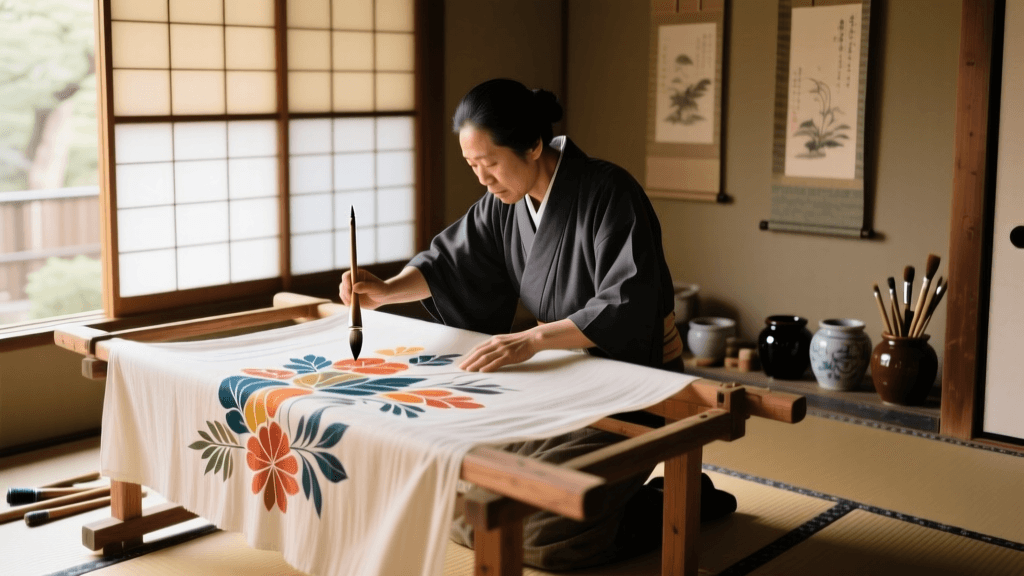
Once the resist paste is dry, the silk is steamed to set it. Then, the irozashi (coloring) phase begins. Artisans use fine brushes to hand-paint synthetic or natural dyes into the outlined sections. Unlike standard painting, the dye must be worked deeply into the silk fibers to ensure colorfastness. Gradients, known as bokashi, are achieved by masterfully blending wet dyes on the fabric, requiring an intimate understanding of how moisture interacts with silk.
4. Ji-zome (Background Dyeing) and Finishing
After the detailed motifs are painted and steamed, the entire fabric is covered in a protective paste, and the background is dyed using large brushes or immersion techniques. Finally, the kimono undergoes yuzen-nagashi (washing). Historically, artisans would wash the silk in the freezing waters of Kyoto's Kamo River to remove the paste and excess dye. Today, due to environmental regulations, this is done in specialized indoor water tanks, though the visual of silk ribbons flowing in the river remains an iconic image of Kyoto's dyeing history.
Participating in a Kyo-Yuzen Workshop: A Practical Guide
For textile enthusiasts and travelers, participating in a Kyo-Yuzen workshop offers a profound, tactile connection to Japanese culture. While creating a full kimono takes months, several historic workshops in Kyoto offer condensed experiences where visitors can learn the basics of irozashi (color application) on smaller silk items. These workshops are typically led by English-speaking guides or bilingual artisans who provide step-by-step instruction.
| Workshop Name | Location | Duration | Approx. Cost (JPY) | Item Created |
|---|---|---|---|---|
| Marumasu Nishimuraya | Nakagyo Ward | 90 - 120 mins | ¥5,500 - ¥8,800 | Silk Scarf / Hankerchief |
| Kyoto Museum of Traditional Crafts | Higashiyama Ward | 60 - 90 mins | ¥3,000 - ¥4,500 | Cotton Tote / Furoshiki |
| Some-no-Sato (Ota Memorial) | Nishijin Area | 120 mins | ¥6,000 - ¥10,000 | Silk Wall Hanging |
One of the most renowned venues for visitors is Marumasu Nishimuraya, a historic Yuzen kimono studio that has opened its doors to the public. Here, participants work on pre-drawn silk stoles or scarves. You are provided with a palette of vibrant dyes and fine brushes, allowing you to apply color to traditional motifs like cranes, peonies, or geometric patterns. The staff handles the final steaming and washing, ensuring you leave with a finished, professional-looking product.
Actionable Tips for Workshop Participants
To ensure a seamless and enriching experience at a Kyoto dyeing workshop, consider the following practical advice:
- Booking Lead Time: Authentic workshops are small, often accommodating only 4 to 10 guests at a time to ensure personalized instruction. Book your session at least 3 to 4 weeks in advance, especially during peak tourist seasons like the spring cherry blossom season (late March to mid-April) and the autumn foliage season (November).
- Attire: Wear dark, comfortable clothing that you do not mind getting stained. While the workshops provide aprons, Yuzen dyes are highly pigmented and can permanently stain light-colored fabrics. Avoid wearing loose, flowing sleeves that might accidentally brush against wet dyes on your workspace.
- Time Management: The coloring process requires immense patience. Do not rush the bokashi (gradient) effects. If you apply too much water or dye at once, it will pool and create harsh, unintended lines. Follow the artisan's advice on brush pressure and moisture control.
- Language Considerations: While major workshops like Marumasu Nishimuraya offer English instruction, smaller neighborhood studios may not. If booking a boutique studio, consider hiring a local translator or bringing a translation app to fully grasp the nuanced instructions regarding dye mixing.
Investing in Authentic Yuzen: Costs and Identification
Beyond the workshop experience, many visitors wish to invest in an authentic Kyo-Yuzen kimono or obi. Understanding the economics and identification markers of genuine hand-painted silk is essential to avoid overpaying for mass-produced, digitally printed imitations.
Identifying Hand-Painted vs. Printed Yuzen
The hallmark of genuine hand-painted Yuzen lies in the itome (the white resist lines). When you examine a real hand-painted kimono up close, the white lines separating the colors should be crisp, slightly raised, and possess a subtle, organic irregularity that proves they were drawn by human hands. Furthermore, the colors on a hand-painted piece will penetrate entirely through the silk; if you look at the inside of the garment, the design should be clearly visible, albeit slightly muted. In contrast, digital or roller-printed Yuzen often features perfectly uniform white lines, and the inside of the fabric will remain stark white.
Cost Breakdown of a Kyo-Yuzen Kimono
Authentic Kyo-Yuzen is a luxury investment. The price reflects the hundreds of hours of specialized labor required. Here is a general cost breakdown for a bespoke, hand-painted silk kimono:
- Standard Hand-Painted Komon (Repeating Pattern): ¥150,000 – ¥300,000 ($1,000 – $2,000 USD)
- Homon-gi (Formal Visiting Wear with Pictorial Motifs): ¥400,000 – ¥800,000 ($2,700 – $5,500 USD)
- Furisode (Long-Sleeved Formal Wear for Unmarried Women): ¥800,000 – ¥2,000,000+ ($5,500 – $14,000+ USD)
- Shitate (Tailoring): Hand-sewing the silk bolts into the final kimono shape costs an additional ¥50,000 to ¥80,000.
For those on a budget, consider purchasing a vintage Kyo-Yuzen kimono from Kyoto's famous Toji Temple flea market or specialized vintage silk shops in the Nishijin district, where high-quality mid-century pieces can be found for ¥10,000 to ¥50,000.
Preserving the Craft for Future Generations
Despite its beauty, the Kyo-Yuzen industry faces severe challenges. The aging demographic of master artisans and the declining daily use of kimono in modern Japan have led to a shortage of successors. The Kyoto City Traditional Crafts Museum actively works to combat this by hosting exhibitions, educational programs, and live demonstrations to inspire younger generations and international audiences. Furthermore, modern Yuzen artisans are adapting by applying their techniques to contemporary items like silk scarves, handbags, and interior decor, ensuring the survival of the craft in a modern context.
By participating in a workshop, investing in authentic pieces, and understanding the immense labor behind every brushstroke, visitors play a vital role in sustaining Kyoto's dyeing heritage. The experience of painting your own silk scarf is not merely a tourist activity; it is a direct participation in a living, breathing tradition that has defined Japanese aesthetic excellence for over three centuries.