Top 2026 Kimono & Hanbok Tailoring Workshops Reviewed
The Renaissance of Traditional Garment Making in 2026
The landscape of cultural travel has shifted dramatically in 2026. Rather than simply observing historical artifacts, modern travelers and slow-fashion enthusiasts are seeking immersive, hands-on experiences. Learning traditional Asian garment making has emerged as a premier way to connect with intangible cultural heritage. According to the UNESCO Intangible Cultural Heritage registry, preserving traditional craftsmanship is vital for maintaining cultural diversity. This year, workshops in Kyoto and Seoul have expanded their English-language seminars, allowing international students to master the intricate construction of the Japanese kimono (wafuku) and the Korean hanbok.
Kyoto Wafuku (Kimono) Tailoring Intensives
In Kyoto, the epicenter of Japanese textile arts, the 2026 Wafuku Tailoring Intensives focus on the philosophy of two-dimensional design. Unlike Western tailoring, which relies on darts and curved seams to contour the body, traditional kimono construction utilizes chokusen-dachi (straight-line cutting). The fabric is cut into rectangular panels and sewn together using running stitches, allowing the garment to be entirely disassembled, washed, and re-sewn.
The premier 5-day seminar held in the Nishijin weaving district guides students through the creation of a yukata (summer cotton kimono) or a basic komon (everyday silk kimono). Students learn to use a hera (bamboo spatula) for marking seam allowances and master the kuke (blind hemming stitch) to ensure invisible finishes on the hem and cuffs. The 2026 tuition for this intensive is approximately 185,000 JPY, which includes all traditional cotton and silk materials, tool rentals, and a final professional pressing.
Seoul Hanbok Construction Masterclasses
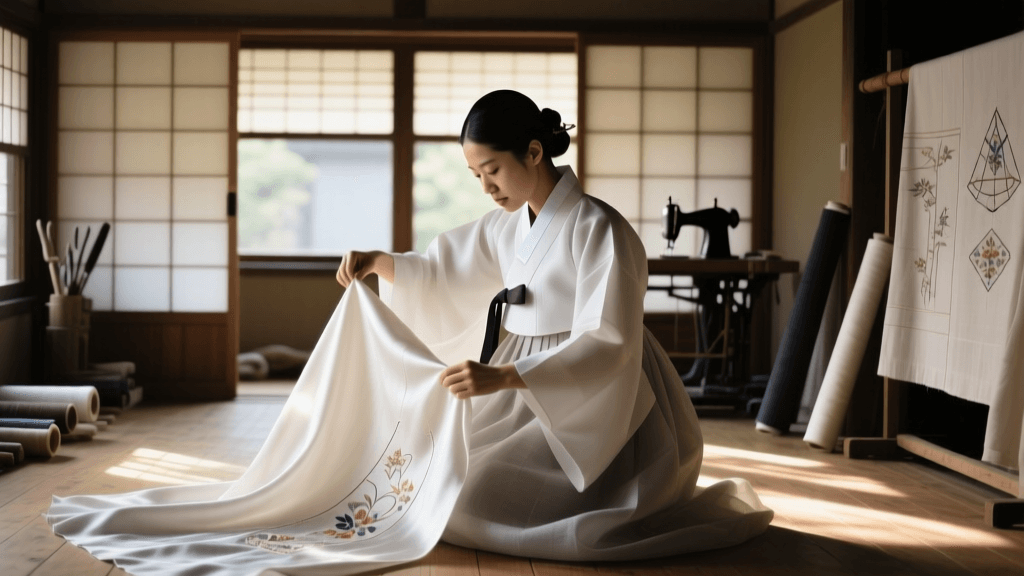
Conversely, Seoul’s Hanbok Construction Masterclasses offer a study in three-dimensional volume and structural elegance. The traditional hanbok is defined by its graceful lines and vibrant color contrasts, rooted in the philosophy of yin and yang and the five elements (obangsaek). The 2026 curriculum at the Bukchon Hanok Village ateliers focuses heavily on the jeogori (traditional jacket) and the chima (wrap-around skirt).
The most challenging and celebrated aspect of hanbok making is drafting the baerae—the distinctive, sweeping curve of the sleeve that mimics the roofline of a traditional Hanok house. Mastering the baerae requires precise bias manipulation and the use of gamchimjil (hidden stitches) to maintain a flawless exterior. Supported by initiatives highlighted by the Korea Tourism Organization, these 7-day masterclasses also include modules on maedeup (traditional knotting) for crafting the goreum (jacket ties). The 2026 pricing averages 1,200,000 KRW, reflecting the high cost of premium myeongju (traditional Korean silk) and personalized instruction.
2026 Workshop Comparison Chart
| Feature | Kyoto Wafuku Intensive | Seoul Hanbok Masterclass |
|---|---|---|
| Duration | 5 Days (40 Hours) | 7 Days (56 Hours) |
| Primary Cutting Technique | Chokusen-dachi (Straight-line) | Curved bias & structured panels |
| Signature Element | Kuke (Blind hemming) | Baerae (Curved sleeve roofline) |
| Primary Fabric Used | Tango Chirimen Silk / Cotton | Myeongju Silk / Ramie |
| 2026 Average Cost | 185,000 JPY (~$1,250 USD) | 1,200,000 KRW (~$900 USD) |
| Language Support | English & Japanese | English & Korean |
The Philosophy of the Cut: Flat Geometry vs. Sculptural Volume
Understanding the underlying philosophy of these garments is a core component of the 2026 seminars. The Japanese kimono is fundamentally a two-dimensional garment. When laid flat, it forms a perfect T-shape, and the beauty of the kimono lies not in how it tailors to the body, but in how it folds, drapes, and is secured by the obi (sash). The seminars emphasize the concept of mu (emptiness), where the space between the body and the fabric allows for breathability and layered wear. Students learn that cutting curves into a kimono panel is strictly forbidden in traditional wafuku tailoring; all shaping is achieved through the wrapping and tying process.
In stark contrast, the Korean hanbok is inherently three-dimensional, even before it is worn. The chima (skirt) is heavily gathered at the waistband to create a bell-like silhouette that expands outward, while the jeogori (jacket) is cropped tightly to the chest to emphasize the volume of the skirt below. Master instructors in Seoul spend entire days teaching students how to manipulate the grainline of the silk to ensure the baerae sleeve curves naturally forward, accommodating the human arm's resting posture. This sculptural approach requires a deep understanding of fabric bias and structural interfacing, making the Seoul masterclass particularly appealing to those with a background in Western couture.
2026 Innovations: Washable Silks and Gaeryang Hanbok
While the core techniques remain rooted in centuries of tradition, the 2026 workshops have integrated modern textile innovations to make these garments more accessible for daily wear. In Kyoto, instructors now offer modules on working with advanced washable silk blends and high-tensile polyester threads that mimic the luster of organic silk but withstand modern machine washing. This aligns with the growing demand for sustainable, low-maintenance traditional wear among younger demographics.
Similarly, the Seoul seminars dedicate a full day to Gaeryang Hanbok (improved or modernized hanbok). Students learn how to adapt the traditional jeogori pattern to include modern closures, such as hidden hooks and eyes, replacing the intricate goreum ties for everyday convenience. They also experiment with structural organza under-linings that maintain the bell-shape of the chima without the heavy, restrictive layering required in historical court garments.
Essential Traditional Tools for the Modern Maker
While the ateliers provide heavy machinery and traditional pressing irons, students in 2026 are advised to familiarize themselves with the specialized hand tools unique to Asian tailoring. In Kyoto, the hera (a bamboo or bone spatula) is indispensable for scoring fold lines into silk without leaving ink marks or chalk residue. The kotedai (pressing board) and heavy cast-iron kote (iron) are used to steam and set seams flat, a critical step in achieving the razor-sharp edges expected of a finished kimono.
In Seoul, the chadol (a traditional brass thimble worn on the middle finger) is essential for pushing the needle through dense, multi-layered silk collars (dongjeong). Students also learn to use the jadong (traditional measuring stick), which relies on the cheok and chon measurement system rather than the metric system, requiring a mental translation that sharpens the maker's spatial awareness. Bringing your own ergonomic shears and high-contrast basting thread is highly recommended, as the workshops move quickly past basic seam finishes and dive directly into advanced textile manipulation.
Sourcing Authentic Textiles Post-Seminar
For those looking to continue their practice after the seminar concludes, sourcing authentic materials is easier than ever. In Kyoto, the Nishijin Textile Center remains the ultimate destination for bolt-end silks and vintage obi brocades. According to the Japan National Tourism Organization, the surrounding wholesale streets have increasingly opened their doors to international retail buyers in 2026, provided you purchase full tanmono (bolt) lengths. In Seoul, the Dongdaemun Comprehensive Market offers floors dedicated exclusively to traditional hanbok silks, ramie weaves, and modern goryeong polyester blends designed to mimic the drape of traditional silk at a fraction of the cost.
Conclusion
Participating in a traditional garment-making workshop is an exercise in mindfulness and cultural preservation. Whether you are drafting the geometric precision of a kimono or sculpting the sweeping curves of a hanbok baerae, the skills acquired in these 2026 seminars offer a profound connection to Asian history. As the slow-fashion movement continues to reject mass production, the knowledge gained in these Kyoto and Seoul ateliers empowers a new generation of makers to carry these ancient, breathtaking traditions into the future.