Top Japanese Kimono Schools & Apprenticeships for 2026
The Renaissance of Traditional Japanese Garment Education in 2026
The creation of traditional Japanese garments—particularly the kimono, yukata, and hakama—is an intricate dance of mathematics, art, and profound cultural philosophy. For decades, the Asian textile heritage sector faced a looming crisis: an aging artisan population with an average age surpassing 65. However, as we navigate through 2026, a vibrant renaissance is underway. Driven by a global resurgence of interest in sustainable, slow fashion and supported by aggressive preservation initiatives from the Japanese government, a new generation of domestic and international students is flocking to Japanese fashion education schools and master apprenticeships.
Whether you are drawn to the mathematical precision of Nishijin-ori (brocade weaving) in Kyoto, the vivid, painterly strokes of Kyo-yuzen dyeing, or the meticulous art of kitsuke (kimono dressing), the pathways to mastering these Asian traditions have evolved. Today’s educational landscape seamlessly blends centuries-old hand techniques with modern pedagogical structures, making it more accessible than ever for dedicated individuals to become custodians of Asian textile arts.
The 2026 Landscape of Japanese Fashion Education
In 2026, the Japanese Ministry of Economy, Trade and Industry (METI) continues to heavily subsidize the preservation of designated traditional crafts through the Association for the Promotion of Traditional Craft Industries (Densan). This support has allowed historic workshops in Kyoto, Kanazawa, and Tokyo to open their doors to formalized apprenticeship programs that offer living stipends, a stark contrast to the unpaid labor models of the past.
Furthermore, the integration of digital archiving and CAD (Computer-Aided Design) in preliminary pattern drafting has shortened the initial learning curve for complex weaving structures, allowing students to spend more time mastering the tactile, hand-finishing techniques that machines cannot replicate. This hybrid approach ensures that the soul of the garment remains entirely human-made, even if the blueprint benefits from 2026’s technological advancements.
Premier Institutions for Traditional Garment Study
For those seeking a structured academic environment before entering a master’s workshop, Japan offers several world-class institutions dedicated to traditional and contemporary fashion.
Bunka Fashion College: Traditional Textile Tracks
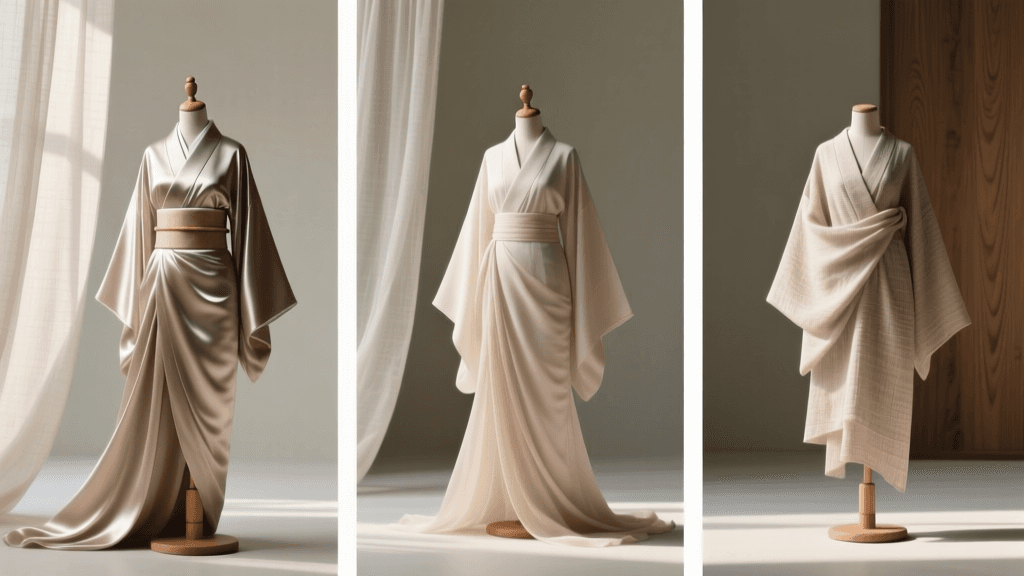
While globally renowned for avant-garde contemporary fashion, Bunka Fashion College in Tokyo maintains a highly respected Traditional Textile and Garment track. In 2026, their curriculum emphasizes the structural engineering of the kimono, focusing on the zero-waste cutting methods inherent to Asian traditional garments. Students learn the precise 36-centimeter bolt width (tanmono) weaving constraints and how to draft patterns that utilize every inch of silk without waste. First-year tuition for international students hovers around 1,450,000 JPY, which includes access to Bunka’s extensive historical garment archives.
Kyoto College of Traditional Arts
Located in the heart of Japan’s cultural capital, this institution is the gold standard for hands-on craft preservation. The college offers specialized two-year diplomas in Nishijin weaving, Kyo-yuzen dyeing, and Kyoto embroidery. The 2026 cohort has seen a 20% increase in international enrollment, prompting the school to introduce bilingual technical manuals for complex dye-resist paste (itome-nori) application. Students here spend their first year mastering the preparation of silk threads and natural indigo vats before ever touching a loom or brush.
Tokyo Kimono Academy
For those less interested in manufacturing and more focused on the styling, history, and dressing of traditional garments, the Tokyo Kimono Academy offers intensive 6-month to 1-year certifications. This school is vital for understanding the sociological aspects of Asian traditions, teaching the strict seasonal rules (kisetsukan) governing kimono motifs, fabrics, and layering techniques.
The Deshi (Apprentice) System: Nishijin Weaving & Yuzen Dyeing
Beyond formal schooling, the traditional deshi (apprentice) system remains the most authentic route to mastery. In 2026, entering a master’s workshop in Kyoto’s Nishijin district or Kanazawa’s Kaga-yuzen studios is a highly competitive, deeply rewarding commitment.
Nishijin-ori Weaving Apprenticeships
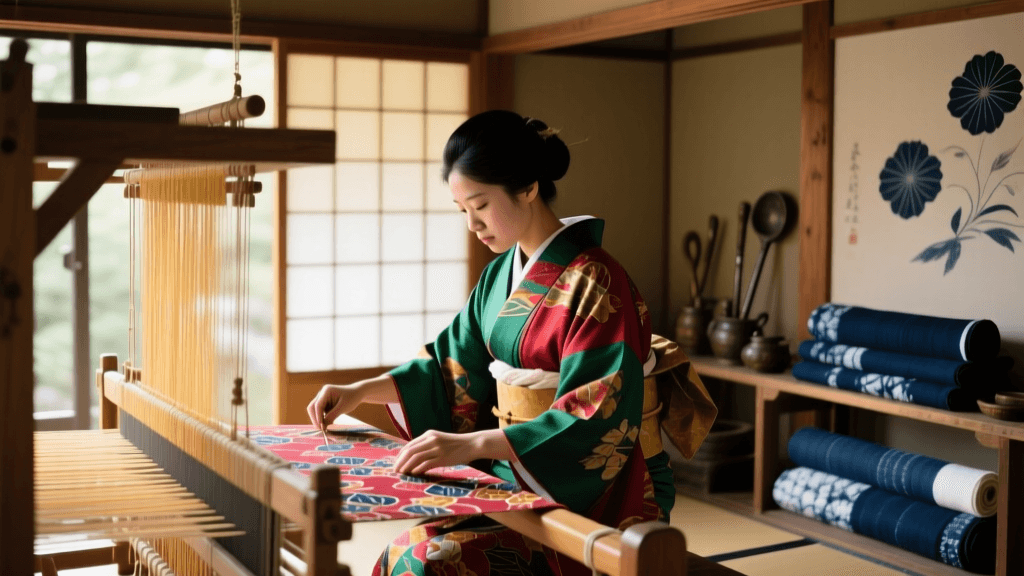
Nishijin brocade is famous for its complex, multi-layered geometric and pictorial patterns. An apprenticeship here typically lasts three to five years. The first year is often spent solely on thread preparation, winding, and warping the loom. By 2026, master weavers are increasingly seeking apprentices who possess both the physical stamina to operate heavy traditional Jacquard looms and the patience to hand-tie thousands of warp threads. Apprentices typically receive a monthly stipend ranging from 130,000 to 160,000 JPY, alongside subsidized housing in traditional machiya (townhouses) near the workshops.
Kyo-Yuzen and Kaga-Yuzen Dyeing
Yuzen dyeing involves applying a rice-paste resist to silk to create intricate, multi-colored designs. Apprentices in this field must develop an encyclopedic knowledge of natural and synthetic dyes, mordants, and the precise humidity controls required for the paste to dry correctly. A Kaga-yuzen apprenticeship in Kanazawa places heavy emphasis on the region's signature five colors (kaga-gosai) and the realistic, botanical motifs that define the style.
Comparison Chart: Formal Schools vs. Master Apprenticeships
| Pathway | Duration | Financial Model (2026) | Primary Focus | Language Requirement |
|---|---|---|---|---|
| Fashion College (e.g., Bunka) | 1 to 2 Years | Tuition: ~1,450,000 JPY/year | Broad textile theory, pattern drafting, contemporary integration | JLPT N2 or equivalent |
| Traditional Arts Diploma | 2 Years | Tuition: ~1,200,000 JPY/year | Deep immersion in a single craft (e.g., embroidery, weaving) | JLPT N3 (N2 preferred) |
| Master Deshi (Apprenticeship) | 3 to 5 Years | Stipend: 130k-160k JPY/month | Hyper-specialized, workshop-specific secret techniques | Fluent Japanese (N1 highly recommended) |
| Kitsuke (Dressing) Academy | 6 Months to 1 Year | Tuition: ~600,000 JPY total | Styling, seasonal rules, dressing techniques, history | JLPT N3 or conversational fluency |
Actionable Steps for Aspiring Artisans in 2026
If you are resolved to dedicate yourself to the preservation and creation of traditional Japanese garments, meticulous preparation is required. Here is your roadmap for entering the field in 2026.
1. Achieve the Necessary Language Proficiency
Traditional craft terminology is highly specialized and rarely translated into English. Terms like karakusa (arabesque pattern), shibori (tie-dye), and ji-nuki (ground bleaching) are part of daily workshop communication. Aspiring students must aim for a minimum of JLPT N3 for school entry, but JLPT N2 or N1 is practically mandatory for a master apprenticeship where nuanced, unspoken communication is just as critical as verbal instruction. Utilizing resources supported by the Japan Student Services Organization (JASSO) can help international applicants find accredited language schools that serve as a bridge to craft colleges.
2. Navigate the Visa Landscape
Your educational path will dictate your visa status. Enrolling in an accredited institution like Bunka Fashion College or the Kyoto College of Traditional Arts qualifies you for a Student Visa, which allows you to study full-time and work part-time (up to 28 hours a week) to supplement your living costs. Conversely, if you are accepted directly into a master’s workshop as an unpaid or stipend-received apprentice without formal school enrollment, you must apply for a Cultural Activities Visa. This visa requires extensive documentation proving the cultural significance of the craft and the master’s pedigree.
3. Assemble a Culturally Relevant Portfolio
When applying to traditional arts programs or seeking a master, your portfolio should not focus on Western fashion design. Instead, demonstrate your understanding of Asian traditions. Include sketches that respect the straight-line cutting of the kimono, watercolor paintings of seasonal flora (plum blossoms, autumn grasses, pine), and evidence of your hand-eye coordination through detailed embroidery, calligraphy, or fine-line illustration. Masters in 2026 are looking for patience, respect for the medium, and a foundational grasp of Japanese aesthetics (such as wabi-sabi and yugen).
4. Procure Your Initial Toolkit
While schools provide heavy machinery like looms and dye vats, apprentices are expected to bring their own hand tools. Budget approximately 80,000 to 120,000 JPY for your starter kit, which should include:
- Yuzen Brushes (Hake): A set of varying widths made from deer hair and horsehair for applying resist paste and dyes.
- Hera (Spatulas): Bamboo and cypress spatulas used for spreading rice paste evenly across silk.
- Kote (Craft Irons): Traditional weighted irons used for pressing seams and setting dyes, alongside modern temperature-controlled alternatives.
- Shaku (Measuring Ruler): A traditional Japanese ruler measuring approximately 37.9 centimeters, essential for drafting tanmono fabric bolts.
Preserving the Future of Asian Textile Arts
The decision to pursue Japanese fashion education and traditional apprenticeships in 2026 is more than a career choice; it is an act of cultural preservation. As the world increasingly turns toward mass-produced, disposable clothing, the artisans of Kyoto, Kanazawa, and Tokyo stand as vital guardians of sustainability, heritage, and unparalleled craftsmanship. Whether you are threading a Nishijin loom or painting a delicate crane onto Kyo-yuzen silk, your dedication ensures that the profound beauty of Asian traditional garments will continue to drape the shoulders of generations to come.