Top Kyoto Kimono Apprenticeships & Schools 2026: A Complete Guide
The State of Japanese Garment Education in 2026
The creation of traditional Japanese garments, particularly the kimono, represents one of the most intricate and revered textile traditions in the world. As we navigate through 2026, the landscape of Japanese fashion education and artisan apprenticeships is undergoing a vital renaissance. Faced with an aging demographic of master craftsmen, the Japanese government and cultural preservation societies have heavily subsidized new educational pathways to ensure that techniques like Nishijin weaving, Kyo-Yuzen dyeing, and Shibori resist-dyeing survive into the next century. For aspiring textile artists and fashion historians, 2026 offers unprecedented access to both traditional deshi (apprentice) programs and modernized vocational curriculums.
According to cultural preservation initiatives highlighted by the Japan National Tourism Organization, Kyoto remains the undisputed epicenter for kimono craftsmanship. The city's workshops are actively seeking dedicated individuals, including international students, to inherit the mantle of these living national treasures. Whether you are looking to weave silk on a centuries-old jacquard loom or paint delicate seasonal motifs using rice-paste resist, understanding the educational avenues available in 2026 is your first step toward mastery.
Traditional Apprenticeships (Deshi) vs. Modern Fashion Schools
When pursuing the art of traditional Japanese garments, students must choose between two distinct educational philosophies: the immersive, highly traditional deshi system, and the structured, academic environment of a modern vocational arts university. Both pathways have evolved in 2026 to accommodate contemporary learning needs while strictly preserving historical accuracy.
The Deshi System: Immersion in the Workshop
The deshi system is the ancient master-disciple relationship. In 2026, entering a Nishijin weaving house or a Yuzen dyeing studio as a live-in or full-time apprentice remains the most authentic way to learn. This path is less about classroom theory and entirely about physical repetition, observation, and earning the master's trust. Apprentices typically spend their first two years solely on preparation tasks: boiling silk, grinding natural dyes, maintaining the humidity of the workshop, and cleaning tools. Only after demonstrating unwavering patience and respect for the craft are they allowed to touch the loom or the dyeing brushes.
Top Vocational Schools for Traditional Garments
For those who prefer a structured syllabus, peer collaboration, and recognized academic credentials, Kyoto's premier art universities offer specialized degrees in traditional crafts. Institutions such as the Kyoto University of the Arts have integrated 2026 digital design technologies with heritage techniques. Students in these programs learn the chemistry of natural indigo and madder root dyes alongside 3D textile modeling, ensuring they can innovate within the boundaries of tradition. These schools provide a safer, more predictable environment for international students who may not yet possess the fluency in Japanese required for a strict deshi household.
2026 Apprenticeship Requirements and Pathways Compared
Choosing the right educational route depends on your career goals, language proficiency, and financial situation. Below is a comprehensive comparison of the primary pathways available for kimono craft education in 2026.
| Feature | Traditional Deshi (Workshop) | University / Vocational School |
|---|---|---|
| Duration | 3 to 7 years (or lifelong) | 2 to 4 years (Degree/Diploma) |
| Language Requirement | JLPT N1 / Native-level fluency | JLPT N2 (English tracks available) |
| Tuition / Fees | Free (Master provides training) | ¥800,000 - ¥1,600,000 annually |
| Stipend / Income | Small monthly living stipend | Self-funded / Scholarships apply |
| Curriculum Focus | Single, hyper-specialized technique | Broad textile arts & design theory |
| Visa Category (2026) | Cultural Activities / Designated Activities | Student Visa |
Deep Dive: Mastering Nishijin Weaving
Nishijin-ori is the pinnacle of Japanese textile weaving, originating in the Nishijin district of Kyoto. Famous for its luxurious brocades and intricate obi (kimono sashes), the craft involves over twenty distinct specialized processes before a single thread is woven. In 2026, the Nishijin Textile Center continues to be the primary hub for both exhibition and apprenticeship placement.
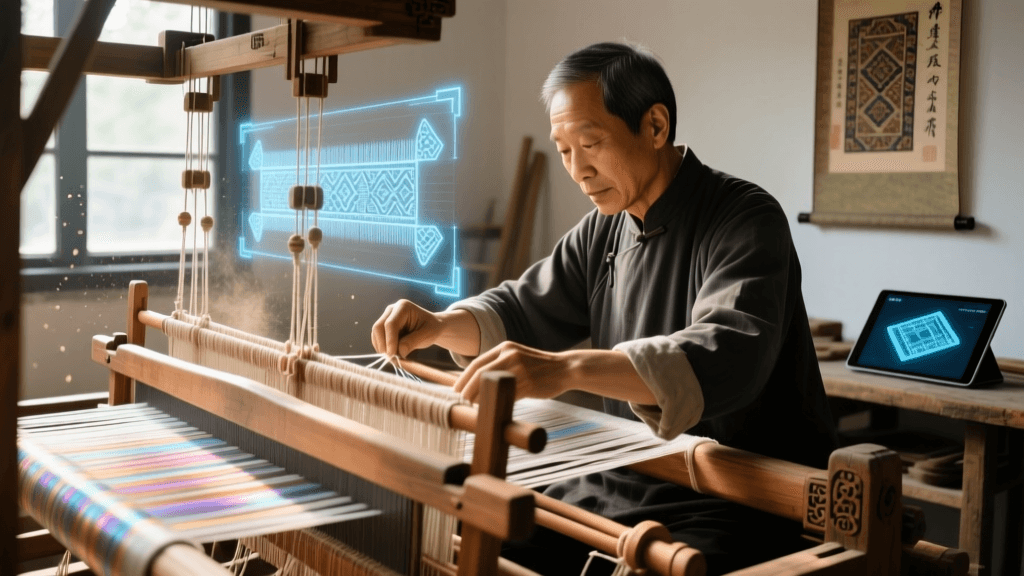
Apprentices in Nishijin weaving must master the preparation of the ito (threads). This includes seikei (sorting and twisting) and kasuri-kukuri (binding threads for resist dyeing before weaving). The modern 2026 Nishijin workshop often utilizes computerized jacquard looms for mass-market obi, but true apprentices are trained on the te-bata (hand loom). Operating a hand loom requires immense physical coordination; the weaver must manipulate the foot pedals to separate the warp threads while simultaneously throwing the hi (shuttle) carrying the weft thread, all while maintaining perfect tension. A single mistake can ruin a pattern that takes months to design. Apprenticeships in Nishijin are highly competitive, and masters look for individuals with exceptional spatial awareness and manual dexterity.
Deep Dive: The Art of Kyo-Yuzen Dyeing
While weaving creates the fabric, Kyo-Yuzen provides its soul. Yuzen is a resist-dyeing technique that allows for the creation of breathtaking, painterly landscapes and floral motifs directly onto silk. The process relies heavily on itome-nori, a specialized rice-paste resist that prevents dyes from bleeding into one another.
In 2026, environmental sustainability has become a major focus in Yuzen education. Historically, artisans would wash the dyed silk in the flowing waters of the Kamo River to remove the rice paste. Today, strict environmental protections mean that apprentices are trained in advanced, closed-loop water recycling studios that mimic the mineral composition and temperature of the river without impacting the local ecosystem. Learning to mix the itome-nori is a science in itself; the apprentice must adjust the paste's viscosity daily based on the workshop's ambient humidity and temperature, a skill that takes years of sensory experience to perfect.
A Day in the Life of a 2026 Textile Apprentice
To truly understand the commitment required, consider the daily schedule of a second-year deshi in a traditional Kyoto dyeing studio. The lifestyle is rigorous, demanding, and deeply spiritual, reflecting the Zen principles of mindfulness in labor.
- 05:30 AM - Workshop Preparation: The apprentice arrives before the master to sweep the floors, prepare the day's rice-paste, and ensure the silk bolts are properly humidified to prevent tearing.
- 07:00 AM - Morning Meditation & Tea: A brief period of mindfulness with the master, reinforcing the mentor-disciple bond and setting the intention for the day's meticulous work.
- 08:00 AM - Thread and Paste Preparation: Grinding pigments, boiling natural plant dyes, and mixing the resist pastes to the exact consistency required by the day's weather.
- 12:00 PM - Communal Lunch: Prepared by the apprentice or the master's family, emphasizing the communal, family-like structure of the traditional workshop.
- 01:00 PM - Observation and Assisted Practice: The apprentice observes the master applying the resist paste. Later, the apprentice is permitted to practice on scrap silk, receiving immediate, often blunt, critique.
- 05:00 PM - Cleaning and Tool Maintenance: Washing brushes, scraping vats, and organizing the studio. Tool maintenance is considered just as important as the art itself.
- 07:00 PM - Journaling and Study: Documenting the day's dye ratios, humidity levels, and master's instructions in a personal ledger.
Navigating Visas and Applications in 2026
For international students hoping to enter the world of traditional Japanese garments, navigating the immigration and application process requires careful planning. In 2026, the Japanese Ministry of Justice has streamlined the 'Cultural Activities' visa for those entering unpaid or stipend-based deshi programs, provided they have a formal letter of acceptance from a registered traditional craftsman or guild.
If you are applying to a university program, the standard 'Student Visa' applies. You will need to submit a comprehensive portfolio demonstrating your understanding of textile arts, alongside proof of Japanese language proficiency. Most traditional masters require at least JLPT N2 for basic workshop communication, but N1 is heavily preferred for the nuanced, often poetic instructions given during advanced dyeing and weaving lessons. Furthermore, applicants must demonstrate a deep respect for Asian traditions, as the preservation of these garments is viewed not merely as a fashion pursuit, but as the safeguarding of Japanese cultural identity.
Preserving the Future of Asian Traditions
The decision to pursue an apprenticeship or formal education in Japanese garment making is a profound commitment to cultural preservation. The kimono is more than a piece of clothing; it is a canvas of seasonal poetry, a testament to regional agriculture, and a masterclass in sustainable, zero-waste design. As the industry moves further into 2026, the fusion of ancient hand-craftsmanship with modern ecological practices ensures that these traditions will continue to drape the shoulders of future generations. Whether you choose the silent, rhythmic clatter of the Nishijin hand loom or the vibrant, fragrant world of Yuzen dye vats, the path of the artisan awaits those willing to dedicate their lives to the beauty of Asian traditions.