Kyoto Kimono Apprenticeships & Top Fashion Schools Guide 2026
The Renaissance of Japanese Garment Education in 2026
The landscape of traditional Japanese fashion education is undergoing a profound transformation in 2026. With the global resurgence of interest in sustainable, slow fashion and the pressing domestic need to preserve intangible cultural heritage, Japan has revamped its approach to teaching the arts of the kimono, Nishijin-ori weaving, and Kyo-Yuzen dyeing. Whether you are an aspiring artisan seeking the rigorous path of a shokunin (master craftsman) or a contemporary designer looking to integrate heritage textiles into modern silhouettes, understanding the educational ecosystem is critical. This comprehensive guide breaks down the traditional apprenticeship models in Kyoto and the premier academic institutions driving Japanese fashion forward in 2026.
The Shokunin Path: Traditional Apprenticeships in Kyoto
For centuries, the transmission of textile knowledge in Japan has relied on the deshi (apprentice) system. In 2026, the Kyoto City Traditional Industries Support Center continues to facilitate placements for dedicated individuals willing to commit to the grueling but deeply rewarding life of a traditional artisan. Unlike academic routes, apprenticeships are less about theory and entirely focused on muscle memory, material intuition, and the repetitive mastery of a single, highly specialized task.
Kyo-Yuzen Dyeing Apprenticeships
Kyo-Yuzen is the pinnacle of Japanese resist-dyeing, famous for its pictorial, painterly motifs. An apprenticeship in a Kyoto Yuzen atelier typically lasts five to seven years. In the first two years, an apprentice will rarely touch silk. Instead, the focus is on preparing the itome-nori (rice paste resist), washing fabrics in the cold waters of the Kamogawa River (or modern temperature-controlled equivalents that mimic its mineral profile), and mastering the ji-ire (soybean milk sizing) process. By 2026, sustainability mandates have also required apprentices to learn the cultivation and extraction of botanical dyes, such as sukumo (fermented indigo) and madder root, reducing reliance on synthetic heavy-metal mordants.
Nishijin-Ori Weaving Mastery
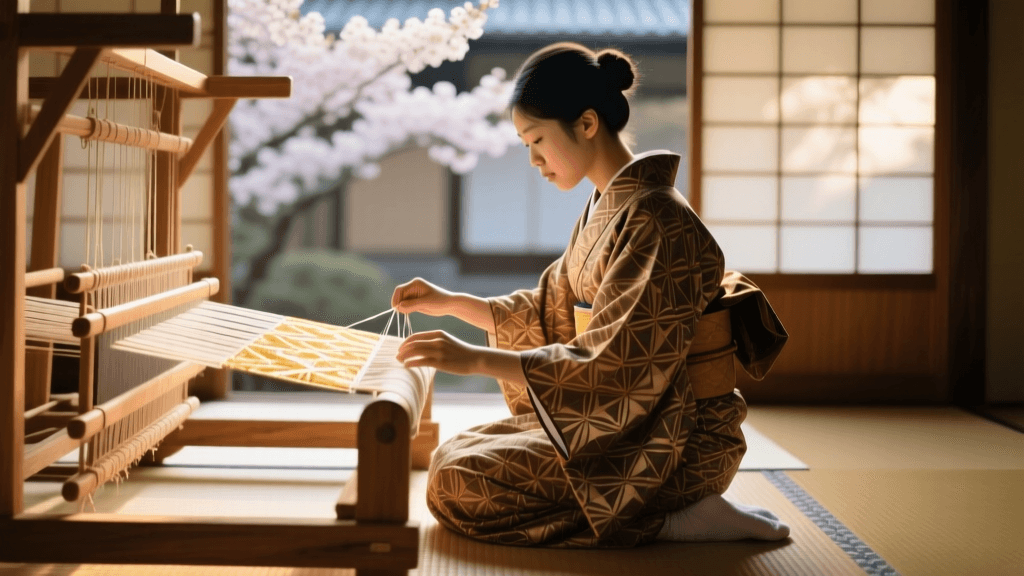
Nishijin-ori represents the zenith of Japanese brocade weaving. Apprenticeships here are highly compartmentalized. You do not simply "learn to weave"; you apprentice as a thread-dyer, a bobbin-winder (hataki), or a Jacquard loom punch-card programmer. In 2026, the integration of digital Jacquard systems with traditional te-bata (hand-operated) looms means modern apprentices must possess a dual fluency in both algorithmic pattern drafting and the tactile tensioning of raw silk threads. Stipends for Nishijin apprentices in 2026 average around 160,000 JPY per month, subsidized by the national Agency for Cultural Affairs to combat the aging artisan demographic.
Top Academic Institutions for Traditional Fashion
For those who prefer a structured academic environment, a blend of contemporary design theory, and international networking, Japan’s top fashion universities have expanded their traditional textile departments for the 2026 academic year.
Bunka Fashion College (Tokyo)
Bunka Fashion College remains the undisputed titan of Japanese fashion education. While globally renowned for producing avant-garde designers like Yohji Yamamoto and Junya Watanabe, Bunka’s Department of Traditional Textiles and Crafts has seen a 30% enrollment surge as of 2026. The curriculum uniquely pairs heritage techniques—such as shibori (tie-dye) and kumihimo (silk braiding)—with 3D digital garment simulation. Students learn to map physical Nishijin weave tensions into digital twins, allowing them to prototype heritage garments sustainably before cutting a single thread of expensive silk.
Kyoto University of the Arts
Located in the cultural heart of Japan, Kyoto University of the Arts offers an immersive BFA and MFA in Textile Arts. The 2026 curriculum heavily emphasizes the intersection of Zen philosophy, regional material sourcing, and garment construction. Students have direct access to local weaving cooperatives and participate in mandatory semester-long externships at historic dye houses in the Nishijin district. The university’s state-of-the-art natural dye laboratory is currently pioneering waterless dyeing techniques using supercritical carbon dioxide, adapted specifically for delicate traditional silks.
2026 Comparison: Apprenticeship vs. Academic Route
Choosing between the atelier and the academy depends entirely on your career trajectory. Below is a structured comparison of the two primary paths for studying traditional Japanese garments in 2026.
| Feature | Kyoto Nishijin/Yuzen Apprenticeship | Bunka Fashion College (Textile BFA) |
|---|---|---|
| Duration | 5 to 7 Years (Full-time immersion) | 4 Years (Academic calendar) |
| 2026 Cost / Tuition | Free (Apprentice receives a stipend) | ~1,450,000 JPY per year |
| Language Requirement | JLPT N1 (Fluent business/keigo) | JLPT N2 (Or English-track equivalent) |
| Primary Focus | Hyper-specialized manual mastery | Design theory, portfolio, hybrid tech |
| Career Outcome | Master Artisan, Atelier Succession | Creative Director, Textile Innovator |
Essential Tools and Materials for 2026 Students
Whether entering an apprenticeship or a university program, students in 2026 are expected to invest in their foundational toolkit. While institutions provide heavy machinery like floor looms and digital printers, the personal tools of the trade remain deeply traditional.
- Yuzen Brushes (Yuzen-bake): Hand-tied deer hair brushes used for applying resist paste. A starter set of five varying widths costs approximately 45,000 JPY in 2026.
- Hiboko (Bobbin Winding Tools): Essential for Nishijin weaving apprentices to manage the tension of gold and silver leaf-wrapped threads.
- Shibori Kanoko Stands: Tension racks used for the meticulous binding of microscopic fabric nodes before indigo immersion.
- Digital Tension Meters: A 2026 staple for academic students, these clip-on sensors measure warp thread tension in real-time, bridging the gap between ancestral intuition and modern quality control.
Step-by-Step Guide to Applying as an International Student
For international candidates, the barrier to entry is primarily linguistic and bureaucratic. Here is the actionable roadmap for securing a placement in 2026.
1. Achieve Linguistic Fluency
Traditional ateliers operate in a highly hierarchical, nuanced dialect of Japanese. While some academic programs at Bunka offer English-language support for design theory, the physical workshops are conducted entirely in Japanese. Passing the JLPT N2 is the absolute minimum for university admission, but N1 is strictly required for a Kyoto apprenticeship. Furthermore, understanding keigo (honorific language) is non-negotiable when addressing master craftsmen.
2. Secure the MEXT Scholarship or Cultural Grants
Funding is a major consideration. The Japanese government’s MEXT (Ministry of Education, Culture, Sports, Science and Technology) scholarship offers full tuition waivers and a monthly living stipend of roughly 145,000 JPY for undergraduate arts students. Applications for the 2026 academic year must be submitted through your local Japanese embassy by May 2025. Alternatively, the Agency for Cultural Affairs offers specific "Next-Generation Densho" grants for foreign nationals committing to a minimum five-year apprenticeship in a designated Traditional Craft Industry.
3. Build a Material-Centric Portfolio
Unlike Western fashion portfolios that prioritize digital rendering and conceptual sketching, Japanese traditional craft programs demand a material-centric portfolio. Admissions committees and master weavers want to see your hands-on capability. Include high-resolution documentation of your weaving samples, natural dyeing experiments, and hand-stitching (sashiko or nuitori). Highlight your understanding of fiber properties—specifically how protein fibers (silk) react to acidic dyes compared to cellulose fibers (cotton/hemp).
The Future of Heritage: Sustainability and Innovation
As we navigate 2026, the most significant shift in Japanese fashion education is the marriage of ancestral sustainability with modern ecology. Traditional kimono production was inherently zero-waste; the straight-line cutting method (chokusen-dachi) ensures that every inch of the 14-inch wide silk bolt (tanmono) is utilized, and the garment can be entirely unpicked, washed, and re-tailored across generations. Today’s students are tasked with translating this philosophy into a global context. By mastering the rigorous apprenticeships of Kyoto and the innovative labs of Tokyo’s top fashion schools, the next generation of designers is ensuring that the soul of the Japanese garment survives, adapts, and thrives for centuries to come.