Inside Kyoto's Nishijin-Ori Artisan Weaving Workshops
The Legacy of Nishijin-Ori: Kyoto's Master Weavers
Kyoto is globally revered as the cultural heart of Japan, and nowhere is this more evident than in its traditional textile arts. At the pinnacle of this artisan hierarchy sits Nishijin-ori, a luxurious, intricately woven silk fabric that has dressed Japanese royalty, aristocrats, and geisha for centuries. The name 'Nishijin' translates to 'western position,' a direct reference to the western Kyoto encampment of the Yamana clan during the devastating Onin War (1467-1477). When the war ended, displaced weavers returned to this specific district, establishing the weaving hub that still thrives today.
Nishijin-ori is not merely a fabric; it is a designated traditional craft recognized by the Japanese government. According to the Nishijin Textile Industry Association, the production of these textiles involves a highly specialized division of labor. Unlike many Western textile traditions where a single weaver manages the entire process, Nishijin weaving requires over twenty distinct steps, each handled by a dedicated artisan. From the initial design and silk reeling to the dyeing, warping, and final weaving, the creation of a single Nishijin obi (kimono sash) is a masterclass in collaborative craftsmanship.
The Intricate 20-Step Weaving Process
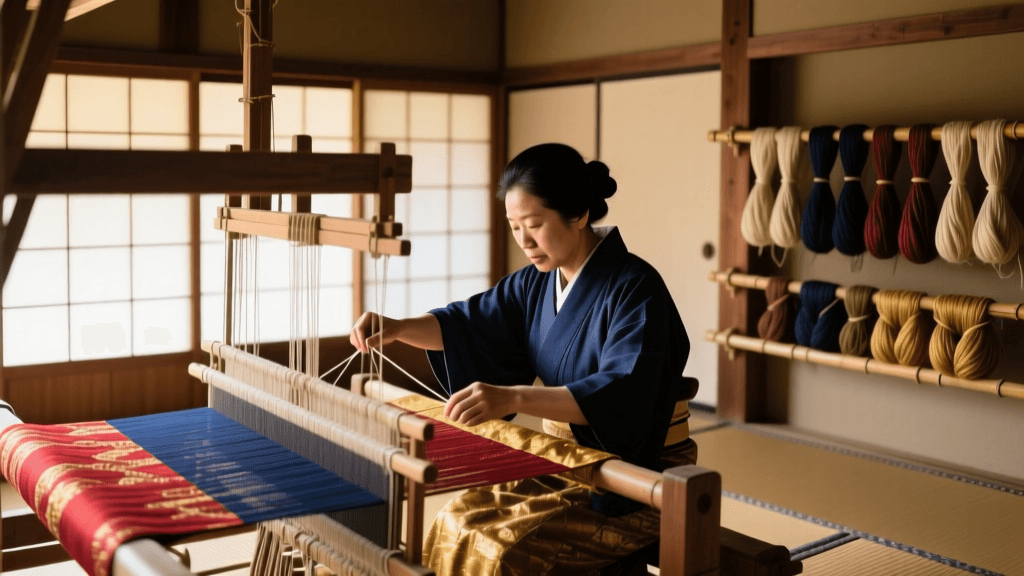
To truly appreciate the value of Nishijin textiles, one must understand the painstaking process behind their creation. The journey begins with the mon-ishi (pattern designer), who drafts the intricate motifs on specialized grid paper. This design is then translated into a Jacquard punch card system or programmed into modern computerized looms, though many high-end workshops still rely on traditional hand-operated Jacquard looms introduced during the Meiji period.
The silk threads undergo rigorous preparation. They are twisted, dyed, and sometimes wrapped in precious metals. The warping process (seikei) requires mathematical precision, as thousands of warp threads must be aligned with zero margin for error. Once the loom is set, the weaving begins. A master weaver operates the loom, using foot pedals to lift specific warp threads while passing the weft thread through the shed. For textiles featuring gold or silver leaf (kinran and ginran), the weaver must carefully slide delicate strips of metallic paper into place, ensuring the light catches the metallic threads perfectly without snapping them.
Material Specifications and Loom Mechanics
The raw materials used in Nishijin workshops are of the highest grade. Artisans typically use raw silk (ken-shi) with a denier count carefully selected for the desired drape and stiffness. For formal obi, heavier, tightly twisted threads are used to create a stiff, sculptural knot. The metallic threads are not solid metal, which would be too heavy and brittle; instead, they are created by applying lacquer and gold or silver leaf onto specialized washi (Japanese paper), which is then cut into micro-strips measuring less than 0.5 millimeters in width. These paper strips are either woven flat or wrapped around a core silk thread to create a rounded, reflective yarn.
Top Artisan Workshops and Museums to Visit
For textile enthusiasts, cultural historians, and fashion designers, visiting a Nishijin workshop is an essential pilgrimage. Here are the top locations in Kyoto to observe, learn, and purchase authentic Nishijin-ori.
- Nishijin Textile Center: This is the most accessible entry point for international visitors. As highlighted in Japan Guide's Nishijin Textile Center profile, the facility offers free daily demonstrations of hand-weaving, Jacquard loom operation, and traditional kimono dressing. The center also houses a museum detailing the history of the craft and a large retail floor. Admission to the museum and demonstrations is free, making it a highly practical stop. It is open daily from 9:00 AM to 5:00 PM.
- Orinasu Kan: Located in a beautifully preserved Edo-period merchant house, this museum and workshop offers a more intimate experience. Visitors can view historical garments, observe artisans working on traditional looms, and even participate in paid weaving workshops where you can create your own small coaster or table runner using a miniature handloom. Booking a hands-on workshop costs approximately 3,000 to 5,000 JPY and requires advance reservation.
- Hosoo Flagship Store: Founded in 1688, Hosoo is one of Nishijin's most prestigious weaving houses. Their modern flagship store in Kyoto's Nakagyo Ward bridges the gap between traditional kimono textiles and contemporary luxury fashion and interior design. While you won't see loud looms in the retail space, the architectural integration of Nishijin textiles into the building's facade and interior walls showcases the fabric's modern evolution. It is an excellent place to purchase high-end, modernized Nishijin accessories like ties, bags, and wallets, with prices starting around 15,000 JPY.
Comparison of Nishijin Woven Obi Types
When purchasing Nishijin textiles, the most common and highly prized items are obi. Understanding the structural differences between the main types of woven obi is crucial for collectors and practitioners of kimono dressing.
| Obi Type | Width | Length | Formality | Average Cost (USD) |
|---|---|---|---|---|
| Maru Obi | ~33 cm (13 in) | ~450 cm (177 in) | Supreme (Bridal/Royalty) | $1,500 - $5,000+ |
| Fukuro Obi | ~31 cm (12.2 in) | ~430 cm (169 in) | High (Formal/Ceremonial) | $300 - $2,500 |
| Nagoya Obi | ~31 cm (12.2 in) | ~360 cm (141 in) | Medium (Semi-formal/Tea) | $150 - $800 |
Note: The Maru Obi is fully patterned on both sides and heavily lined, making it extremely heavy and difficult to tie, which is why it is now mostly reserved for brides or museum displays. The Fukuro Obi is patterned on one side and is the standard for formal wear today.
Authenticating and Purchasing Nishijin Crafts
The market for Japanese textiles includes both authentic masterworks and mass-produced imitations woven overseas. To ensure you are purchasing genuine Nishijin-ori, look for the official certification mark issued by the Ministry of Economy, Trade and Industry (METI). This small, holographic or stamped paper label guarantees that the textile was woven in the Nishijin district using traditional methods and approved materials.
When shopping in Kyoto, be prepared for the reality of pricing. A true, hand-woven Fukuro obi featuring gold thread will rarely drop below 300,000 JPY (approx. $2,000 USD). If you encounter 'Nishijin' obi for 3,000 JPY at a street market, they are likely machine-woven synthetics or imported replicas. For authentic pieces on a budget, look for vintage Nagoya obi in local antique markets like the Toji Temple flea market, or purchase smaller crafted goods like coin purses, book covers, and neckties from the Nishijin Textile Center.
Care and Maintenance of Woven Silk
Nishijin-ori is an investment that requires meticulous care to preserve its structural integrity and metallic luster. Because the fabrics often incorporate metallic paper threads, they are highly sensitive to moisture and friction.
Artisan Care Tip: Never attempt to wash a Nishijin obi or kimono at home, and avoid standard dry cleaners. The chemicals used in standard dry cleaning can strip the lacquer from the gold and silver paper threads, causing them to tarnish or flake off. Always seek out a specialized Japanese kimono cleaner (kimono arai) who understands the chemistry of traditional dyes and metallic threads.
For storage, avoid plastic bags, which trap humidity and promote mold growth. Instead, wrap the textile in acid-free tatou-shi (traditional Japanese wrapping paper) or unbleached cotton. Store the wrapped textile in a wooden drawer, preferably made of paulownia (kiri), which naturally regulates humidity and repels insects. Include natural camphor or cedar blocks to deter pests, but ensure they do not directly touch the silk, as the oils can cause permanent staining.
Conclusion
Visiting the artisan workshops of Nishijin offers a profound glimpse into the soul of Japanese craftsmanship. It is a world where mathematics, art, and centuries of muscle memory converge to create some of the most breathtaking textiles on earth. Whether you are observing the rhythmic clatter of a Jacquard loom at the Nishijin Textile Center, studying the metallic weave of a Fukuro obi, or simply tracing the history of the weavers who rebuilt Kyoto after the Onin War, the legacy of Nishijin-ori remains a vibrant, living tradition. By supporting these workshops and understanding the immense labor behind every thread, we help ensure that this magnificent craft continues to weave its way into the future.