Japanese Kimono Apprenticeships vs Fashion Schools in 2026
The Crossroads of Heritage and Innovation in 2026
Japan’s sartorial landscape in 2026 represents a fascinating intersection of ancient craftsmanship and hyper-modern technological innovation. For aspiring designers, textile artists, and garment historians, the decision to pursue Japanese fashion education requires navigating two vastly different worlds: the centuries-old shokunin (artisan) apprenticeship system and the structured, globally connected environment of modern fashion academies. As the demand for sustainable, culturally rich, and meticulously crafted garments surges globally in 2026, understanding the nuances of these educational pathways is critical for anyone looking to master traditional Japanese clothing.
The Traditional Route: Kyoto Nishijin-ori and Kyo-Yuzen Apprenticeships
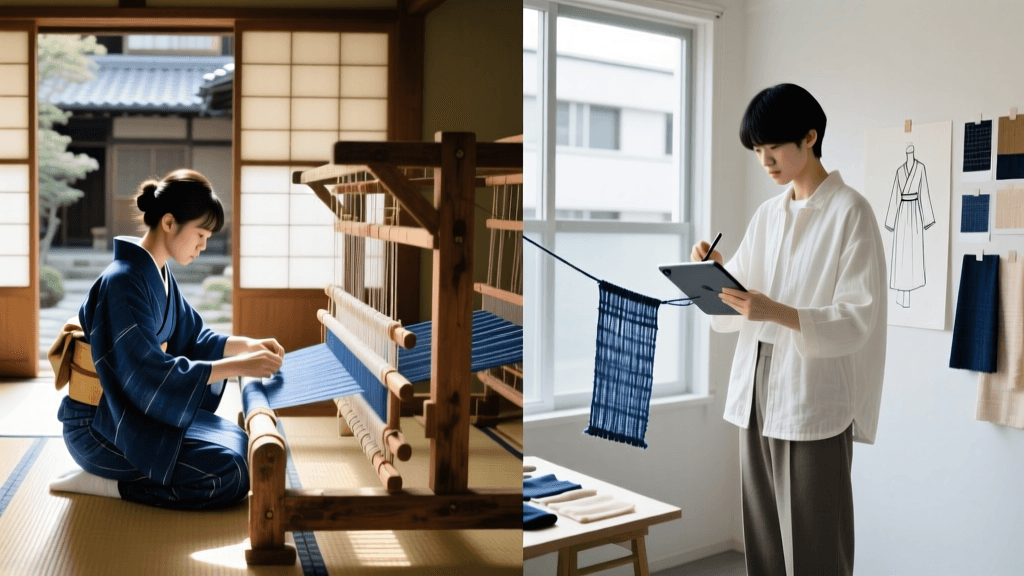
For centuries, the transmission of Japanese textile arts has relied on the deshi (apprentice) system. In the historic weaving district of Nishijin in Kyoto, mastering the intricate Nishijin-ori brocade or the delicate resist-dyeing techniques of Kyo-Yuzen is not something learned from a textbook. It is acquired through minarai—learning by watching—and the rigorous, often grueling physical repetition of tasks under the watchful eye of a master artisan.
In 2026, the traditional apprenticeship model faces a demographic crisis, with the average age of a master weaver exceeding 65. To combat this, the Japanese government and local cooperatives have heavily subsidized new apprenticeship programs. Unlike the past, where apprentices worked for free in exchange for room and board, modern 2026 apprenticeships in recognized traditional craft sectors often include a modest living stipend, funded by regional cultural preservation grants. However, the time commitment remains immense. A dedicated apprentice can expect to spend five to ten years sweeping floors, preparing silk threads, and mixing natural dyes before they are permitted to touch a master’s loom or apply a yuzen cone to premium silk.
The philosophy here is rooted in nusumu, or 'stealing the art.' Masters rarely give explicit verbal instructions. Instead, the apprentice must observe the subtle tension of the master's hands, the exact humidity required for the silk, and the unspoken rhythm of the workshop. This path produces unparalleled mastery of heritage techniques but offers little in the way of modern business training or global fashion networking.
The Institutional Route: Bunka Fashion College and Modern Academies
Conversely, institutions like Bunka Fashion College in Tokyo offer a highly structured, fast-paced, and globally oriented education. Founded in 1923, Bunka has evolved dramatically. In 2026, the curriculum seamlessly blends traditional Japanese garment construction—such as the precise, straight-seam geometry of the kimono and the complex draping of the haori—with cutting-edge digital fashion technology.
Students in Bunka’s 2026 diploma programs spend their mornings studying the historical context of Heian-era layering (junihitoe) and their afternoons utilizing AI-driven textile simulation software and 3D pattern-making tools like CLO 3D. The tuition for a comprehensive diploma course in 2026 hovers around ¥1,400,000 to ¥1,600,000 per year, a significant financial investment compared to the subsidized traditional routes. However, the return on investment is evident in the school's robust industry connections, annual graduate fashion weeks, and direct recruitment pipelines to both avant-garde Tokyo labels and international luxury houses in Paris and Milan.
While an institutional graduate may not possess the decades-deep muscle memory of a Nishijin master weaver, they emerge with a holistic understanding of the global fashion supply chain, brand management, and contemporary design aesthetics, all while maintaining a profound respect for Japanese sartorial roots.
Comparative Analysis: Apprenticeship vs. Fashion School
To help prospective students navigate these options, the following table outlines the core differences between the traditional atelier apprenticeship and the modern fashion academy as of 2026.
| Feature | Traditional Apprenticeship (Nishijin/Yuzen) | Fashion College (e.g., Bunka/Mode Gakuen) |
|---|---|---|
| Duration | 5 to 10+ years for full mastery | 2 to 4 years (Diploma/Degree) |
| Financial Model | Modest stipend + subsidized housing (2026 grants) | ¥1.4M - ¥1.6M annual tuition + living costs |
| Curriculum Focus | Hyper-specialized heritage techniques, material prep | Broad design, pattern making, digital tech, business |
| Technology Integration | Minimal; focus on hand tools and traditional looms | High; AI textiles, 3D modeling, laser cutting |
| Career Outcome | Master artisan, heritage brand custodian, restorer | Fashion designer, brand director, tech-designer |
The 2026 Hybrid Model: Bridging the Gap
Recognizing the urgent need to preserve heritage while fostering innovation, 2026 has seen the rise of hybrid educational models. The Association for the Promotion of Traditional Craft Industries, backed by the Ministry of Economy, Trade and Industry (METI), has partnered with major fashion academies to offer immersive 'craft electives.' Fashion students can now spend a semester in Kyoto or Kanazawa, earning academic credits while learning foundational gold-leaf application (kinkaku) or silk weaving from certified masters.
Furthermore, government-backed 'Den-Sho' (Traditional Craftsman) certification pathways have been modernized. Young designers who graduate from fashion schools can now enter accelerated, government-sponsored apprenticeship tracks that condense the business and historical theory components, allowing them to focus purely on the physical mastery of the craft. This synergy ensures that the next generation of Japanese fashion leaders can innovate without severing their ties to ancestral techniques.
Actionable Guide for 2026 Applicants
Whether you are a domestic student or an international applicant dreaming of mastering Japanese garments, the logistical hurdles of entering these programs require careful planning. Here is a practical guide to securing your place in 2026.
1. Navigating Visa Requirements
International students must carefully select their visa pathway. Those enrolling in accredited institutions like Bunka Fashion College will apply for a standard Student Visa, which permits part-time work (up to 28 hours a week) and offers a clear path to post-graduation employment visas. However, those pursuing independent, private apprenticeships in small Kyoto ateliers often do not qualify for student visas. Instead, they must apply for a Cultural Activities Visa. According to the Japanese Ministry of Foreign Affairs, the Cultural Activities visa requires proof of financial self-sufficiency, as it strictly prohibits paid employment. You must demonstrate that you have the personal funds to support your living expenses in Japan while studying the craft unpaid or on a non-taxable cultural stipend.
2. Language and Cultural Fluency
While modern fashion academies increasingly offer support for English-speaking students, the traditional atelier environment is strictly Japanese-speaking. To survive a Nishijin-ori apprenticeship, a minimum JLPT (Japanese-Language Proficiency Test) N2 is required, though N1 is highly recommended. More importantly, apprentices must master keigo (honorific Japanese) and the unspoken cultural rules of the workshop hierarchy. In 2026, several private language schools in Kyoto offer specialized 'Artisan Japanese' courses tailored specifically for foreign apprentices, focusing on textile vocabulary and workshop etiquette.
3. Portfolio and Interview Preparation
For fashion schools, your portfolio should demonstrate a blend of conceptual creativity and technical understanding. In 2026, admissions committees at top-tier Japanese schools look for applicants who respect traditional silhouettes but can articulate how they will evolve them using modern sustainable practices. For traditional apprenticeships, portfolios are largely irrelevant. Masters are looking for konjo (guts/perseverance), humility, and a willingness to endure years of repetitive, unglamorous labor. Your 'interview' for an apprenticeship will likely involve a trial period of sweeping, cleaning, and observing, where your attitude and attention to minute details will be judged far more harshly than your drawing skills.
Conclusion: Choosing Your Path
The decision between a traditional Japanese kimono apprenticeship and a modern fashion school in 2026 ultimately depends on your ultimate goal. If your ambition is to become a globally recognized fashion designer who draws inspiration from Japanese heritage, the institutional route provides the network, technology, and business acumen required to succeed on the world stage. However, if your soul is tethered to the preservation of human history, and you are willing to dedicate a decade of your life to the quiet, meditative mastery of silk and dye, the traditional shokunin path remains one of the most profoundly rewarding educational journeys on earth. Both paths are vital, and together, they ensure the survival and evolution of Asian traditional garments for generations to come.