Top Kyoto Kyo-Yuzen Kimono Tailoring Workshops 2026
The Renaissance of Traditional Japanese Garment Making
The kimono is far more than a traditional garment; it is a wearable canvas of Japanese history, philosophy, and meticulous craftsmanship. In 2026, the global slow fashion movement and a renewed interest in sustainable, zero-waste textiles have sparked an unprecedented renaissance in traditional Asian garment making. For textile enthusiasts, fashion historians, and sustainable design advocates, traveling to Kyoto to participate in Kyo-Yuzen dyeing and kimono tailoring workshops has become a premier educational pursuit. These immersive seminars offer a rare, hands-on opportunity to learn directly from master artisans who have dedicated their lives to preserving Japan's sartorial heritage.
Kyo-Yuzen, originating in the late 17th century under the legendary artisan Miyazaki Yuzensai, revolutionized silk decoration. Unlike earlier weaving techniques that restricted complex patterns to geometric grids, Yuzen allowed for free-form, pictorial designs on silk using a meticulous resist-dyeing method. Today, the Agency for Cultural Affairs in Japan actively supports the transmission of these techniques to younger generations and international students. The government recognizes that the survival of intangible cultural properties relies not just on museum preservation, but on active practice, innovation, and global appreciation.
Why Study Kimono Tailoring in Kyoto in 2026?
Kyoto remains the undisputed heart of Japan's textile industry, specifically in the Nishijin weaving district and the Higashiyama artisan quarters. In 2026, the city has expanded its cultural tourism infrastructure, offering specialized, multi-day seminars that cater to international students. These workshops bridge the gap between historical technique and modern sustainable fashion. By learning how a kimono is constructed, dyed, and maintained, students gain insights into a circular fashion economy that predates modern environmentalism by centuries.
Furthermore, the integration of digital pattern drafting alongside traditional hand-painting has made these 2026 workshops more accessible to contemporary fashion designers. Students can now map out their Yuzen designs on tablets before committing them to silk, ensuring precision while maintaining the soulful imperfections of hand-applied dyes.
Top Kyo-Yuzen and Tailoring Workshops for 2026
Selecting the right workshop depends on your skill level, time commitment, and specific area of interest. Below is a comparison of the most highly regarded seminars available in Kyoto this year.
| Workshop Name | Duration | 2026 Estimated Cost | Focus Area | Language Support |
|---|---|---|---|---|
| Marumasu-Nishimuraya Yuzen Experience | Half-Day | ¥18,000 | Resist Dyeing Basics & Color Application | English |
| Chiso Masterclass Series | 5 Days | ¥210,000 | Advanced Yuzen, Silk Prep & Gold Leaf | Japanese (Translator available) |
| Kyoto Traditional Tailoring Seminar | 3 Days | ¥115,000 | Wasa Sewing, Tanmono Cutting & Fitting | English |
| Tango Chirimen Weaving & Dyeing Retreat | 4 Days | ¥160,000 | Silk Crepe Weaving & Background Dyeing | English & French |
Marumasu-Nishimuraya Yuzen Experience
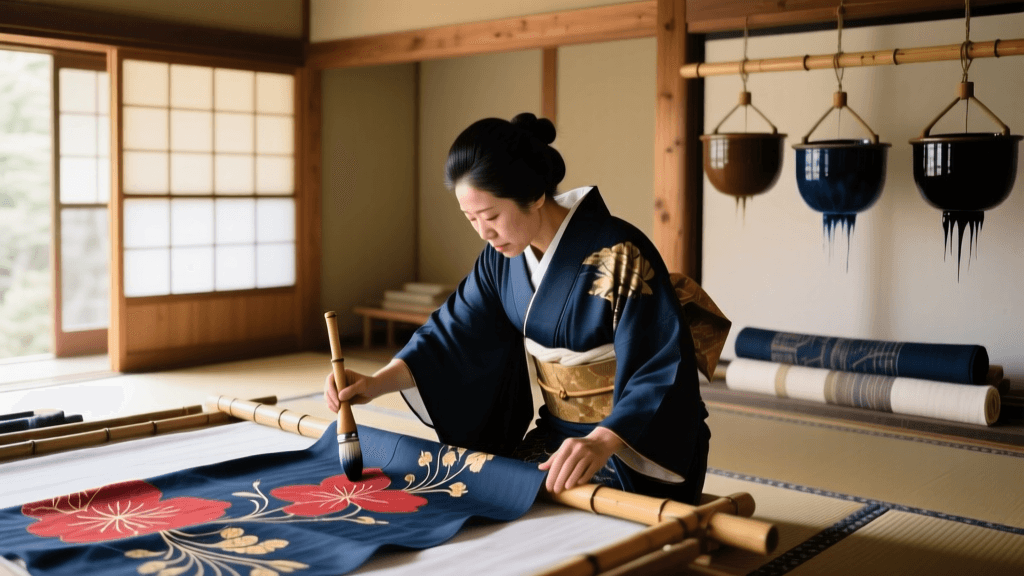
Ideal for beginners and those on a tight schedule, this half-day seminar focuses on the foundational steps of Kyo-Yuzen. Participants learn to apply itome-nori (rice paste resist) using a specialized metal-tipped cone to outline designs. Once the paste dries, students use surikomi-bake (small dye brushes) to hand-paint vibrant colors within the resist boundaries. The session culminates in steaming the fabric to set the dyes, a mesmerizing process that reveals the final, crisp design.
Chiso Masterclass Series
Chiso is one of Kyoto's oldest and most prestigious Yuzen houses, having served the imperial family for centuries. Their 2026 masterclass is an intensive, five-day deep dive into advanced techniques. Students learn the delicate art of surikomi (gradient shading) and the application of pure gold and silver leaf (haku) to accentuate floral and avian motifs. This seminar is highly recommended for professional textile designers seeking to elevate their couture portfolios.
Kyoto Traditional Tailoring Seminar
While dyeing captures the imagination, the structural engineering of the kimono is equally profound. This three-day seminar focuses entirely on Wasa (traditional Japanese sewing). Students learn how to cut a standard tanmono (a 12-meter bolt of silk) into precise rectangular panels without wasting a single thread. The focus is on mastering the hon-buse seam, a straight stitch that allows the garment to drape elegantly while remaining structurally sound.
The Philosophy of Wasa: Zero-Waste Tailoring
The construction of a kimono is fundamentally different from Western tailoring. Western pattern making often involves curved cuts that result in significant textile waste. In contrast, kimono tailoring utilizes straight, rectangular panels. This zero-waste philosophy is highly relevant in 2026's eco-conscious fashion climate, where designers are actively seeking historical precedents for sustainable manufacturing.
Moreover, the seams of a kimono are designed to be easily unpicked. This allows the garment to be completely disassembled, washed, stretched, and re-sewn—a traditional maintenance process known as arai-hari. During the tailoring workshops, students practice this disassembly and reassembly process, learning how to mist the silk and stretch it over wooden boards to revitalize the fabric's luster and remove wrinkles without the use of harsh chemical dry cleaning.
Essential Tools of the Trade
Participants in these 2026 workshops will become intimately familiar with a variety of specialized, handcrafted tools that have remained largely unchanged for generations:
- Hera: A smooth, hardened wooden or tortoiseshell spatula used to crease silk and guide the application of rice paste.
- Shinshi: Bamboo stretchers equipped with tiny, sharp needles at the ends. These are used to keep the silk taut and prevent the fabric from touching itself while the wet dyes are setting.
- Yuzen-bake: Specially crafted brushes made from deer hair and horsehair, designed to hold and release liquid dyes in controlled, gradual gradients.
- Tango Chirimen: The premier silk crepe used in these workshops. Woven in the nearby Tango region, its high-twist yarns create a distinctive pebbled texture that catches the light and absorbs Yuzen dyes with unparalleled vibrancy.
Preparing for Your 2026 Workshop
Planning a trip to Kyoto for a specialized craft seminar requires foresight. The most prestigious workshops, particularly those hosted by historic houses like Chiso, cap their class sizes at five to eight students to ensure personalized instruction. Consequently, bookings for the 2026 spring and autumn seasons often close six months in advance. The Japan National Tourism Organization provides excellent resources for navigating craft tourism, including verified lists of English-speaking artisan studios and recommended local ryokans (traditional inns) that cater to textile tourists.
When packing for your seminar, bring your own set of high-quality fabric shears and a thimble if you have personal preferences, though all specialized Yuzen tools will be provided by the studios. It is also advisable to wear comfortable, dark clothing that you do not mind getting stained, as the indigo and botanical dyes used in the resist-dyeing process are notoriously permanent.
Preserving Intangible Heritage Through Practice
Attending a Kyo-Yuzen and tailoring workshop is more than a vacation; it is an act of cultural preservation. As the UNESCO Intangible Cultural Heritage frameworks emphasize, traditional craftsmanship survives only when it is practiced, taught, and valued by new generations. By investing time and resources into learning these techniques in 2026, international students help sustain the livelihoods of Kyoto's aging artisan population. They also carry the principles of zero-waste tailoring, natural dyeing, and mindful consumption back to their home countries, ensuring that the wisdom of the kimono continues to influence the future of global fashion.