Top Kyoto Kimono Construction Masterclasses for 2026: A Guide
The Renaissance of Wafuku in 2026
In the current 2026 landscape of global slow fashion, the appetite for authentic, heritage-based garment construction has never been higher. Among the most revered and technically fascinating traditions is the creation of wafuku (Japanese clothing). For international textile artists, fashion historians, and bespoke tailors, traveling to Kyoto to study traditional kimono construction has become a pinnacle educational experience. Unlike Western tailoring, which relies heavily on complex curved pattern drafting and dart manipulation to fit the human form, traditional Japanese garment making operates on an entirely different geometric and philosophical paradigm. This guide explores the premier workshops and seminars available in Kyoto for 2026, providing actionable insights for artisans looking to master the art of the kosode (the foundational T-shaped robe that evolved into the modern kimono).
The Philosophy of Chokusen-dachi and Zero-Waste Tailoring
Before enrolling in a masterclass, it is vital to understand the core philosophy you will be studying: chokusen-dachi, or the straight-line cut. Traditional kimono are constructed from a single bolt of fabric known as a tanmono, which typically measures approximately 36 centimeters in width and 12 meters in length. The fabric is cut into straight rectangular panels—two for the body, two for the sleeves, and smaller strips for the collar and overlapping front panels.
According to the Victoria and Albert Museum's extensive archives on Japanese dress, this method of construction is not merely an aesthetic choice but a deeply ingrained cultural approach to material conservation. Because the panels are cut in straight lines, the garment can be entirely disassembled, washed, re-dyed, and resewn without wasting a single millimeter of textile. In 2026, as the global fashion industry grapples with severe textile waste, the zero-waste methodology of the tanmono offers invaluable lessons for modern sustainable fashion designers. Masterclasses in Kyoto do not just teach you how to sew; they teach you how to respect the integrity of the woven cloth.
Top Kyoto Kimono Construction Masterclasses for 2026
Kyoto remains the undisputed epicenter of Japanese textile arts. For the 2026 academic and tourist seasons, several prestigious institutions and private ateliers have opened their doors to international students, offering English-language support and specialized curricula. Below are the top three programs currently accepting applications.
1. The Nishijin Textile Center: Kosode Intensive Seminar
Located in the historic Nishijin weaving district, this two-week intensive seminar is ideal for those who want to understand the relationship between the loom and the needle. The 2026 curriculum begins with three days of tanmono selection and weaving observation, allowing students to understand how silk tension and weave density affect the drape of the final garment. The remaining days are spent in the sewing studio, where master artisans guide students through the shitate (assembly) process. Students will complete one unlined summer kimono (hitoe) by the end of the course.
2. Kyoto Traditional Arts Center: Historical Pattern Alignment
For advanced sewers and fashion historians, this four-week deep dive focuses on the meticulous art of pattern matching across the straight-cut seams. When a kimono features a continuous landscape or geometric motif, the artisan must ensure the design flows seamlessly across the body panels, sleeves, and collar. This seminar utilizes vintage and reproduction yuzen-dyed silks, teaching the mathematical precision required to align motifs while adhering to the strict zero-waste cutting rules of the tanmono.
3. Wafuku no Gakko: Summer Machiya Atelier Cohort
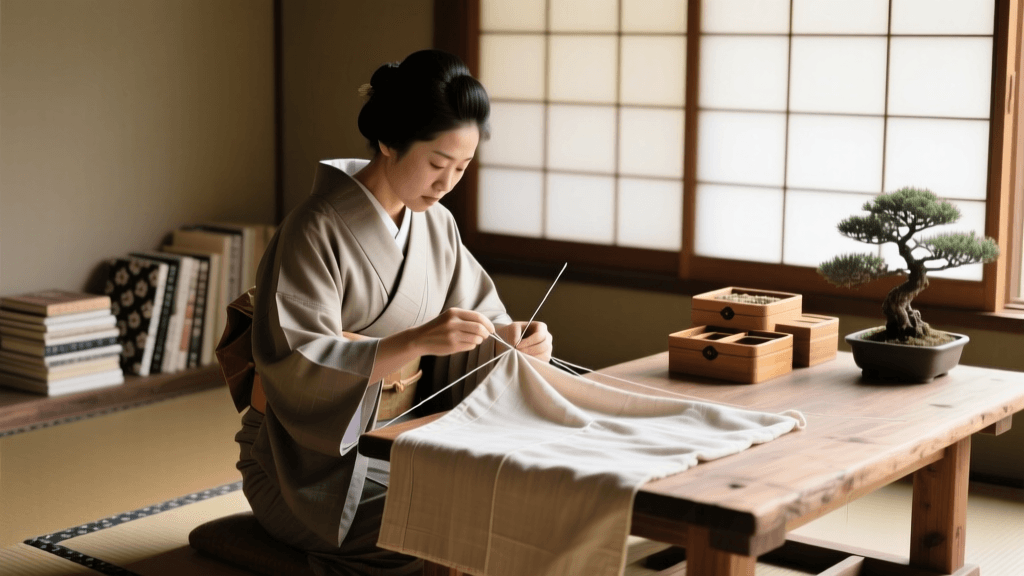
Housed in a beautifully restored wooden machiya (traditional townhouse), this private atelier offers a highly personalized, one-week bespoke workshop. Limited to just four students per cohort, the focus here is on the hand-stitching techniques that define high-end kimono construction. Students learn the hon-gushi (main running stitch) and the chikushi (reinforcement stitch), mastering the precise tension required to make hand-sewn silk seams virtually invisible from the outside while remaining incredibly durable.
2026 Workshop Comparison Chart
To help you choose the right program for your skill level and schedule, we have compiled a comparison of the top 2026 Kyoto workshops. Pricing reflects the current 2026 USD exchange rates and includes all materials.
| Workshop Name | Duration | 2026 Tuition (USD) | Primary Focus Area | Language Support |
|---|---|---|---|---|
| Nishijin Textile Center Intensive | 2 Weeks | $2,400 | Weaving context & Hitoe assembly | English / Japanese |
| Kyoto Traditional Arts Center | 4 Weeks | $4,850 | Motif alignment & Yuzen silk handling | English / Japanese / French |
| Wafuku no Gakko Machiya Cohort | 1 Week | $1,600 | Advanced hand-stitching & finishing | English / Japanese |
The Artisan’s Toolkit: What You Will Learn to Use
Western tailoring relies heavily on the sewing machine, steam irons, and complex paper patterns. In a traditional Kyoto masterclass, you will be introduced to a deeply specialized, centuries-old toolkit. Understanding these tools is a prerequisite for any 2026 applicant:
- Hera (Bamboo Spatula): Used instead of chalk or pins to mark fold lines and crease the silk. The smooth bamboo prevents snagging delicate fibers while creating sharp, temporary guidelines.
- Kote and Kotedai (Traditional Iron and Board): Unlike modern steam irons, the kote is a small, heated metal tool used with precise, localized pressure to set seams and manipulate the silk's grain without stretching it.
- Mehari (Leather Thimble): A specialized palm or finger thimble designed to push the needle through multiple layers of tightly woven silk during the hon-gushi running stitch.
- Kakehari (Fabric Tension Frame): A wooden frame and clamp system used to stretch the fabric taut while sewing, ensuring that the running stitches remain perfectly even and the silk does not pucker.
Navigating 2026 Logistics: Visas, Accommodations, and Enrollment
Planning a textile study trip to Japan requires careful logistical preparation. According to the Kyoto City Tourism Association, the city has seen a massive surge in cultural tourism, meaning early booking for both workshops and accommodations is essential for 2026.
Visa Requirements for Artisans
If you are enrolling in a one or two-week seminar, a standard tourist visa (or visa waiver, depending on your passport) is sufficient. However, if you plan to undertake the four-week intensive at the Kyoto Traditional Arts Center and wish to extend your stay for independent research, you may need to apply for a Cultural Activities Visa. In 2026, the Japanese immigration bureau requires documented proof of enrollment in a registered cultural institution, a detailed syllabus of your study plan, and proof of sufficient financial means to support your stay without engaging in paid labor.
Accommodation: The Machiya Experience
To fully immerse yourself in the textile tradition, many students opt to rent a room in a traditional machiya guesthouse. These wooden townhouses often feature tatami mat rooms and tokonoma (alcoves) where seasonal textiles are displayed. Booking through the Japan National Tourism Organization's certified heritage stay network ensures that your accommodation meets modern safety standards while preserving historical architecture. Expect to pay between $120 and $250 per night in 2026 for a private room in a shared heritage machiya.
Modern Styling and the Future of the Kosode
While the masterclasses focus on historical accuracy and traditional techniques, the ultimate goal for many 2026 students is to integrate these zero-waste, straight-line construction methods into contemporary fashion. The kosode is inherently modular. By mastering the traditional seams, modern designers are learning how to create garments that can be easily altered, resized, or repurposed as the wearer's body changes over time. The skills acquired in Kyoto's ateliers are not just about preserving the past; they are about engineering a more sustainable, mindful future for global garment construction.
Whether you are a bespoke tailor looking to expand your hand-finishing repertoire, or a sustainable fashion advocate seeking zero-waste pattern solutions, Kyoto’s 2026 kimono construction masterclasses offer an unparalleled educational journey. Prepare your hands, respect the silk, and embrace the profound geometry of traditional Asian tailoring.