Inside Kyoto's Artisan Workshops: Weaving and Dyeing Kimono Silk
The Living Heritage of Japanese Textile Artisans
The creation of a single silk kimono is rarely the work of one individual. Instead, it is a symphony of specialized artisans, each mastering a distinct phase of textile production. From the meticulous spinning of silk floss to the application of resist dyes and the rhythmic clatter of the loom, traditional Japanese garment creation is a profound intersection of art, engineering, and cultural preservation. According to the Metropolitan Museum of Art's Heilbrunn Timeline of Art History, the Edo period (1615–1868) saw a massive shift in Japanese textiles. Strict sumptuary laws restricted the common classes from wearing overtly luxurious fabrics, which inadvertently pushed artisans to develop incredibly subtle, sophisticated dyeing and weaving techniques to bypass these regulations while maintaining aesthetic brilliance.
Today, Kyoto remains the undisputed heart of Japan's kimono industry. For textile enthusiasts, fashion historians, and cultural travelers, stepping into a Kyoto artisan workshop offers a rare glimpse into the foundational aspects of Asian sartorial traditions. This guide explores the intricate worlds of Nishijin-ori weaving and Kyo-Yuzen dyeing, providing actionable advice on how to experience, understand, and support these heritage crafts.
Nishijin-Ori: The Symphony of the Loom
Nishijin-ori (Nishijin weaving) is not a single fabric, but rather a collective term for the highly complex, multi-layered brocades and patterned silks produced in the Nishijin district of Kyoto. The tradition traces its roots back to the Onin War (1467–1477), when displaced weavers returned to the ruined western part of the capital and reestablished their looms.
The Architecture of the Tanmono
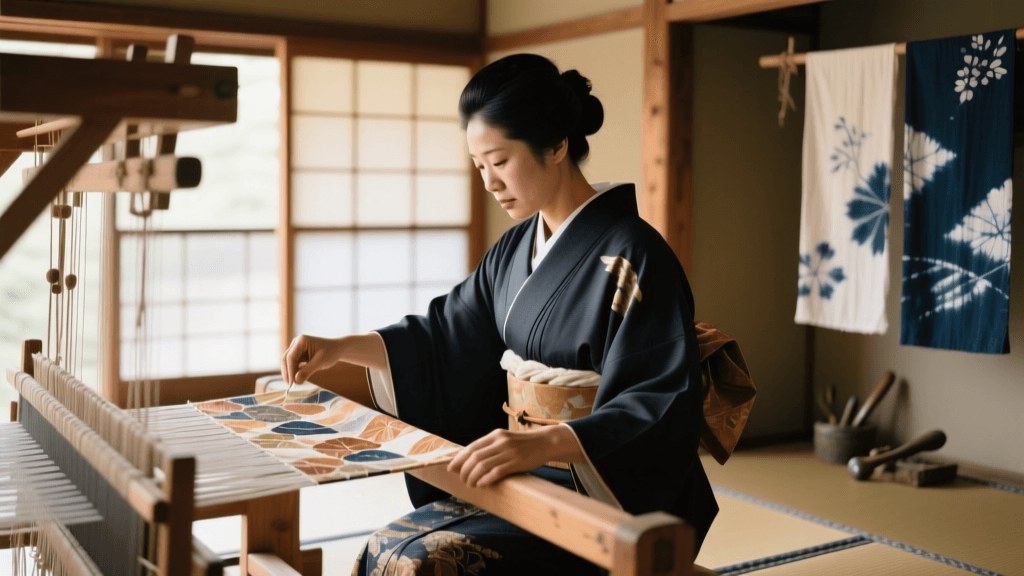
To understand Nishijin weaving, one must understand the tanmono, the standard bolt of kimono fabric. Unlike Western tailoring, which cuts fabric into varied shapes and discards the scraps, a kimono is constructed from a single bolt of cloth measuring exactly 36 centimeters (14 inches) wide and 12 meters (13 yards) long. This specific measurement dictates the entire cutting and sewing pattern of the garment, ensuring virtually zero waste. Weavers in Nishijin must engineer their Jacquard looms and traditional soribata (curved hand looms) to accommodate this precise width, weaving intricate patterns—such as the kinran (gold leaf threads)—that will perfectly align with the kimono's seams when tailored.
Visiting and Experiencing Nishijin
For travelers, the Nishijin Textile Center is the most accessible entry point. While entry to the museum and daily kimono fashion shows is free or costs around 1,000 JPY, the real value lies in the hands-on workshops. Visitors can book a session to weave their own small items, such as a coaster or a small pouch, on a traditional table loom.
- Cost: Approximately 2,500 to 3,500 JPY per person for a small woven souvenir.
- Timing: Sessions last 45 to 60 minutes. Walk-ins are sometimes accepted, but booking a week in advance is recommended.
- Actionable Tip: If you wish to purchase an authentic, hand-woven Nishijin obi (kimono sash) directly from a master weaver, expect to pay between 300,000 and 1,500,000 JPY. Always ask for the shosai (certificate of authenticity) and the weaver's stamp.
Kyo-Yuzen: Painting with Resist Dyes
While Nishijin-ori relies on the interplay of pre-dyed threads, Kyo-Yuzen is a surface design technique that treats silk like a painter's canvas. Invented in the late 17th century by Miyazaki Yuzensai, a fan painter, this technique allowed for the creation of sweeping, pictorial landscapes and vibrant floral motifs that were previously impossible to achieve through weaving alone.
The 20-Step Process of Tegaki-Yuzen
Authentic tegaki-yuzen (hand-painted Yuzen) is a grueling, multi-step process. First, the artisan sketches the design using aobana (dayflower juice), a water-soluble blue ink that vanishes when washed. Next, the outlines are traced with itome-nori, a thick rice-paste resist that prevents dyes from bleeding. The fabric then undergoes jizome (base dyeing), followed by irosashi, where artisans use delicate brushes—often made of deer hair—to apply vibrant chemical or natural dyes. Finally, the silk is steamed at high temperatures to set the colors and washed in cold running water to remove the resist paste, historically done in Kyoto's Kamo River during winter.
Booking a Yuzen Dyeing Workshop
Many studios in the Higashiyama and Nishijin districts offer condensed Yuzen experiences for visitors. Because the full kimono process takes months, workshops focus on smaller items like silk furoshiki (wrapping cloths), tenugui (hand towels), or silk stoles.
- Cost: 3,500 to 6,000 JPY per person, depending on the size of the silk piece (e.g., a 30cm x 100cm stole vs. a 50x50cm furoshiki).
- Timing: 2 to 3 hours. Because the fabric requires steaming and drying, you usually cannot take your finished piece home the same day. Studios will mail it to your hotel or international address within a week.
- Actionable Tip: Wear dark, old clothing to the workshop. While the rice paste acts as a resist, accidental splashes of liquid dye on your clothes will not wash out.
Comparing Kyoto's Premier Textile Crafts
Understanding the distinction between weaving and dyeing is crucial for collectors and enthusiasts. Below is a comparison chart to help you decide which artisan workshop to prioritize during your visit.
| Feature | Nishijin-Ori (Weaving) | Kyo-Yuzen (Dyeing) |
|---|---|---|
| Primary Technique | Interlacing pre-dyed threads on a loom | Applying dye to woven white silk using resist paste |
| Best Used For | Obi (sashes), heavy formal outer layers, ties | Kosode/kimono bodies, linings, furoshiki |
| Visual Texture | Tactile, raised patterns, metallic sheen | Smooth, painterly, vibrant gradients |
| Workshop Cost | ~3,000 JPY (small table loom items) | ~4,500 JPY (stoles and wrapping cloths) |
| Time to Master | 10+ years (loom engineering and threading) | 10+ years (brush control and color theory) |
Beyond Kyoto: Oshima Tsumugi and Yuki-Tsumugi
While Kyoto dominates the luxury silk market, rural workshops preserve some of the most labor-intensive textile traditions in the world. On Amami Oshima island, artisans create Oshima Tsumugi (pongee silk) using a unique mud-dyeing technique called dorozome. Silk threads are dyed in a decoction of plum tree bark and then submerged in iron-rich mud, creating a deep, colorfast charcoal grey that is highly prized for its understated elegance.
Further north, in Ibaraki and Tochigi prefectures, artisans produce Yuki-tsumugi. This craft is so culturally significant that it was inscribed on the UNESCO Intangible Cultural Heritage list. Yuki-tsumugi involves hand-spinning silk floss into thread without twisting it, resulting in a fabric that is incredibly lightweight yet retains immense warmth. The kasuri (tie-dye) patterns are created by binding individual microscopic sections of thread with cotton before dyeing, requiring mathematical precision to ensure the pattern aligns perfectly when woven. A single bolt of high-grade Yuki-tsumugi can take over a year to complete and cost upwards of 2,000,000 JPY.
Practical Guide to Booking and Workshop Etiquette
Visiting traditional workshops requires an understanding of Japanese professional etiquette and logistical planning. Most master artisans do not speak English, and their studios are active workplaces, not just tourist attractions.
How to Book
Do not expect to simply walk into a master's private studio. Instead, use curated platforms like Rakuten Travel Experiences or the official Kyoto City Tourism Association website to book guided visits. These platforms provide bilingual interpreters who can translate the nuanced terminology of textile production. For those looking to purchase verified traditional crafts after their visit, the Japan Traditional Craft Aoyama Square (backed by the Ministry of Economy, Trade and Industry) is an invaluable resource for locating certified artisans and official regional galleries across Japan.
Studio Etiquette
- Footwear: You will almost certainly be required to remove your shoes before entering a weaving or dyeing studio to protect the silk from street dirt. Always carry a clean pair of socks; bare feet are considered unhygienic in these environments.
- Photography: Never use flash photography, as intense light can degrade certain natural dyes over time. Furthermore, always ask permission before photographing a weaver's loom setup or a dyer's sketchbook, as these often contain proprietary, unreleased designs.
- Handling Silk: If an artisan hands you a piece of undyed or dyed silk to examine, handle it only by the very edges. The natural oils and acids on human fingertips can stain or weaken delicate silk fibers over time.
Preserving the Future of Traditional Textiles
The greatest threat to Japanese traditional garment crafts is not a lack of interest, but an aging artisan population. The average age of a master weaver or dyer in Kyoto is well over 60. By participating in workshops, paying fair market value for authentic textiles, and taking the time to understand the staggering amount of human labor required to produce a single tanmono, visitors play a direct role in sustaining these institutions. When you wrap a hand-dyed Yuzen furoshiki around a gift, or tie a Nishijin-woven sash, you are not just wearing a garment; you are participating in a living, breathing lineage of Asian artistic mastery.