Hanfu vs Xifu: 2026 Guide To Kunqu And Peking Opera Costumes
The Intersection of History and Theatricality
As the global appreciation for traditional Asian performing arts reaches new heights in 2026, the intersection of historical fashion and theatrical costuming has never been more relevant. For enthusiasts, practitioners, and collectors of Kunqu and Peking Opera (Jingju), understanding the distinction between everyday historical Hanfu and specialized stage garments—known as Xifu (戏服)—is essential. While the modern Hanfu movement has beautifully revived the daily and ceremonial dress of the Han people, the theatrical wardrobe operates under an entirely different set of aesthetic, functional, and symbolic rules. This comprehensive 2026 guide explores the nuances of Kunqu and Peking Opera costuming, providing actionable advice on sourcing, measuring, and maintaining these magnificent wearable artworks.
The Evolutionary Bridge: From Hanfu to Xifu
To appreciate the theatrical garments of today, one must understand their historical roots. According to Encyclopædia Britannica, the visual language of Peking Opera was largely codified during the Qing Dynasty, drawing heavy inspiration from the clothing of the preceding Ming Dynasty. Consequently, the foundational silhouettes of Xifu—such as the round-collar robes and crossed-collar jackets—are direct descendants of historical Hanfu. However, the stage demands exaggeration. Where historical Hanfu prioritized drape, modesty, and social regulation, Xifu prioritizes movement, character identification, and visibility from the back of a grand theater.
In 2026, master artisans in Suzhou and Beijing continue to utilize traditional silk-weaving and metallic-thread embroidery techniques, ensuring that the legacy of these Ming-inspired theatrical garments remains vibrant. The UNESCO Intangible Cultural Heritage recognition of Kunqu Opera has further catalyzed investment in authentic costume preservation, driving a renaissance in specialized theatrical tailoring that strictly adheres to historical embroidery motifs while adapting to modern stage lighting and performer ergonomics.
The Five Pillars of the Theatrical Wardrobe
Unlike historical Hanfu, which is categorized by dynasty and specific ceremonial function, Xifu is categorized by the social status and role type (Sheng, Dan, Jing, Chou) of the character. The wardrobe is broadly divided into five main categories:
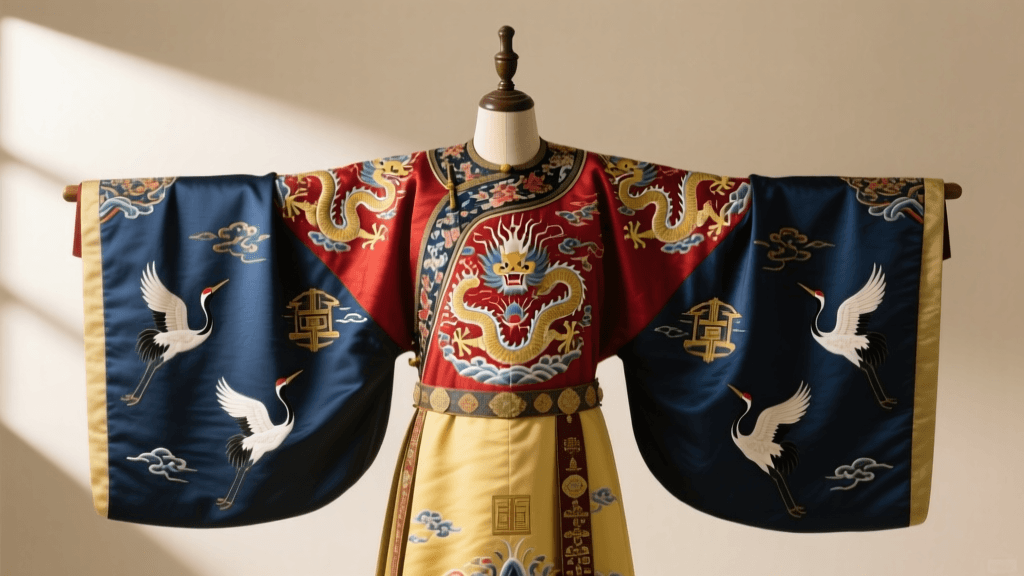
- Mang (蟒 - Python Robe): The highest form of theatrical dress, worn by emperors, high-ranking officials, and nobles. Despite the name, the embroidery typically features dragons with four claws. In 2026, a hand-embroidered silk Mang robe from a master Suzhou studio costs between $4,500 and $9,000 USD, featuring intricate gold-wrapped thread couching.
- Kao (靠 - Armor): Worn by military generals and warriors. The Kao is highly stylized, featuring four triangular flags attached to the back to represent an army. The armor is heavily padded and embroidered with scale motifs, allowing for acrobatic combat sequences without restricting the performer's range of motion.
- Pei (帔 - Casual Noble Wear): A relaxed, open-front robe with wide sleeves, worn by nobles and scholars in domestic or informal settings. It is the theatrical equivalent of historical Hanfu casual outerwear, often featuring symmetrical floral or avian embroidery.
- Xuezi (褶子 - Informal Dress): The most versatile garment in the Xifu wardrobe. It is a crossed-collar robe worn by almost all character types. A black Xuezi with minimal embroidery denotes a scholar in distress or a commoner, while brightly colored, heavily embroidered versions denote wealthy or heroic figures.
- Yi (衣 - Miscellaneous Garments): A catch-all category for specific character costumes, including the garments worn by eunuchs, monks, and martial artists, which do not fit into the strict hierarchical structure of the Mang or Kao.
Sourcing Authentic Xifu in 2026
For theater companies, serious students, and collectors looking to acquire authentic Xifu in 2026, the market is distinctly bifurcated between mass-produced practice gear and master-crafted performance pieces.
Practice and Student Grade
For rehearsals and amateur productions, machine-embroidered polyester and synthetic silk blends are the standard. These garments are durable, machine-washable, and cost-effective. A standard practice Xuezi can be sourced from specialized theatrical suppliers in Beijing's Liulichang district or via verified online artisans for approximately $80 to $150 USD. While they lack the luster of real silk, they are essential for the rigorous physical demands of daily martial arts and acrobatic training.
Master-Crafted Performance Grade
For professional stage performances and archival collections, natural mulberry silk and genuine metallic threads are mandatory. The undisputed hub for high-end Xifu embroidery remains Suzhou, specifically the workshops surrounding the Suzhou Silk Museum. Commissioning a bespoke Mang or Kao in 2026 requires a lead time of 4 to 8 months. Buyers should expect to pay a 30% deposit upfront, with the final cost reflecting the density of the embroidery (measured in stitches per square inch) and the purity of the gold leaf used in the thread.
Crucial Measurements for Stage Garments
Tailoring for Xifu differs significantly from historical Hanfu. While chest, waist, and hip measurements are taken, the theatrical tailor prioritizes measurements that affect stage presence and prop manipulation.
- Nape to Wrist (Water Sleeve Base): The base sleeve must end precisely at the wrist bone to allow for the seamless attachment of the Shuixiu (water sleeves).
- Shoulder Width (For Kao): The shoulder seams of the armor must align perfectly with the performer's natural shoulder pivot to ensure the back flags remain upright and balanced during combat choreography.
- Inseam and Cuff Width: Trousers worn beneath the robes must feature tightly bound cuffs (using specialized theatrical leg wraps) to prevent tripping during high kicks and leaps.
Historical Hanfu vs. Stage Xifu: A 2026 Comparison
| Feature | Historical Hanfu (Ming Dynasty Revival) | Theatrical Xifu (Kunqu/Peking Opera) |
|---|---|---|
| Primary Purpose | Daily wear, ceremonies, historical accuracy | Stage performance, character archetypes, acrobatics |
| Sleeves | Standard width,琵琶袖 (Pipa sleeves) or wide cuffs | Exaggerated length with detachable white silk Shuixiu (Water Sleeves) |
| Embroidery | Asymmetrical, subtle, nature-inspired, historically regulated | Symmetrical, bold, high-contrast, visible from 50+ meters away |
| Closures | Hidden ties, fabric buttons, subtle fastenings | Reinforced brass hooks, heavy-duty ties to withstand rapid movement |
| Color Palette | Dye-based, historically accurate pastels and deep tones | Highly saturated, symbolic colors (e.g., bright yellow for royalty) |
Essential Theatrical Accessories
No Xifu ensemble is complete without its specialized accessories, which are just as critical to the performance as the garments themselves.
- Shuixiu (Water Sleeves): In 2026, professional Kunqu performers typically use water sleeves measuring 18 to 24 inches in length for subtle emotional expression, while Peking Opera performers may use sleeves up to 36 inches for dramatic, sweeping choreography. They are made of unbleached, heavy-weight silk crepe to ensure they snap and fold correctly in the air.
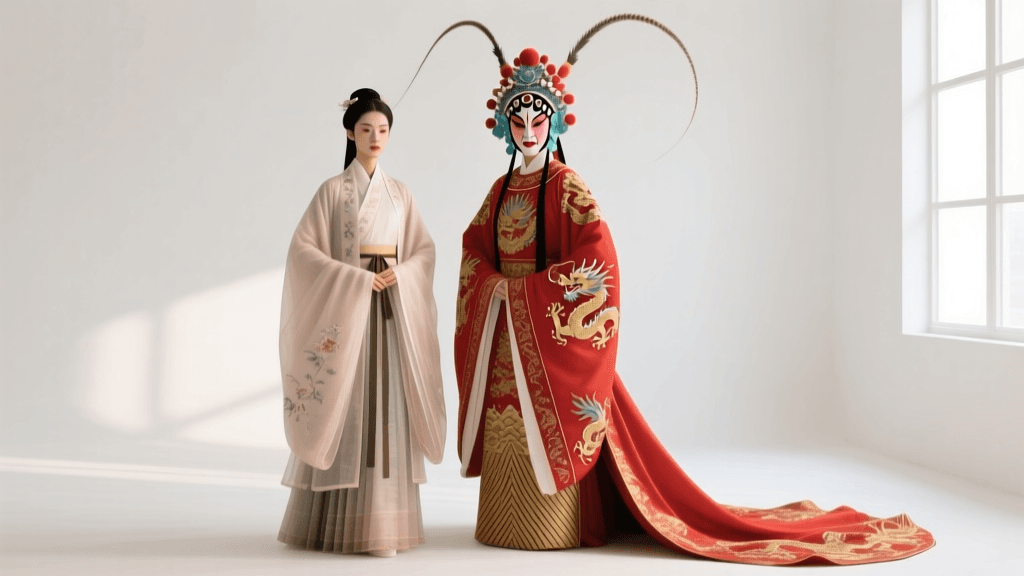
- Lingzi (Pheasant Feathers): Attached to the helmets of martial characters, these six-foot-long feathers are used to express emotion through subtle head movements. Authentic Lingzi are sourced from specific molting cycles of ring-necked pheasants, and a matched pair can cost upwards of $300 USD due to the strict requirement for symmetry and flexibility.
- Fengguan (Phoenix Crown): Worn by high-ranking female characters (Dan). Unlike historical Hanfu hairpins, the theatrical Phoenix Crown is heavily weighted with beaded tassels and spring-mounted ornaments that quiver with the actor's slightest movement, amplifying their stage presence.
"The costume does not merely dress the actor; it dictates the actor's soul. When the water sleeve extends, it is not fabric moving; it is the character's grief reaching across the stage." — Traditional Kunqu Costuming Proverb.
Archival Care and Maintenance for 2026
Proper maintenance of Xifu is critical, especially for master-crafted silk pieces that represent a significant financial and cultural investment. The heavy use of metallic threads and stiffening agents in theatrical costumes requires specialized care that differs vastly from standard historical Hanfu maintenance.
Climate Control and Storage
Silk and metallic threads are highly susceptible to humidity fluctuations. In 2026, archival best practices dictate storing Xifu in acid-free, breathable cotton garment bags within a climate-controlled environment maintaining a steady 45-55% relative humidity. The Kao (armor) must never be folded, as the stiffened canvas and metallic embroidery will crack. It must be hung on custom-padded, wide-shoulder hangers to distribute the immense weight of the back flags and padding.
Cleaning Protocols
Never machine wash or aggressively spot-clean performance-grade Xifu. The sweat and stage makeup absorbed by the inner linings should be addressed by specialized theatrical dry cleaners who understand the chemical sensitivity of gold-wrapped threads. For minor odors between performances, practitioners in 2026 utilize UV-C sanitizing wands and ozone-free air purifiers inside the storage wardrobes to neutralize bacteria without degrading the silk fibers or fading the vibrant, high-contrast stage dyes.
Conclusion
The world of Kunqu and Peking Opera costuming is a breathtaking fusion of Ming Dynasty Hanfu aesthetics and the hyper-functional demands of the stage. As we move through 2026, the dedication of artisans in Suzhou and Beijing ensures that the Mang, Kao, and Xuezi remain not just relics of the past, but living, breathing components of a dynamic performing art. Whether you are a theater director sourcing authentic garments for a new production, or a cultural historian studying the evolution of Asian textiles, understanding the profound differences between historical Hanfu and theatrical Xifu is the first step toward truly appreciating the sartorial majesty of traditional Chinese opera.