Hanfu in Kunqu and Peking Opera: 2026 Stage Costume Guide
The Renaissance of Hanfu in Traditional Performing Arts
The global resurgence of Hanfu has evolved far beyond street fashion and social media photography. As we navigate through 2026, the most profound impact of the Hanfu movement is visible on the traditional stage, particularly within the highly stylized worlds of Kunqu and Peking Opera (Jingju). Today's premier theater troupes are no longer relying solely on the exaggerated, anachronistic costumes of the mid-20th century. Instead, there is a deliberate, meticulously researched return to the authentic silhouettes of the Ming and Song dynasties, adapted ingeniously for the rigorous demands of live theatrical performance.
Kunqu Opera, often revered as the 'mother of a hundred operas' and recognized by UNESCO as an Intangible Cultural Heritage, relies heavily on visual poetry. The costumes must reflect the refined, scholarly aesthetics of historical Hanfu while allowing for the explosive, acrobatic, and deeply emotional movements required by the performers. This 2026 stage costuming guide explores the fascinating intersection of historical accuracy and theatrical practicality, offering a comprehensive look at how traditional Chinese garments are engineered for the modern stage.
Bridging Historical Accuracy and Theatrical Exaggeration
To understand stage Hanfu, one must distinguish between historical daily wear and Xifu (traditional opera costumes). Historically, opera costumes were a melting pot of various dynastic styles, often prioritizing visual hierarchy and character archetypes over strict historical accuracy. However, the 2026 theatrical landscape demands a higher degree of authenticity. Audiences are more educated about traditional Chinese dress than ever before, and directors are responding by grounding their productions in verifiable history.
For instance, the foundational garments worn by scholars and officials in contemporary Kunqu productions are now heavily based on the Ming Dynasty Daopao (Taoist robe) and Yisan (pleated robe). Yet, these garments are modified. The hems are weighted, the collars are stiffened for better visibility under stage lighting, and the color palettes are adjusted to align with both historical dyeing capabilities and modern LED stage design. According to research highlighted by The Metropolitan Museum of Art's Heilbrunn Timeline of Art History, Chinese opera costumes have always served as a visual language to denote rank, gender, and personality; the 2026 approach simply refines this language with historical precision.
The Mechanics of Water Sleeves (Shui Xiu)
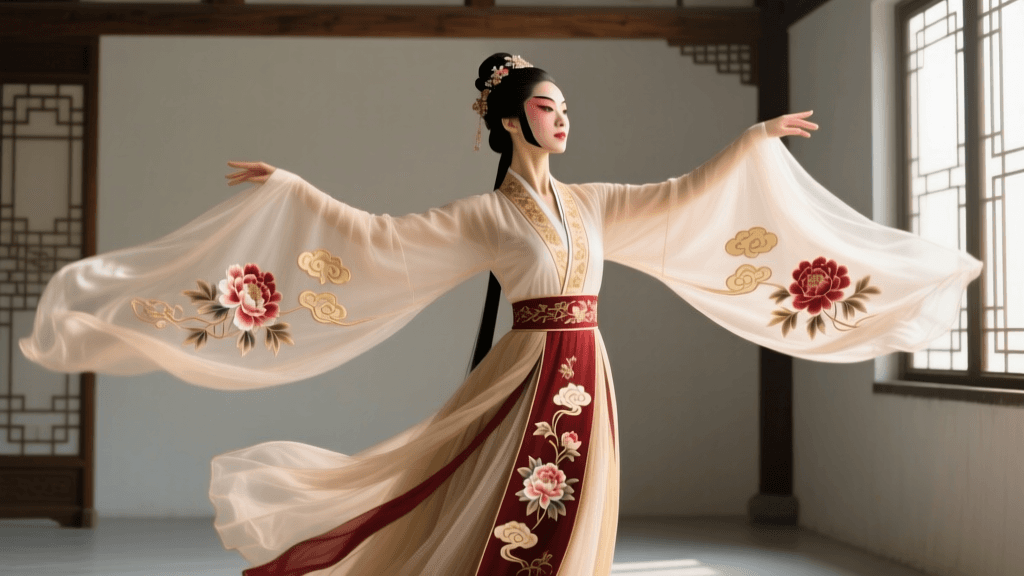
No element of traditional Chinese performing arts is more iconic than the water sleeve. While historical Hanfu featured generous sleeves—such as the wide Daxiushan of the Tang dynasty or the elegant Pipa sleeves of the Ming dynasty—the theatrical water sleeve is an extreme exaggeration designed purely for kinetic expression. In 2026, the standard stage water sleeve measures between 1.5 and 2.2 meters in length, extending far beyond the fingertips.
The material science behind these sleeves has seen significant upgrades this year. Traditional mulberry silk, while beautiful, is prone to tearing and heavy water staining from performer perspiration. Modern troupes now utilize high-tensile peace silk blended with micro-modal fibers. This 2026 textile innovation provides the exact fluid drape and 'snap' required for techniques like touxiu (throwing the sleeve) and zhengxiu (straightening the sleeve), while offering a 40% increase in tensile strength and moisture-wicking properties. The cuffs are often weighted with micro-lead alternatives to ensure the sleeves fall perfectly back onto the forearm when not in active use.
Embroidery and the Python Robe (Mang)
The Mang robe, worn by emperors and high-ranking officials in Peking Opera, is a direct theatrical descendant of the Ming Dynasty court dragon robe. In 2026, the embroidery techniques used on these garments represent the pinnacle of Suzhou (Su) embroidery. A single lead actor's Mang robe can feature over two million individual stitches.
Historically, gold and silver threads were used to denote imperial status, but these tarnished quickly under hot, traditional stage lights. Today's costumiers use advanced metallic-coated polymer threads that reflect light brilliantly without oxidizing. Furthermore, the motifs have been corrected to reflect accurate historical heraldry. Where mid-century operas might have loosely applied five-clawed dragons to minor lords, 2026 productions strictly adhere to Ming sumptuary laws, utilizing four-clawed mang (pythons) for officials and reserving the five-clawed long (dragons) exclusively for the emperor character.
2026 Material Innovations for the Stage
Performing a three-hour Kunqu epic under modern theatrical lighting generates immense body heat. The heavy brocades and layered Hanfu silhouettes, while visually stunning, pose a severe thermoregulation challenge for the actors. The breakthrough for 2026 stage Hanfu is the integration of Phase-Change Material (PCM) linings.
Originally developed for aerospace applications, PCM microcapsules are now woven into the inner cotton linings of heavy opera coats and pleated skirts. These linings absorb and store excess body heat when the performer is active, and release it back when they are standing still in a dramatic pause. This allows the outer layers to remain thick, structured, and historically accurate brocade, while the performer experiences the comfort of a climate-controlled garment.
Comparison Chart: Historical Hanfu vs. 2026 Opera Stage Adaptations
| Garment Feature | Historical Hanfu (Ming/Song Era) | 2026 Opera Stage Adaptation |
|---|---|---|
| Sleeve Structure | Wide or Pipa-shaped, ending at or slightly past the hands. | Fitted base with attached 1.5m+ white silk water sleeves for kinetic movement. |
| Fasteners | Fabric ties, subtle pearl or jade buttons. | Reinforced heavy-duty ties and hidden velcro for rapid costume changes. |
| Embroidery Thread | Silk floss, genuine gold/silver foil strips. | High-sheen synthetic blends, non-tarnishing metallic polymers. |
| Collar and Neckline | Soft, overlapping crossed collars (Jiaoling Youren). | Stiffened interfacing to maintain perfect V-shape under harnesses and armor. |
| Skirt Pleating | Natural drape, soft knife or box pleats. | Heat-set, permanent pleats weighted at the hem for dramatic spinning effects. |
Sourcing and Commissioning Stage Hanfu in 2026
For independent theater companies, university drama departments, or serious practitioners looking to commission authentic stage Hanfu, the landscape in 2026 is highly specialized. Mass-market Hanfu vendors do not produce the structural integrity required for stage combat or the rigorous movement of Peking Opera.
Commissioning a custom stage garment requires engaging with specialized ateliers, primarily located in Suzhou and Hangzhou. A standard, high-quality Xuezi (the informal robe worn by scholars or young lovers) crafted from stage-grade silk and featuring hand-embroidered floral motifs will typically cost between $800 and $1,500 USD. For a fully embroidered Mang robe or a general's Kao (armor), prices range from $3,500 to over $8,000 USD, reflecting the hundreds of hours of hand-stitching required.
Lead times are a critical factor. In 2026, top-tier embroidery houses are booked months in advance. Troupes must allow a minimum of four to six months for the creation of lead-role garments. It is also standard practice to commission 'stunt doubles' for these garments—slightly less ornate versions made from durable synthetic brocades used exclusively during rigorous fight choreography rehearsals, preserving the pristine silk originals for dress rehearsals and live performances.
Training and Movement: Adapting to the Garment
Wearing stage Hanfu is not merely about putting on clothes; it is about mastering an extension of the body. The weight distribution of a heavily embroidered opera robe fundamentally changes a performer's center of gravity. In 2026, vocational opera schools incorporate specific 'garment conditioning' into their daily regimens.
Students practice basic footwork and sleeve techniques while wearing weighted training vests that simulate the 3 to 5 kilograms of a fully layered stage costume. Furthermore, the manipulation of the Yujin (jade belt) and the lifting of the heavy hem require precise, stylized hand gestures that must look effortless to the audience. The integration of historical Hanfu silhouettes means that modern performers must also study ancient etiquette manuals to ensure their posture and gait reflect the dignified bearing of Ming dynasty scholars, rather than the more stylized, exaggerated steps of 20th-century opera.
Conclusion
The integration of authentic Hanfu into Kunqu and Peking Opera in 2026 represents a beautiful synthesis of reverence for the past and embrace of modern innovation. By utilizing advanced textiles, historically accurate embroidery, and a deep understanding of dynastic tailoring, today's costumiers are elevating the visual storytelling of traditional Asian performing arts. For performers and directors alike, understanding the nuances of these garments is no longer optional—it is essential to delivering a performance that is as visually breathtaking as it is culturally profound.