Hanfu in Peking Opera & Kunqu: 2026 Stage Costume Guide
The Intersection of Historical Hanfu and Theatrical Costumes
As the global appreciation for traditional Asian garments continues to surge in 2026, the intersection of historical Hanfu and traditional performing arts has never been more vibrant. For modern troupes, scholars, and dedicated enthusiasts, understanding the nuanced relationship between everyday historical Hanfu and the highly stylized stage costumes of Peking Opera (Jingju) and Kunqu is essential. While the contemporary Hanfu movement largely focuses on historical accuracy and daily wearability, theatrical costumes—often referred to as Xingtou—prioritize visual impact, character archetypes, and kinetic movement under stage lighting.
Kunqu, recognized globally for its refined elegance, relies heavily on the silhouettes of Ming Dynasty Hanfu. According to the UNESCO Intangible Cultural Heritage list, Kunqu is one of the oldest and most refined forms of Chinese opera, and its costuming strictly mirrors the scholarly and aristocratic dress of the Ming era. Peking Opera, conversely, incorporates a broader, more stylized amalgamation of historical garments, blending Ming and Qing dynasty elements with exaggerated theatrical proportions to ensure visibility from the back rows of grand theaters.
The Four Pillars of Theatrical Hanfu
To source or design for traditional performances in 2026, one must understand the foundational wardrobe categories. Theatrical Hanfu is generally divided into four main garment types, each serving a specific narrative function:
1. Mang (The Python Robe)
Reserved for emperors, high-ranking officials, and nobility, the Mang is the most formal and ornate garment in the theatrical wardrobe. Featuring a round collar, large sleeves, and intricate python or dragon embroidery, the Mang is heavily structured. In 2026, high-end troupes are returning to authentic gold-leaf couching techniques for the embroidery, moving away from the synthetic metallic threads that dominated the early 2020s.
2. Pei (The Informal Robe)
The Pei is a versatile, cross-collared robe with a center front opening, worn by scholars, officials, and noblewomen in casual or domestic scenes. It features a softer drape than the Mang and often utilizes subtle, tone-on-tone damask weaves. For female roles, the Pei is frequently paired with a pleated skirt and an elaborate cloud shoulder (Yunjian).
3. Kao (The Armor)
Worn by generals and warriors, the Kao is a highly stylized, exaggerated interpretation of historical military armor. It consists of a front and back panel heavily embroidered with scales or tiger motifs, complete with four pennants attached to the back to signify command. The 2026 standard for professional Kao emphasizes lightweight carbon-fiber framing beneath the silk to reduce performer fatigue during acrobatic sequences.
4. Xue (The Casual Robe)
The Xue is the most common garment on stage, worn by a wide array of characters from commoners to mid-level officials. It features a cross-collar and side slits for ease of movement. Because it is used so frequently, sourcing durable yet breathable silk-blend weaves has become a primary focus for modern wardrobe departments.
2026 Sourcing and the Eco-Friendly Dye Renaissance
The year 2026 has marked a definitive shift in how traditional theater costumes are sourced and dyed. Driven by a broader push for sustainability in the performing arts, premier Kunqu and Peking Opera troupes are increasingly demanding naturally dyed silks. Historical Hanfu utilized plant-based dyes, and modern theatrical costumers are reviving these methods to achieve richer, more authentic hues that do not degrade under intense LED stage lighting.
Suzhou and Hangzhou remain the undisputed hubs for theatrical silk production. However, the 2026 market has seen a rise in specialized ateliers offering cao-mu-ran (plant-dyed) silks specifically treated for stage use. Indigo is used for the deep blues of scholarly robes, madder root provides the vibrant reds for heroic characters, and pagoda tree buds are utilized to achieve the imperial yellows. These natural dyes are now bonded using eco-friendly, aluminum-free mordants, ensuring the garments are safe for performers who sweat heavily under stage lights.
According to Britannica's comprehensive guide to Peking Opera, the visual language of color in Jingju is strictly codified—red denotes loyalty, black signifies integrity, and white suggests treachery. Sourcing naturally dyed fabrics that meet these strict color codes while remaining colorfast is the primary challenge for 2026 wardrobe masters.
Stage Fabric Comparison Guide (2026 Market Standards)
| Fabric Type | Estimated Cost (USD) | Weight & Drape | Breathability | Best Use Case |
|---|---|---|---|---|
| Hand-Embroidered Mulberry Silk | $3,500 - $6,000+ | Heavy, structured, luxurious drape | High | Lead roles, archival pieces, international tours |
| Machine-Embroidered Silk Brocade | $900 - $1,800 | Medium weight, holds shape well | Medium | Standard professional repertory performances |
| Naturally Dyed Silk-Linen Blend | $400 - $800 | Lightweight, fluid, matte finish | Very High | Kunqu scholars, summer performances, understudies |
| Synthetic Performance Brocade | $150 - $350 | Stiff, highly reflective, durable | Low | Student troupes, amateur productions, background extras |
Mastering the Water Sleeves (Shui Xiu)
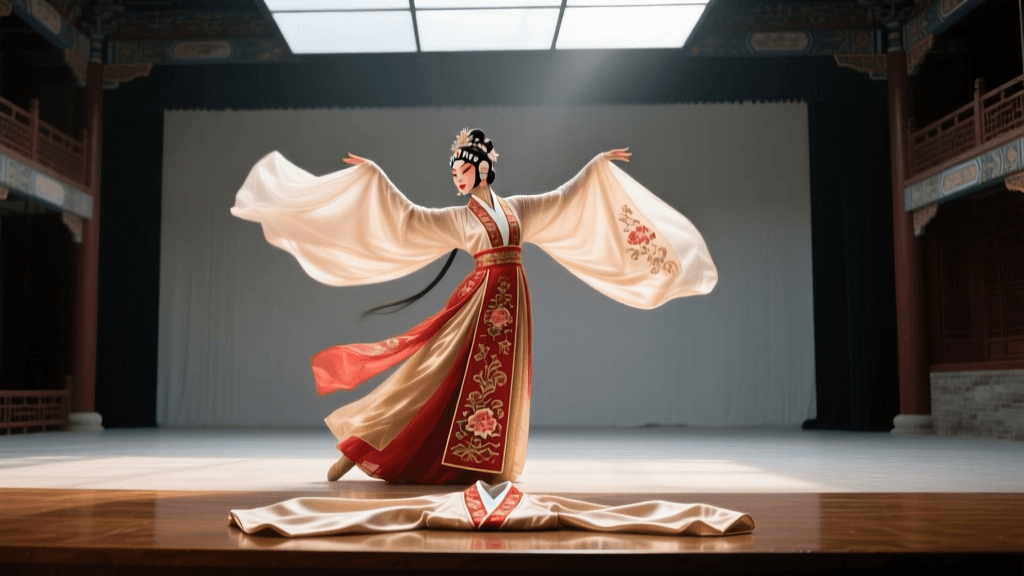
No discussion of Hanfu in traditional performing arts is complete without addressing the Shui Xiu, or water sleeves. While historical Hanfu sleeves were long and flowing, theatrical water sleeves are exaggerated extensions of white silk attached to the cuffs of the Mang, Pei, or Xue. They serve as an extension of the actor's body, translating internal emotions into sweeping, kinetic visual poetry.
In 2026, the standard length for professional Kunqu water sleeves is between 60 to 80 centimeters beyond the wrist, while Peking Opera sleeves can extend up to 100 centimeters for specialized acrobatic roles. The silk used for Shui Xiu in 2026 is a specialized high-twist crepe de chine. This specific weave provides the necessary 'snap' and weight required for techniques like 抖袖 (shaking the sleeve) and 抛袖 (tossing the sleeve), preventing the fabric from tangling during rapid choreography.
For performers training in these arts today, mastering the physics of the water sleeve requires understanding the bias cut of the silk. Modern tailors cut the sleeve extensions on the true bias, allowing the fabric to spiral and ripple organically through the air. When sourcing replacement water sleeves, always verify the grainline with the atelier; a straight-grain cut will result in a stiff, unresponsive sleeve that severely limits expressive range.
Archival Care and Maintenance for Theatrical Hanfu
Theatrical costumes are significant financial and cultural investments. Proper maintenance is critical, especially for the delicate, naturally dyed silks that have become the standard in 2026. Unlike everyday Hanfu, which can often be gently hand-washed, stage garments require specialized archival care.
- Spot Cleaning and Aeration: After performances, garments must be aired out in a climate-controlled room (ideally 45-55% humidity) to evaporate sweat. Spot cleaning with distilled water and pH-neutral silk soap is preferred over full immersion, which can cause natural dyes to bleed.
- Storage Solutions: The 2026 best practice for storing Mang and Kao is flat archival storage. Hanging heavily embroidered garments causes the silk foundation to warp and tear under the weight of the metallic threads. Use acid-free tissue paper to stuff the sleeves and bodice, maintaining the garment's three-dimensional shape inside cedar-lined, breathable canvas boxes.
- Pest Management: Avoid chemical mothballs, which can react with natural plant dyes and cause yellowing or fabric degradation. Instead, utilize traditional sachets of dried mugwort, cloves, and Sichuan peppercorns, which naturally repel insects while imparting a subtle, historically appropriate fragrance to the wardrobe room.
The Future of Traditional Arts on the Global Stage
As we navigate 2026, the boundary between historical Hanfu revivalists and traditional theater practitioners is beautifully blurring. Audiences are more educated than ever, demanding both historical authenticity in the textile weaves and the breathtaking theatricality of the stage. By understanding the distinct requirements of Peking Opera and Kunqu costuming—from the structural engineering of the Kao to the fluid dynamics of the Shui Xiu—performers and designers can ensure these ancient art forms continue to captivate the modern world. Whether you are sourcing a bespoke python robe from a Suzhou atelier or maintaining a troupe's existing wardrobe, respecting the material history of these garments is the key to preserving their magic for generations to come.