Hanfu and Kunqu Opera Costumes: 2026 Performer Guide
The Intersection of Historical Hanfu and Theatrical Xifu in 2026
The year 2026 marks a fascinating renaissance in traditional Chinese performing arts. As the global Hanfu revival movement matures, a distinct intersection has emerged between historical garment enthusiasts and traditional theater troupes. For performers, directors, and cultural preservationists, understanding the nuanced differences between authentic historical Hanfu and traditional operatic costumes—known as Xifu—is more critical than ever. While both draw from the same deep well of Chinese sartorial history, their purposes, constructions, and movements on stage are vastly different. Whether you are staging a classic Kunqu opera masterpiece, choreographing a modern Peking Opera fusion piece, or simply attending a traditional performance, this comprehensive 2026 guide will help you navigate the vibrant world of Asian traditional stage garments.
Kunqu Opera, recognized globally for its elegant choreography and haunting melodies, relies heavily on the visual poetry of its costumes. According to the UNESCO Intangible Cultural Heritage registry, Kunqu is one of the oldest and most refined forms of Chinese opera, and its visual language is inextricably linked to the Ming Dynasty aesthetic. However, the garments worn on stage are not historical replicas; they are theatrical amplifications designed to convey character, status, and emotion to the back row of a grand theater.
The Core Distinction: Historical Hanfu vs. Operatic Xifu
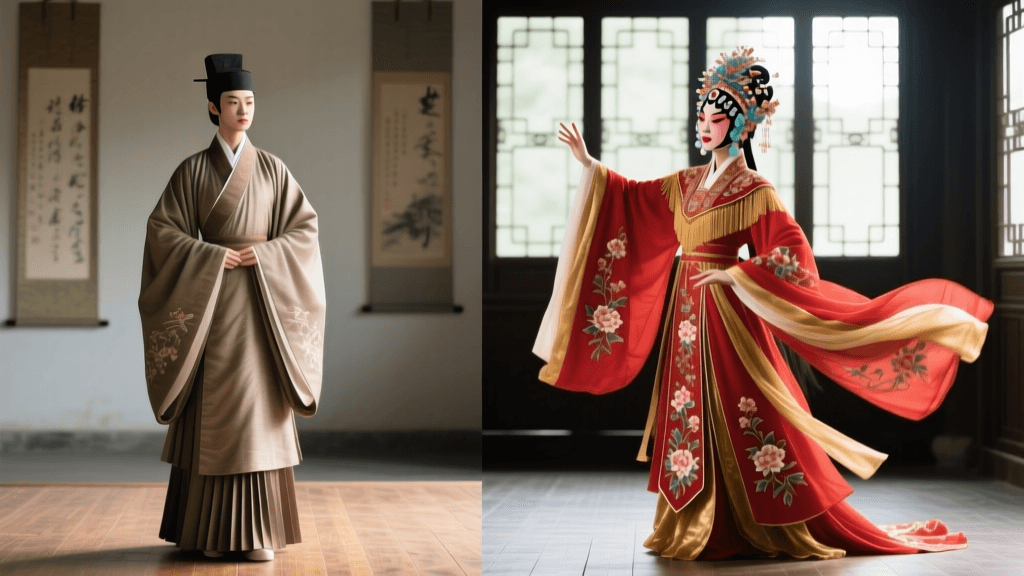
To the untrained eye, a Ming Dynasty Aoqun (jacket and skirt) and a Kunqu stage Pei (informal robe) might look similar. Both feature crossed collars, wide sleeves, and silk brocades. However, the design philosophy diverges sharply when the garment is meant for daily historical life versus theatrical performance.
Historical Ming Hanfu
Authentic Hanfu from the Ming Dynasty (1368–1644) was designed for the realities of daily life, court ceremonies, and scholarly pursuits. The silhouettes were structured, the sleeves were proportionate to the human arm (with some wide-sleeved ceremonial exceptions), and the fabrics, while luxurious, were tailored to drape naturally over the body. In 2026, the Hanfu market has seen a massive surge in museum-grade replicas, utilizing digital loom technology to recreate historical weave structures like Yunjin (cloud brocade) with staggering accuracy. These garments are meant to be worn with historical undergarments and accessories, prioritizing authenticity and cultural reverence.
Traditional Kunqu and Peking Opera Xifu
Operatic Xifu, on the other hand, is an exaggerated, codified system of dress that evolved primarily during the Qing Dynasty, heavily blending Ming aesthetics with theatrical necessity. As noted by theater historians at Encyclopedia Britannica, Chinese opera costumes are not bound by strict historical accuracy; rather, they are bound by the rules of the stage. A general in a Kunqu play will wear a Kao (armor) with four pennants attached to the back, a purely theatrical invention that does not exist in historical Chinese military armor but brilliantly communicates martial authority and creates dynamic visual shapes during acrobatic combat sequences.
2026 Sourcing and Pricing Guide for Troupes
For independent troupes and university performing arts programs sourcing garments in 2026, the market is divided into historical Hanfu vendors and specialized theatrical tailors. The craftsmanship hubs of Suzhou and Hangzhou remain the epicenters for both, but the workshops are distinctly separated.
- Historical Hanfu Workshops: Focus on accurate patterning, natural dyes, and historical textile weaving. A high-end, custom-tailored Ming-style Mamianqun (horse-face skirt) made with genuine mulberry silk and gold-woven threads will cost between $800 and $1,500 USD in 2026.
- Theatrical Xifu Tailors: Focus on durability, stage lighting reflection, and specialized features like reinforced armpits for acrobatics and integrated Shui Xiu (water sleeves). A bespoke, hand-embroidered silk Mang (python robe) for professional Kunqu performances ranges from $1,800 to $4,500 USD, depending on the density of the metallic thread embroidery.
In 2026, many modern troupes are adopting hybrid approaches. For experimental, avant-garde Kunqu productions, directors are increasingly commissioning historical Hanfu garments but modifying them with hidden theatrical reinforcements, blending the muted, elegant color palettes of the Ming court with the dynamic movement requirements of the stage.
Comparative Analysis: Hanfu vs. Stage Xifu
Understanding the structural differences is vital for costume designers and performers. The following table outlines the primary distinctions between historical Ming garments and traditional operatic costumes.
| Feature | Historical Ming Hanfu | Kunqu / Peking Opera Xifu |
|---|---|---|
| Sleeve Construction | Fitted cuffs or moderate wide sleeves; designed for practical use. | Extended Shui Xiu (Water Sleeves) made of white silk, ranging from 1.5 to 2.5 meters. |
| Collars and Necklines | Crossed collars (right over left) or standing collars; sits flush against the neck. | Often features a stiff, white protective collar band (Huling) to frame the face and protect the silk from stage makeup. |
| Color Symbolism | Dictated by sumptuary laws, court ranks, and seasonal aesthetics. | Strictly codified by character archetypes (e.g., yellow for royalty, red for loyalty, black for integrity). |
| Footwear | Historical cloth boots, cloud-toe shoes, or bound footwear (in historical context). | Thick-soled platform boots (Hou底) to artificially increase the actor's height and alter their gait. |
| Embellishment | Woven patterns, subtle embroidery, jade accessories. | Dense, high-contrast metallic embroidery designed to catch harsh stage lighting. |
Choreography and the Art of the Water Sleeve
The most profound difference between wearing Hanfu and wearing Xifu lies in the choreography. Historical Hanfu restricts and guides movement in a way that promotes the dignified, grounded posture associated with traditional Confucian ideals. Operatic Xifu, particularly the Shui Xiu (water sleeves), transforms the garment into an extension of the actor's emotional state.
In Kunqu Opera, the water sleeve is not merely a piece of fabric; it is a vital acting tool. The techniques required to manipulate these sleeves take years to master. In 2026, performing arts academies utilize motion-capture technology to analyze the biomechanics of master performers, breaking down the precise wrist flicks and shoulder rotations required to execute the Touxiu (throwing the sleeve) or the Douxiu (trembling the sleeve to show fear or anger). A historical Ming garment with standard wide sleeves cannot replicate this effect; the fabric lacks the specific weight, length, and unlined silk construction required to ripple and snap through the air.
For performers transitioning from Hanfu cultural demonstrations to theatrical stage work, the learning curve is steep. Theatrical garments require the actor to maintain constant tension in the upper back and wrists. Dropping the sleeve incorrectly can result in the heavy silk tangling around the elaborate headdress (Fengguan), a disaster on stage that historical Hanfu wearers rarely face.
Garment Care and Conservation in 2026
Maintaining these exquisite garments requires specialized knowledge. The Victoria and Albert Museum Asian Collections emphasizes that historical silk textiles are highly susceptible to light damage, humidity fluctuations, and the oils from human skin. While museum conservation focuses on preservation, theatrical conservation focuses on longevity amidst rigorous use.
Caring for Historical Hanfu
Authentic Hanfu garments, especially those woven with delicate gold leaf or dyed with natural plant-based pigments like indigo and madder, should rarely be dry-cleaned using modern chemical solvents, which can strip the natural sericin from the silk. In 2026, the best practice for high-end Hanfu is spot-cleaning with specialized enzymatic silk detergents, followed by flat-drying in a climate-controlled room. Storage requires acid-free tissue paper and breathable cotton garment bags, never plastic.
Maintaining Theatrical Xifu
Opera costumes face a harsher reality. They are subjected to heavy stage makeup, profuse sweating under hot theatrical lights, and the physical stress of acrobatic choreography. Modern theatrical tailors in 2026 have begun treating the inner linings of Mang robes and Kao armor with hydrophobic nano-coatings. This innovation allows the costumes to resist sweat stains and makeup transfer without altering the external drape or sheen of the silk brocade. Furthermore, the white Huling (collar band) and the inner cuffs of the water sleeves are now universally constructed with hidden snap-fasteners, allowing them to be detached and aggressively laundered after every performance, preserving the integrity of the heavily embroidered outer shell.
Conclusion: Respecting the Boundaries
As we navigate the cultural landscape of 2026, the synergy between the Hanfu revival and traditional opera is a testament to the enduring power of Asian sartorial heritage. However, recognizing the boundaries between the two is essential. Historical Hanfu offers a profound, tactile connection to the daily lives, philosophies, and aesthetics of our ancestors. Operatic Xifu offers a brilliant, exaggerated, and emotionally explosive theatrical language. By understanding the distinct purposes, sourcing methods, and choreographic demands of both, performers and enthusiasts can ensure that both traditions continue to thrive, evolve, and captivate audiences for generations to come.