Kunqu Opera Hanfu 2026: Sourcing Stage Robes & Sleeves
The Living Legacy of Kunqu Opera Stage Hanfu
Kunqu opera, often revered as the "mother of a hundred operas," is one of the oldest and most refined forms of Chinese musical theater. Recognized for its elegant choreography, poetic librettos, and haunting bamboo flute melodies, the art form relies heavily on its visual splendor. At the heart of this visual storytelling is the theatrical Hanfu wardrobe. Unlike everyday historical clothing, Kunqu stage garments are highly stylized, exaggerated extensions of Ming Dynasty fashion, designed to amplify the actor's movements and convey character archetypes instantly to the audience.
As we navigate the cultural landscape of 2026, there has been a massive resurgence in traditional performing arts among younger generations. Contemporary troupes and independent performers are increasingly seeking historically grounded, yet stage-practical Hanfu. Whether you are a theater student, a professional performer, or a dedicated collector of Asian traditional garments, understanding the anatomy, sourcing, and maintenance of Kunqu stage Hanfu is essential. This comprehensive guide explores the intricate world of Kunqu theatrical costumes, focusing on the iconic Mang robes and the expressive Shui Xiu (water sleeves).
The Core Wardrobe: Mang, Xuezi, and Kao
The Kunqu wardrobe is strictly codified based on character roles, which are broadly divided into Sheng (male), Dan (female), Jing (painted face), and Chou (clown). The garments are not meant to be historically accurate replicas of a specific dynasty; rather, they are a theatrical synthesis, heavily leaning on the silhouettes of the Ming Dynasty.
The Mang (Python Robe)
The Mang is the most formal and majestic robe in the Kunqu wardrobe, worn by emperors, high-ranking officials, and nobility. It features a round collar, large sweeping sleeves, and intricate embroidery of dragons, pythons, and auspicious clouds. In 2026, top-tier theatrical tailors in Suzhou and Beijing are utilizing advanced, breathable silk-organza blends for the inner linings of the Mang. This modern adaptation allows performers to wear these heavy, multi-layered garments under hot stage lights without compromising the structural stiffness required for the robe's dramatic silhouette.
The Xuezi (Scholar's Informal Robe)
For scenes depicting domestic life, travel, or scholarly pursuits, actors wear the Xuezi. Characterized by a crossed collar and a more relaxed, flowing fit, the Xuezi is a staple for both male and female roles. The elegance of the Xuezi lies in its subtlety; while the Mang shouts power, the Xuezi whispers refinement. Modern 2026 productions often favor hand-dyed gradient silks for the Xuezi, moving away from the harsh synthetic dyes that dominated the late 20th century.
The Kao (Armor)
Worn by martial generals and warriors, the Kao is a highly stylized suit of armor. It consists of a padded jacket, a skirt, and four pennants (flags) attached to the back. The weight and balance of the Kao are critical. In 2026, master armorers have begun incorporating lightweight carbon-fiber rods into the flag structures, reducing neck strain for performers executing rigorous acrobatic routines while maintaining the traditional visual profile.
The Soul of the Performance: Shui Xiu (Water Sleeves)
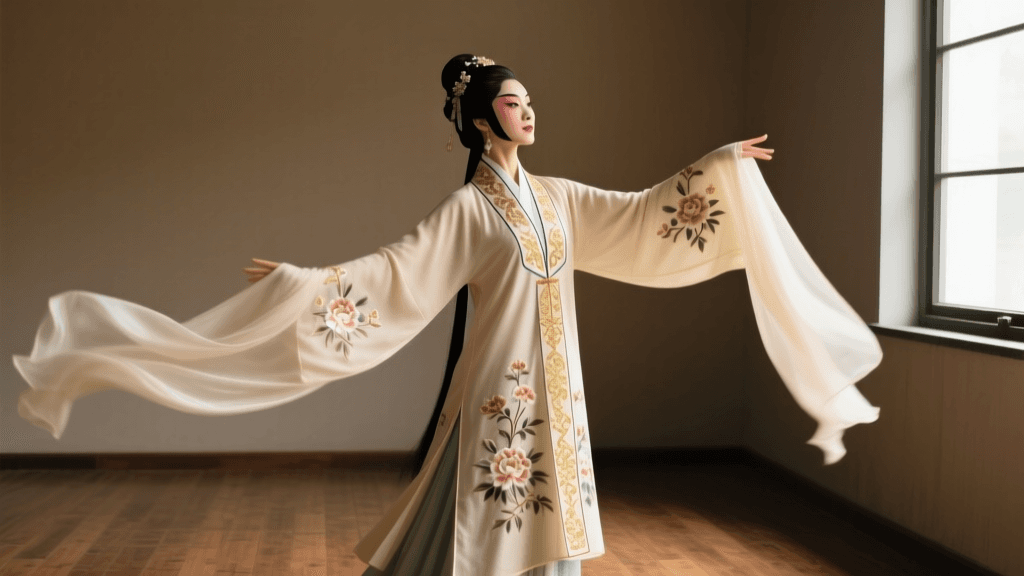
No discussion of Kunqu Hanfu is complete without the Shui Xiu, or water sleeves. These are the long, flowing white silk extensions attached to the cuffs of the Mang, Xuezi, and other robes. The water sleeves are not merely decorative; they are an extension of the actor's body and a primary tool for emotional expression. Through dozens of codified movements—such as pao xiu (throwing the sleeve), fu xiu (brushing the sleeve), and dou xiu (trembling the sleeve)—actors convey grief, joy, anger, and shyness.
According to the UNESCO Intangible Cultural Heritage archives, the mastery of water sleeves is one of the defining technical hurdles for any Kunqu performer. The length, weight, and fabric of the sleeve must be perfectly calibrated to the actor's height, arm length, and specific role type.
2026 Shui Xiu Measurement and Fabric Guide
When commissioning or purchasing a stage robe in 2026, selecting the correct water sleeve specifications is paramount. The fabric must have enough weight to "snap" back to the arm, but enough fluidity to ripple like water. Heavy silk crepe remains the gold standard, though high-density matte charmeuse has gained popularity this year for its resistance to stage-light glare.
| Role Type | Standard Sleeve Extension | Preferred Fabric (2026) | Performance Characteristics |
|---|---|---|---|
| Qingyi (Virtuous Female) | 65cm - 80cm | Heavy Silk Crepe | Emphasizes grace, sorrow, and restrained emotion. Requires high fabric drape. |
| Huadan (Lively Female) | 45cm - 55cm | Matte Silk Charmeuse | Shorter for agile, flirtatious movements. Needs quick snap-back recovery. |
| Xiaosheng (Young Male) | 60cm - 75cm | Silk-Cotton Blend | Balances scholarly elegance with youthful vigor. Moderate weight. |
| Laosheng (Older Male) | 50cm - 60cm | Stiffened Silk Organza | Shorter, stiffer sleeves to denote age, dignity, and measured authority. |
Note: Sleeve extensions are measured from the wrist bone to the tip of the silk. Always add 10cm to your desired visual length to account for the seam allowance and the natural gathering at the cuff.
Sourcing Authentic Theatrical Garments in 2026
Sourcing genuine Kunqu stage Hanfu requires navigating a specialized market. Unlike commercial "Hanfu fashion" brands that cater to streetwear and photography, theatrical garments are produced by heritage workshops, primarily located in Suzhou (for embroidery and silk weaving) and Beijing (for final tailoring and structural assembly).
The Suzhou Embroidery (Su Xiu) Connection
The intricate motifs on a Mang robe are traditionally executed using Su Xiu (Suzhou embroidery). As detailed in Encyclopedia Britannica's archive on Kunqu, the visual opulence of the costumes is inextricably linked to the textile arts of the Jiangnan region. In 2026, genuine hand-embroidered theatrical robes are considered investment-grade art pieces.
- Entry-Level / Student Grade ($250 - $600 USD): Features high-quality machine embroidery with hand-finished details. Ideal for drama students, amateur troupes, and rigorous rehearsal schedules. Fabrics are typically synthetic blends for easy washing.
- Professional Stage Grade ($800 - $1,800 USD): Combines machine-embroidered base motifs with hand-embroidered focal points (like the dragon's eyes or the phoenix crest). Uses genuine mulberry silk and features traditional structural padding.
- Master Artisan / Heritage Grade ($3,500 - $8,000+ USD): 100% hand-embroidered using traditional Su Xiu techniques, including gold and silver thread couching. Commissioning a Master Grade Mang robe in 2026 typically requires a 6-to-9-month waitlist through established Suzhou heritage workshops.
Styling and Movement: The Actor's Relationship with the Garment
Purchasing the garment is only the first step; mastering its movement is a lifelong pursuit. The Hanfu worn in Kunqu is designed to obscure the actor's natural physical limitations and create an illusion of ethereal gliding. Performers must learn to walk using the Yunbu (cloud step), keeping the upper body entirely still while the feet move rapidly beneath the heavy skirts and robes. This makes the character appear as though they are floating across the stage.
When styling the Mang robe, the inclusion of the Yuling (pheasant tail feathers) attached to the headdress is crucial for martial and high-ranking roles. In 2026, ethical sourcing has become a priority, and top workshops now utilize meticulously crafted synthetic keratin feathers that mimic the exact weight, flex, and iridescence of natural pheasant tails, allowing actors to execute the famous "feather trembling" technique without harming wildlife.
Maintenance, Storage, and Care
Theatrical Hanfu represents a significant financial and cultural investment. Proper maintenance ensures these garments survive for decades, often being passed down through generations of performers.
Cleaning Protocols
Never machine wash or submerge a silk theatrical robe. The internal structural elements, such as the stiffened collars and padded shoulders, will warp and collapse if exposed to water.
- Spot Cleaning: Use a specialized, pH-neutral silk detergent applied with a microfiber cloth for minor stage makeup stains on the collar.
- Water Sleeves: The white silk Shui Xiu can be carefully detached (most modern professional robes use hidden hook-and-eye clasps at the cuff) and hand-washed in cold water with a mild silk wash. Lay flat to dry away from direct sunlight.
- Professional Care: For deep cleaning, take the garments to a dry cleaner who specializes in historical textiles or theatrical costumes. Standard commercial dry cleaning chemicals can strip the metallic threads used in the embroidery.
Storage Solutions
Silk is highly susceptible to humidity, moths, and light degradation. In 2026, the standard for storing master-grade Kunqu Hanfu involves climate-controlled environments.
- Acid-Free Tissue: Always stuff the sleeves and bodice with acid-free archival tissue paper to maintain the garment's three-dimensional shape and prevent deep creasing in the silk.
- Camphor Wood Boxes: Traditional camphor wood chests remain the best storage solution. The natural oils in the wood repel insects and impart a subtle, traditional fragrance that is synonymous with the backstage atmosphere of classic Chinese theater.
- Climate Control: Maintain a storage environment with a relative humidity of 45-55% and a temperature around 18°C (65°F). Avoid plastic garment bags, which can trap moisture and cause mildew; use breathable cotton canvas covers instead.
Conclusion
The Hanfu of Kunqu opera is a breathtaking intersection of textile artistry, historical homage, and kinetic performance. As the global appreciation for traditional Asian performing arts continues to deepen in 2026, the demand for authentic, well-crafted stage garments has never been higher. By understanding the distinct roles of the Mang and Xuezi, respecting the precise engineering of the Shui Xiu, and committing to rigorous garment care, performers and collectors alike play a vital role in keeping this magnificent, centuries-old tradition vibrantly alive on the modern stage.