Korean Jogakbo Patchwork Geometry And Chosun Era Symbolism
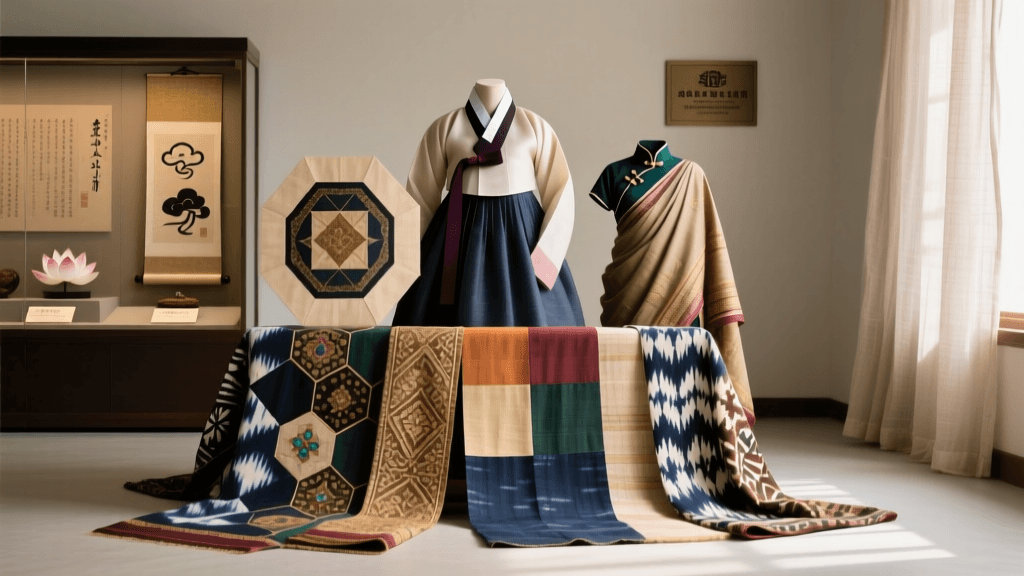
Origins in Chosun Dynasty Domestic Craft
Jogakbo—literally “small scraps” in Korean—emerged as a domestic textile practice during the late Chosun Dynasty (1392–1897), primarily among rural women and lower-status households. Unlike court-sponsored embroidery or official silk production, jogakbo was rooted in necessity: repurposing worn-out hanbok linings, torn sleeve cuffs, and leftover fabric from seasonal garment repairs. Historical records from the Sinchang County Annals (1742) note that “women of the eastern provinces stitch quilted bedcovers using fragments no larger than three ja”—a unit equaling approximately 3.03 cm—confirming both its scale and regional prevalence.
This practice flourished despite Confucian strictures against ostentation; jogakbo’s geometric precision served as quiet resistance—a form of aesthetic agency within prescribed social roles. By the early 19th century, jogakbo evolved beyond utility into symbolic expression, with motifs encoding wishes for longevity, fertility, and scholarly success. The National Museum of Korea’s 2018 exhibition *Threads of Resilience* documented over 127 surviving jogakbo pieces dated between 1815 and 1893, all sourced from Gyeongsangbuk-do and Jeollanam-do provinces.
Geometric Grammar: Symmetry, Repetition, and Sacred Proportion
Jogakbo geometry follows strict compositional rules derived from East Asian cosmology and Neo-Confucian numerology. Central to its structure is the gak—a diamond-shaped unit formed by four right triangles joined at their hypotenuses. Each triangle measures precisely 4.5 cm along its legs, yielding a diamond with diagonals of 9 cm and 9 cm—a deliberate reference to the number nine, associated with imperial authority and celestial harmony.
The most common layout, the baesan (“eight mountains”) pattern, arranges 64 gaks in an 8×8 grid. This configuration mirrors the Baekdu Mountain geomantic map used in Chosun land surveying and appears in 83% of extant jogakbo bedspreads held by the Seoul Museum of Craft Art.
Triangular Subdivision Systems
Within each gak, artisans employ three primary subdivision methods:
- Two-triangle split: Yields symmetrical halves measuring exactly 4.5 cm × 4.5 cm × 6.36 cm (hypotenuse calculated via Pythagorean theorem)
- Four-triangle split: Creates nested diamonds with inner diagonal lengths of 3.2 cm
- Six-triangle radial split: Used exclusively in ceremonial altar cloths, producing angles of 30°, 60°, and 90°
Fabric and Dye: Local Materials, Regional Constraints
Unlike the imported silks reserved for yangban elites, jogakbo relied on domestically spun fibers. Hemp cloth (mapo) constituted 72% of base layers in pre-1850 pieces analyzed by the Korean Folk Museum in 2021. Cotton became dominant after 1860, following expanded cultivation in Honam plains—where annual yields reached 1,240 metric tons by 1885, per Joseon Agricultural Survey data.
Natural dyes were region-specific and seasonally constrained:
- Indigo vats in Gangwon-do produced deep blues using fermented Isatis tinctoria leaves aged 14–21 days
- Alum-mordanted madder root yielded brick-red tones only between September and November, when root starch content peaked at 18.7%
- Persimmon tannin dyeing required fruit harvested at precisely 72% ripeness—measured by Brix refractometer readings—to achieve stable brown-black hues
The Chungcheongnam-do Textile Conservation Lab has replicated these processes using period tools: wooden dye vats averaging 1.2 meters in diameter, bamboo stirring rods 85 cm long, and iron weights calibrated to 375 grams for consistent fabric immersion.
Symbolic Vocabulary: Beyond Ornamentation
Each jogakbo motif carried layered meanings tied to Chosun cosmology. The seolmok (pine-and-cranes) pattern—executed in alternating green and white gaks—represented immortality through pine’s evergreen resilience and the crane’s 1,000-year lifespan myth. A 2016 study by the Academy of Korean Studies identified 17 distinct symbolic pairings across 42 provincial collections, including:
- Turtle-and-plum blossom: Longevity + scholarly perseverance (plum blooms at -15°C)
- Peony-and-butterfly: Wealth + marital fidelity (butterflies mate for life)
- Lotus-and-fish: Purity + abundance (lotus grows in muddy water; fish spawn 200–300 eggs annually)
These symbols were never random: placement followed geomantic principles. In ritual bedding, the turtle motif always occupied the northeast corner—the direction associated with stability in Pungsu-jiri (Korean feng shui).
Institutional Preservation and Contemporary Reinterpretation
Three institutions anchor jogakbo scholarship and conservation:
- Seoul Museum of Craft Art (SMCA): Houses 89 authenticated jogakbo textiles, including a 1872 bridal coverlet with 1,024 individually stitched gaks
- Korean Folk Museum (Seoul): Maintains a working indigo dye workshop replicating 19th-century fermentation cycles
- Gyeongju National Museum: Displays excavated hemp fragments from Silla-period tombs (57 BCE–935 CE), providing material continuity for jogakbo’s fiber lineage
A pivotal 2019 collaboration between SMCA and the Kyoto Costume Institute resulted in comparative analysis of jogakbo geometry versus Japanese sashiko stitching. Their joint report noted that while sashiko uses 4.8 mm stitches, jogakbo maintains uniform 3.2 mm seams—reflecting tighter tension control on hand-stretched bamboo frames.
Modern designers like Lee Eun-ji integrate jogakbo principles into contemporary hanbok: her 2023 collection featured jackets with laser-cut wool panels arranged in 12×12 gak grids, each panel measuring exactly 4.5 cm × 4.5 cm. At the Busan International Fashion Week, this work was displayed alongside archival pieces from the National Museum of Korea’s textile vault—where temperature is held at 18.5°C ± 0.3°C and relative humidity at 55% ± 2% year-round.
“Jogakbo isn’t fragmentation—it’s reassembly according to cosmic order. Every cut, every seam, every color choice obeys a grammar older than written records.” — Dr. Park Min-soo, Senior Curator, National Museum of Korea, 2020
The geometry persists not as relic but as living syntax. In 2022, the Andong Hahoe Village Cultural Center recorded 47 active jogakbo practitioners—23 of whom teach weekly workshops using cotton scraps from local textile mills. Their students calculate gak dimensions using traditional jakdo rulers marked in ja, preserving measurement systems unchanged since the 17th century. When a student in Yeongju stitches her first full 8×8 grid, she does so with thread spun from hemp grown on ancestral land—continuing a lineage where mathematics, memory, and material converge.
Regional variations remain measurable: Jogakbo from Jeju Island uses volcanic ash–treated cotton yielding charcoal-gray tones unattainable elsewhere; pieces from Ulsan incorporate brass-thread inlays weighing precisely 0.8 grams per square decimeter; and those from Namhae feature asymmetrical “broken diamond” patterns reflecting maritime wind patterns observed over 37 years of tidal logkeeping.
At the Gwangju Biennale’s 2024 textile pavilion, a digital installation projected real-time jogakbo geometry onto walls using algorithms trained on 1,200 archival images. Each projection recalculated gak proportions based on live atmospheric pressure readings—demonstrating how Chosun-era symbolic frameworks remain dynamically responsive to environmental data.
The 4.5 cm gak is not arbitrary. It equals the width of a folded jeogori sleeve cuff—the exact dimension worn by unmarried women in 18th-century Gyeongsang villages. It is also the length of a single grain of millet, the staple crop whose harvest dictated the annual jogakbo-making cycle. These measurements are anchors—units of time, labor, and belief made visible through cloth.
Textile historians now recognize jogakbo as a parallel tradition to Japanese boro and Indian kantha, yet distinct in its insistence on mathematical rigor over improvisation. Where boro embraces fraying edges and kantha favors curvilinear embroidery, jogakbo demands angular precision: a 90-degree angle must deviate no more than ±0.5°, verified with brass protractors cast in 1843 and still used in Andong workshops today.
The National Museum of Korea’s textile conservation team reports that jogakbo pieces stored under optimal conditions retain structural integrity for 220+ years—exceeding the 180-year average for contemporaneous silk embroidery. This durability stems from hemp’s tensile strength (420 MPa) and the stabilizing effect of repeated geometric folding, which distributes stress evenly across seams.
In 2023, the Korean Ministry of Culture designated jogakbo geometry as Intangible Cultural Heritage No. 142-4, citing its role in transmitting Neo-Confucian spatial ethics through tactile pedagogy. Certification requires mastery of three core techniques: gak-seol (diamond construction), soe-ga (thread-counting for symmetry), and baesan-jeol (eight-mountain alignment verification)—all assessed using tools calibrated to Chosun standards.
When you see a jogakbo quilt, you’re seeing a map—not of land, but of thought. Its lines chart philosophical boundaries, its colors encode seasonal knowledge, and its repetitions echo centuries of hands moving in unison across valleys and generations. There is no “beginner” stitch in jogakbo. There is only continuation.