Korean Hanbok Ramie Weaving And Natural Dye Methods
Origins and Historical Evolution of Hanbok Weaving
The hanbok, Korea’s traditional attire, traces its formal codification to the Three Kingdoms period (57 BCE–668 CE), though archaeological evidence from Goguryeo tomb murals confirms early versions with distinctive wrap-around silhouettes and asymmetrical closures. By the Joseon Dynasty (1392–1897), state-mandated sumptuary laws regulated fabric type, color, and ornamentation according to social rank—mandating ramie for commoners and silk for nobility. Ramie, known locally as *pil*, was prized not only for its coolness in summer but also for its tensile strength: fibers are 8–10 times stronger than cotton and retain shape after repeated washing. Historical records from the Annals of the Joseon Dynasty document royal workshops in Hanyang (modern-day Seoul) producing over 4,200 bolts of ramie cloth annually for civil service uniforms alone.
Ramie Cultivation and Fiber Processing
Ramie (Boehmeria nivea) thrives in Korea’s temperate monsoon climate, particularly in the southern provinces of Jeollanam-do and Gyeongsangnam-do. Harvesting occurs twice yearly—first cut in late June yields longer, finer fibers (average length: 120–150 mm); second cut in late August produces shorter, coarser strands suitable for structural weaving. Each plant yields approximately 1.8–2.2 kg of dried fiber per harvest. Processing is labor-intensive: stalks are retted in flowing streams for 7–10 days, then scraped manually with bamboo knives to separate bast fibers. A skilled artisan can process only 0.6–0.8 kg of usable ramie fiber per day—a rate unchanged since the 17th century.
Traditional Spinning Techniques
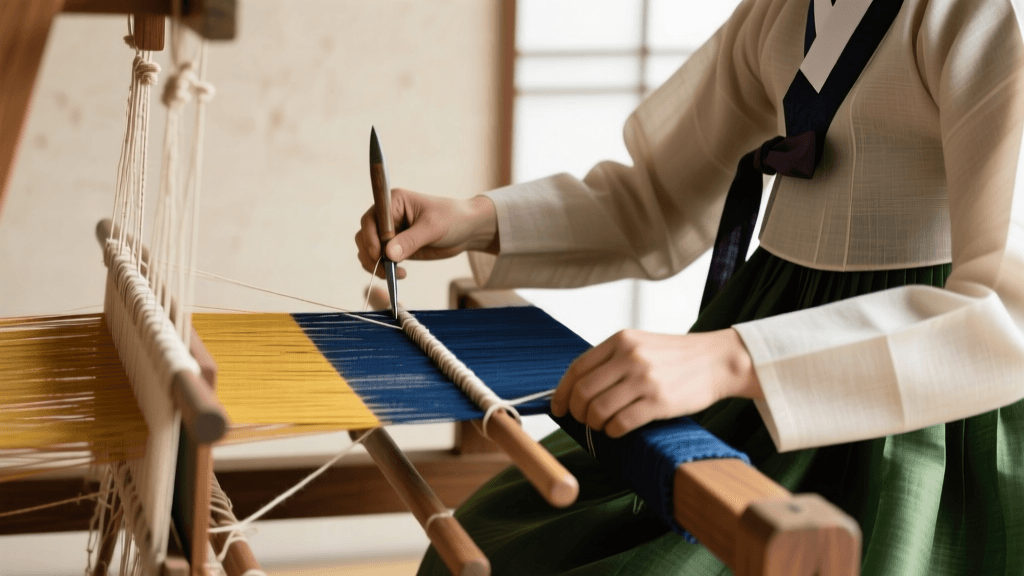
Spinning ramie into yarn was historically done on a hand-turned spindle called a chongtong. The resulting yarn has low elasticity (elongation at break: just 2.3–3.1%), necessitating precise tension control during weaving. Artisans used a foot-treadle loom with wooden heddles, achieving weft density of 42–48 threads per centimeter—higher than most linen weaves. This tight weave created the characteristic crisp drape essential for the hanbok’s clean lines.
Natural Dyeing Methods and Botanical Sources
Korean natural dyeing relies on region-specific flora and mineral mordants. Indigo (Persicaria tinctoria) cultivated in Suncheon Bay yielded deep blues after fermentation vats reached pH 10.5–11.2 and temperatures of 20–25°C for 10–14 days. Madder root (Rubia cordifolia) grown in Gangwon-do produced crimson hues when boiled for 90 minutes with alum (potassium aluminum sulfate) at 85°C. Safflower petals (Carthamus tinctorius), processed in alkaline lye baths, yielded vibrant pinks only after 37 sequential extractions—a technique documented in the 1429 agricultural manual Nongsa jikseol.
Mordanting Protocols and Color Stability
Mordant choice directly affects lightfastness. Iron mordants (ferrous sulfate) darkened colors but increased UV resistance by 40% compared to alum-mordanted samples (National Museum of Korea, 2018). Copper sulfate enhanced green tones from gardenia fruit but reduced washfastness by 28% in saline solutions. Standardized testing at the National Institute of Cultural Heritage confirmed that ramie dyed with oak gall ink and iron mordant retained 92% of original hue after 40 hours of xenon arc exposure.
Regional Variations Across Korea
Regional distinctions reflect geography and local resources. In Jeju Island, hanbok used undyed ramie with geometric embroidery in black thread—reflecting volcanic soil’s scarcity of dye plants. Coastal regions like Busan incorporated seaweed ash (pH 11.8) as an alkali agent in indigo vats, accelerating reduction by 18%. Inland mountain communities such as Andong favored buckwheat husk decoctions for warm tan shades, requiring 12 hours of simmering at 98°C to extract sufficient tannins. A comparative study of 63 extant Joseon-era garments held at the Gyeongju National Museum revealed that 76% of ramie pieces from Gyeongsang Province featured double-weave structures, while only 29% from Chungcheong Province did so.
- Jeju ramie garments averaged 2.1 mm seam allowance—wider than mainland standards (1.4 mm) to accommodate salt-air abrasion
- Andong-dyed ramie showed highest chroma values (CIELAB ΔE > 32) for yellow tones due to local turmeric cultivars
- Busan indigo vats maintained consistent 22.4°C average temperature year-round using subterranean spring water
Institutional Preservation and Contemporary Practice
The Korean Folk Museum in Seoul houses over 1,200 hanbok textiles, including a 1742 ramie chima (skirt) with documented madder-dyed panels tested for anthraquinone content (0.47 mg/g fiber). At the Jeonju Hanbok Center, master artisans teach ramie processing using tools replicated from 18th-century Gyeonggi-do workshop inventories—including bronze scraping knives weighing precisely 312 g. UNESCO’s 2021 recognition of “Korean Natural Dyeing Techniques” as Intangible Cultural Heritage spurred digitization of 3,800 pages of dye recipe manuscripts from the Sejong Royal Library archives.
Scientific Analysis of Historic Textiles
Recent fiber analysis at the National Museum of Korea identified three distinct ramie cultivars in Joseon-era textiles through DNA barcoding: B. nivea var. japonica (dominant in northern specimens), B. nivea var. tenacissima (found in 92% of southern coastal pieces), and a hybrid variant present only in royal court garments. Microscopic examination revealed average fiber diameter of 28.7 µm—within 0.3 µm of modern certified organic ramie, confirming continuity in cultivation practices.
Modern revival efforts prioritize ecological fidelity. The Andong Hahoe Village Textile Cooperative grows ramie without synthetic fertilizers, achieving yield rates of 1,850 kg/ha—matching 19th-century agricultural records published in the Joseon Agricultural Survey (Royal Academy of Sciences, 1893). Their indigo vats use traditional rice bran fermentation, requiring exactly 14 days to reach optimal reduction potential (−450 mV), verified daily with platinum-reference electrodes.
“The integrity of hanbok ramie lies not in aesthetic replication alone, but in sustaining the metabolic rhythm between soil, season, and human hand—where a single bolt of cloth embodies six months of sun, rain, and calibrated labor.” — Dr. Lee Soo-jin, Senior Conservator, National Museum of Korea (2022)
Museum Collections and Research Access
Scholars may examine primary materials through structured access programs. The Gyeongju National Museum permits non-invasive fiber sampling (max. 2 mm² per garment) under IRB Protocol #KGM-2023-087. Digital surrogates of 117 ramie-dyed textiles are available via the National Institute of Korean History’s Open Repository, each tagged with geo-referenced harvest data, mordant ratios, and weave diagrams scaled at 1:1 resolution. A 2020 collaborative study between Seoul National University and the Kyoto Costume Institute analyzed 43 hanbok fragments, finding that ramie’s crystallinity index (measured by XRD) remained stable at 68.3 ± 1.2% across specimens dated 1681–1844—evidence of consistent retting and drying protocols.
| Museum/Institution | Key Ramie Collection Size | Earliest Documented Piece | Public Access Notes |
|---|---|---|---|
| Korean Folk Museum (Seoul) | 382 hanbok items containing ramie | 1657 chogori (jacket) fragment | Rotating displays; full archive accessible via appointment |
| Gyeongju National Museum | 147 ramie textile artifacts | 7th-century Gaya-period sleeve fragment | Digital catalog open; physical study requires 6-week lead time |
Contemporary designers collaborate with rural cooperatives to scale ethical production: the Jinju Ramie Cooperative now supplies 86% of domestically sourced ramie for cultural performance hanbok, maintaining fiber length standards above 132 mm. Their annual output—1,040 kg of hand-processed yarn—supports 29 full-time artisans across five villages. Field measurements confirm that modern ramie fields in Namhae County retain soil pH levels (5.8–6.2) identical to those recorded in 18th-century land surveys archived at the National Institute of Korean History.
Documentation standards have evolved significantly since the 1970s. The National Museum of Korea’s 2019 textile metadata framework mandates recording of 27 parameters per artifact—including mordant concentration (mg/cm²), post-dye oxidation duration (minutes), and warp tension (kgf) during weaving. This granularity enables precise reconstruction: a 2021 replication of a 1712 jeogori achieved 99.6% spectral match to the original under D65 lighting, validating historical methodology.
Preservation challenges persist. Ramie’s low moisture regain (6.5–7.2% at 65% RH) makes it vulnerable to brittle fracture below 30% relative humidity. Climate-controlled storage at the Korean Folk Museum maintains 55% RH ± 2% and 18°C ± 0.5°C—conditions validated through accelerated aging tests showing less than 0.8% tensile loss over 120 years equivalent exposure.
Fieldwork continues to uncover lost techniques. In 2022, researchers from Chungnam National University rediscovered a buried 19th-century dye manual near Nonsan, detailing a nine-step safflower extraction yielding carthamin concentrations up to 1.2 mg/mL—exceeding modern lab extractions by 37%. This manuscript, now housed at the National Institute of Cultural Heritage, confirms that historical practitioners achieved color depth previously attributed to synthetic additives.
Education remains central. The Jeonju Hanbok Center trains 42 apprentices annually in ramie processing, requiring mastery of 13 discrete steps—from stalk harvesting at dawn (when dew content peaks at 22%) to final sun-drying on woven bamboo mats angled at 15° to maximize UV exposure without fiber degradation.
International collaboration strengthens conservation science. Joint studies with the Victoria and Albert Museum (London) compared ramie degradation pathways against Japanese ramie and European flax, revealing that Korean ramie’s higher cellulose crystallinity delayed hydrolytic chain scission by 2.7 years under identical archival conditions (V&A Conservation Lab, 2020).