Hanfu Etiquette: Greeting Rituals and Dress Code Rules
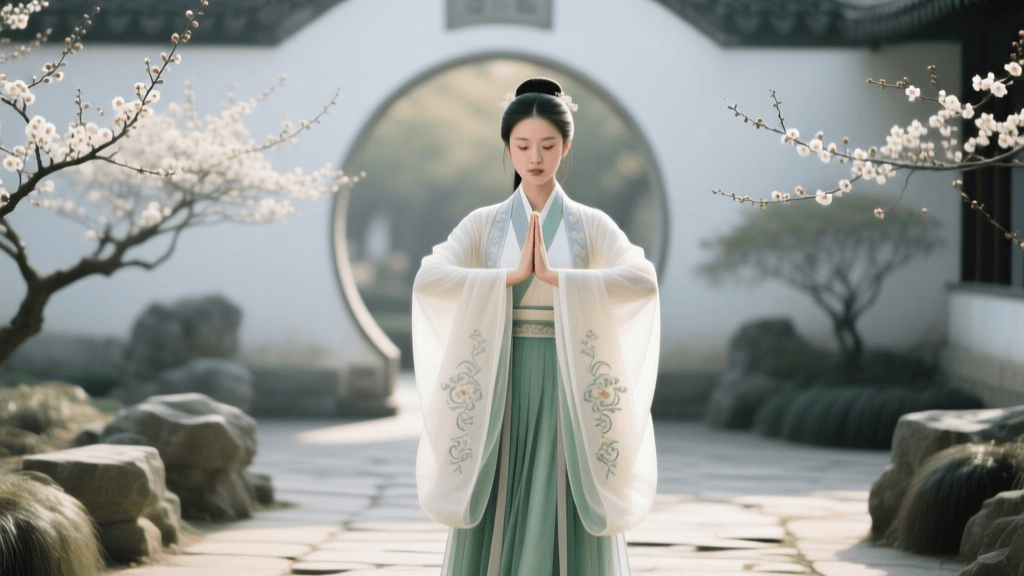
The Resurgence of Hanfu and the Return of Ritual Propriety
The modern Hanfu movement is not merely a sartorial revival; it is a profound cultural reawakening that reconnects contemporary wearers with thousands of years of Chinese history. As millions of young people across China and the global diaspora don traditional Han garments for festivals, tea ceremonies, and daily wear, the conversation has naturally evolved beyond fabric and silhouette. Today, the focus has shifted toward the behaviors, manners, and philosophies that originally accompanied these garments. Wearing Hanfu is intrinsically linked to the practice of traditional etiquette, transforming the act of dressing into a holistic embodiment of cultural heritage.
To truly honor the garment, one must understand the rituals that govern its wear. In ancient China, clothing was never just about protection from the elements or personal adornment; it was a visual language that communicated social order, respect, and moral cultivation. This article explores the foundational etiquette of Hanfu, detailing the precise mechanics of traditional greetings, the immutable rules of dress code, and the philosophical underpinnings that make these practices so vital to the modern revival.
The Philosophy of Li in Hanfu Culture
At the heart of Hanfu etiquette is the Confucian concept of Li (礼), which translates roughly to ritual propriety, etiquette, or the correct way of conducting oneself. According to Britannica's exploration of Confucian ritual propriety, Li encompasses the entire spectrum of human interaction, from state ceremonies to the subtle ways one greets a neighbor. In the context of Hanfu, Li dictates that the outward appearance of the garment must be matched by an inward disposition of respect and humility.
When a person wears Hanfu, their posture, gait, and gestures are expected to reflect the dignity of the clothing. The wide sleeves, flowing skirts, and structured collars are designed to encourage deliberate, mindful movement. Rushing, slouching, or making erratic gestures disrupts the harmony of the silhouette and violates the spirit of Li. Therefore, mastering Hanfu etiquette begins with mastering one's own physical presence, ensuring that every bow and greeting is executed with intentionality and grace.
Essential Hanfu Greeting Rituals
Unlike the modern Western handshake or the casual wave, traditional Chinese greetings are deeply symbolic, utilizing the hands and the depth of a bow to convey specific levels of respect, gender dynamics, and social hierarchy. As noted in comprehensive guides on traditional Chinese greetings, the physical act of greeting is a manifestation of social harmony. Below are the primary greeting rituals observed in the Hanfu community today.
Gongshouli: The Cupped Hand Salute
The Gongshouli (拱手礼) is the most common and versatile greeting in Hanfu culture, suitable for daily interactions, meeting peers, and casual gatherings. The mechanics of this greeting are strictly governed by Yin and Yang philosophy, which assigns different energetic properties to the left and right sides of the body.
- For Men: The left hand is placed over the right fist. In ancient martial and cultural contexts, the right hand was considered the 'weapon' or 'aggression' hand. Covering it with the left hand symbolizes peace, respect, and the restraint of violence.
- For Women: The right hand is placed over the left fist. This reversal aligns with traditional cosmological views where the male principle (Yang) is associated with the left, and the female principle (Yin) is associated with the right.
When performing the Gongshouli, the hands are held at chest or stomach level, and the greeter executes a slight bow of about 15 to 30 degrees, maintaining a straight back and a respectful gaze.
Zuoyili: The Deep Formal Salute
The Zuoyili (作揖礼) is a more formal and profound variation of the cupped hand salute, reserved for showing deep respect to elders, teachers, or during formal ceremonies. The hand placement remains identical to the Gongshouli (left over right for men, right over left for women), but the arms are extended further forward, and the bow is much deeper, often reaching 45 to 90 degrees. This greeting requires the wearer to bend from the waist, keeping the spine straight, allowing the wide sleeves of the Hanfu to drape elegantly forward.
Comparison of Traditional Hanfu Greetings
| Greeting Name | Hand Placement (Male) | Hand Placement (Female) | Bow Depth | Primary Occasion |
|---|---|---|---|---|
| Gongshouli | Left hand over right fist | Right hand over left fist | 15-30 degrees | Daily greetings, peers, casual events |
| Zuoyili | Left hand over right fist, arms extended | Right hand over left fist, arms extended | 45-90 degrees | Respecting elders, formal ceremonies |
| Wanshouli | Hands raised to forehead, then to floor | Hands raised to forehead, then to floor | Full kneel, head to floor | Ancestral worship, historical reenactment |
Immutable Hanfu Dress Code Rules
Beyond greetings, the physical construction and styling of Hanfu are bound by strict historical rules. Violating these rules is not merely a fashion faux pas; it is considered culturally insensitive and historically inaccurate. The modern Hanfu community takes these dress codes very seriously, viewing them as essential markers of cultural literacy.
The Sacred Left-over-Right Lapel (Jiaoling Youren)
The most critical and non-negotiable rule of Hanfu is the Jiaoling Youren (交领右衽) rule, which dictates that the left side of the collar must always cross over the right side, forming a 'y' shape at the neckline. This rule is deeply rooted in ancient Chinese cosmology and ancestral reverence. The left side represents Yang (life, light, and the living), while the right side represents Yin (death, darkness, and the spirit world).
Wrapping the garment right-over-left is strictly reserved for dressing the deceased for burial. To wear a Hanfu right-over-left in daily life is considered highly inauspicious and deeply offensive, as it symbolically brands the wearer as a corpse. Furthermore, historically, neighboring nomadic tribes often wore their garments right-over-left, so the left-over-right rule also served as a marker of civilized, agrarian Han identity.
The Visibility of the Zhongyi (Inner Layer)
Hanfu is fundamentally a layered garment system. The Zhongyi (中衣) is the traditional undergarment or inner layer, typically made of white or neutral-colored cotton or linen. A strict rule of Hanfu etiquette is that the collar of the Zhongyi must always be visible beneath the outer robe or jacket. This visible layering not only adds visual depth and elegance to the outfit but also symbolizes modesty and the proper ordering of one's inner and outer self. Wearing a Hanfu outer robe directly against the skin without a visible inner collar is considered sloppy and incomplete.
Footwear and Hemline Management
Modern footwear, particularly sneakers or heavy boots, severely clashes with the flowing aesthetics of Hanfu and breaks the immersive cultural experience. Traditional etiquette calls for Yuntouxie (cloud-head shoes), embroidered cloth boots, or simple leather slippers. Furthermore, the wearer must practice 'hemline management.' When walking, especially in long, sweeping skirts like the Mamianqun (horse-face skirt), one must take measured, gliding steps to prevent the hem from dragging in the dirt or tangling around the ankles. Lifting the skirt too high or hiking it up to the knees is considered highly improper and immodest.
Regulating the Body: Accessories and Movement
Hanfu etiquette extends to the accessories worn with the garment, which serve a functional purpose in regulating behavior. A prime example is the Peiyu (佩玉), or jade pendant ensemble. In ancient China, jade was the ultimate symbol of moral purity and virtue. Gentlemen and noblewomen wore complex arrangements of jade pendants tied to their sashes.
The true purpose of the Peiyu was auditory and kinetic. When the wearer walked with a hurried, erratic, or unrefined gait, the jade pieces would clash together, producing a harsh, discordant sound. However, when the wearer moved with the slow, measured, and dignified pace required by Li, the jade pieces would gently chime in a harmonious, rhythmic melody. Thus, the accessories themselves acted as a physical enforcer of etiquette, training the body to move with grace and deliberation.
Occasion-Specific Etiquette and Ceremonies
Different occasions demand different levels of formality in both dress and behavior. The Hanfu community has revived several key life-cycle ceremonies that require strict adherence to traditional protocols.
- Guanli and Jili (Coming of Age Ceremonies): These are the traditional coming-of-age rituals for young men (Guanli) and young women (Jili), typically performed around the age of twenty. The ceremony involves multiple changes of increasingly formal Hanfu garments, symbolizing the transition from childhood to the responsibilities of adulthood. The etiquette here is highly formal, involving deep bows to parents and elders, and the receiving of a courtesy name.
- Festivals and Temple Fairs: During events like the Mid-Autumn Festival or the Huazhao Festival (Flower Goddess Festival), the etiquette is more relaxed but still respectful. Bright, festive colors are encouraged, and the Gongshouli is the standard greeting. However, modesty rules still apply; garments should not be overly revealing, maintaining the dignified nature of the tradition.
- Tea Ceremonies: When participating in or hosting a traditional tea ceremony in Hanfu, the wide sleeves must be managed carefully. It is customary to use one hand to gracefully hold back the opposite sleeve while pouring or receiving tea, ensuring the fabric does not dip into the hot water or sweep across the tea table.
As recognized by UNESCO's definition of intangible cultural heritage, the transmission of these rituals, ceremonies, and social practices is just as vital as the preservation of the physical garments themselves. The clothing is the vessel, but the etiquette is the living culture.
Conclusion: Embodying the Culture
The revival of Hanfu is a beautiful testament to the enduring appeal of traditional Asian aesthetics, but it is the accompanying etiquette that gives the garments their true soul. Understanding the philosophy of Li, mastering the gender-specific mechanics of the Gongshouli, and strictly adhering to the left-over-right lapel rule are not arbitrary restrictions. They are the keys to unlocking a deeper, more respectful relationship with Chinese history. By embracing these greeting rituals and dress code rules, modern wearers do more than just dress up; they become active participants in a living, breathing cultural continuum that has spanned millennia.