The Evolution of Hanfu Commerce: Silk Markets to E-Commerce
The Ancient Silk Markets: Birthplaces of Hanfu Commerce
Long before the advent of digital storefronts and global shipping networks, the acquisition of traditional Chinese garments was a deeply localized, tactile, and highly regulated experience. In ancient China, the commerce of clothing was centered around bustling urban markets and the legendary trade routes that connected the East to the West. During the Tang Dynasty (618–907 CE), the Western Market (Xishi) in the capital city of Chang'an served as a massive commercial hub. Here, merchants from across Asia traded raw silk, dyes, and finished textiles. According to the University of Washington's Silk Road Project, these markets were not just economic centers but cultural melting pots where foreign influences merged with domestic Hanfu styles, leading to the cosmopolitan fashion trends of the era.
Garment commerce in antiquity was largely divided into two categories: the purchase of raw fabrics and the commissioning of tailored pieces. Most citizens did not buy ready-to-wear clothing. Instead, they visited silk merchants and weavers in renowned textile hubs like Hangzhou and Suzhou to purchase bolts of fabric. The Victoria and Albert Museum notes that Chinese silk production was a closely guarded state secret for centuries, and the domestic markets in Jiangnan (the region south of the Yangtze River) were heavily monitored to ensure the highest quality weaves, such as Song brocade and Shu embroidery, were reserved for the imperial court and aristocracy. Tailors would then measure the client and construct the flat-patterned, cross-collared robes characteristic of early Hanfu.
The Digital Renaissance: How the Internet Revived Hanfu
The transition from physical silk markets to e-commerce is one of the most fascinating aspects of modern Chinese cultural history. For much of the 20th century, traditional Hanfu was largely relegated to museums, historical dramas, and diaspora ceremonies. However, the early 2000s sparked a grassroots cultural revival known as the Hanfu Movement. Early enthusiasts relied on internet forums like Baidu Tieba and early iterations of Taobao to share historical research, exchange sewing patterns, and commission the first modern replicas of historical garments.
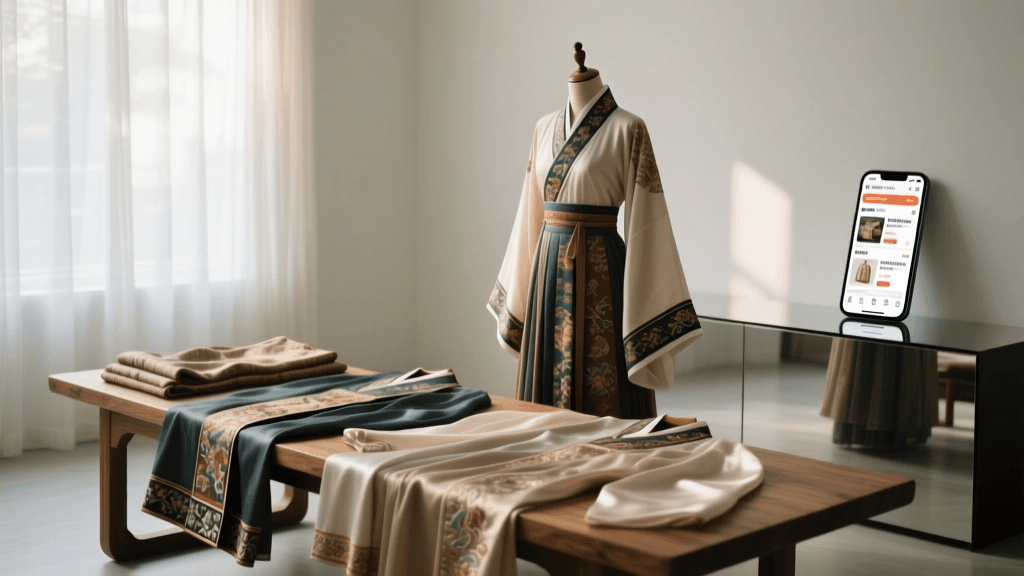
Today, the Hanfu e-commerce market is a multi-billion-dollar industry. Platforms like Taobao, Tmall, and Douyin (the Chinese version of TikTok) have completely democratized access to traditional clothing. Livestream shopping has become a dominant force, where hosts demonstrate the drape of a Ming Dynasty mamianqun (horse-face skirt) or the intricate jacquard weave of a Song Dynasty beizi (jacket) in real-time. This digital shift has allowed niche artisans and historical researchers to launch independent brands, bypassing traditional retail gatekeepers and selling directly to a global audience.
Navigating Modern E-Commerce: A Buyer’s Guide
For international buyers and newcomers, navigating Chinese e-commerce platforms to purchase authentic Hanfu can be daunting. The market is saturated with everything from museum-grade historical replicas to cheap, mass-produced costumes. To shop successfully, one must understand the specific terminology used by online vendors.
Essential Search Terms for Online Shoppers
- 汉服 (Hanfu): The general term for traditional Han Chinese clothing.
- 汉元素 (Hanfu Su / Hanfu Elements): Modern clothing that incorporates traditional motifs or silhouettes but does not strictly adhere to historical accuracy. Ideal for daily, practical wear.
- 原创 (Yuan Chuang): Original design. This is a crucial keyword. It indicates that the store has designed the garment and pattern themselves, supporting the artisan community.
- 山寨 (Shan Zhai): Knock-offs or stolen designs. Reputable Hanfu communities actively boycott these sellers.
- 明制 (Ming Zhi) / 宋制 (Song Zhi) / 唐制 (Tang Zhi): Refers to garments strictly modeled after the Ming, Song, and Tang dynasties, respectively.
Vetting Sellers and Identifying Authenticity
When browsing platforms like Taobao or specialized international sites, look for product descriptions that cite historical artifacts or museum pieces. High-end, reputable brands such as Minghuatang or Shisanyu often include diagrams of historical tomb murals or textile fragments to prove the accuracy of their patterns. Furthermore, check the fabric composition carefully. While ancient garments were made of silk, hemp, or ramie, many modern e-commerce sellers use polyester blends for affordability. If you are seeking authentic textiles, search for 真丝 (real silk) or 宋锦 (Song Brocade), and be prepared to pay a premium.
Comparison Chart: Where to Buy Hanfu Today
Choosing the right platform depends on your budget, your patience for shipping, and your demand for historical accuracy. Below is a comparison of the primary channels for purchasing Hanfu in the modern e-commerce era.
| Platform / Channel | Price Range (USD) | Authenticity & Quality | Shipping Time | Best Use Case |
|---|---|---|---|---|
| Taobao (Direct) | $30 - $400+ | High (if buying Yuan Chuang) | 2 - 4 Weeks | Enthusiasts seeking the widest variety and direct-from-artisan pricing. |
| Tmall (Flagship Stores) | $80 - $500+ | Very High (Verified Brands) | 2 - 3 Weeks | Buyers wanting guaranteed authenticity, premium silks, and reliable customer service. |
| AliExpress | $20 - $150 | Low to Medium (Often Hanfu Su) | 2 - 6 Weeks | Casual buyers, beginners, or those wanting modified, daily-wear styles without navigating Chinese UI. |
| Specialized Western Retailers | $100 - $600+ | High (Curated Imports) | 1 - 2 Weeks | International buyers willing to pay a markup for localized sizing, English support, and fast domestic shipping. |
| Physical Markets (Hangzhou/Suzhou) | $150 - $1000+ | Exceptional (Custom Tailored) | Immediate / Custom | Travelers and purists seeking bespoke, hand-woven silk garments and the traditional market experience. |
Sizing, Fabrics, and the Art of the Perfect Fit
One of the most significant hurdles in buying Hanfu online is understanding traditional sizing. Unlike Western fashion, which relies on form-fitting measurements (bust, waist, hips), traditional Hanfu is constructed using flat, geometric patterns that drape over the body. The fit is determined primarily by two measurements:
- Xiongwei (Chest Width): Because Hanfu jackets and robes are wrap-style and cross-collared, the chest measurement dictates how securely the garment will close and how the fabric will drape across the torso.
- Tongxiu (Sleeve Length): Historical garments often feature exaggerated sleeves. Tongxiu is measured from the center of the back of the neck, over the shoulder, and down to the wrist (or past the hands for ceremonial styles). Getting this measurement wrong can result in sleeves that are awkwardly short or dragging on the floor.
Fabric choice is equally critical. The Metropolitan Museum of Art highlights the historical significance of complex silk weaves like damask and brocade in Chinese textile history. When shopping online, beware of "printed" fabrics masquerading as brocade. True jacquard brocade (提花) features patterns woven directly into the fabric structure, meaning the design is visible on both the inside and outside of the garment. E-commerce listings for authentic woven fabrics will typically include macro-photography of the reverse side of the textile to prove the weaving technique. Printed polyester, conversely, will show a blank or muddy reverse side and lacks the structural weight required for garments like the Ming Dynasty mamianqun to pleat and drape correctly.
The Future of Traditional Garment E-Commerce
The journey of Hanfu from the heavily guarded silk markets of ancient Chang'an to the algorithmic feeds of modern e-commerce represents a profound cultural shift. Today, artificial intelligence is being used by top Taobao sellers to help international buyers calculate their traditional flat-pattern measurements based on standard Western body metrics. Meanwhile, virtual try-on technology and high-definition livestreams allow buyers to see the exact sheen of a silk-organza overlay under different lighting conditions before making a purchase.
As the Hanfu movement continues to globalize, the e-commerce ecosystem is adapting. We are seeing a rise in cross-border collaborations, where traditional Chinese textile artisans partner with global logistics firms to reduce shipping times, and the establishment of overseas warehouses dedicated solely to traditional Asian garments. For the modern consumer, the ancient silk market is no longer a physical destination; it is a vibrant, accessible digital world where centuries of sartorial history are just a click away.