Chinese Heritage Textiles on the Global Haute Couture Runway
The Paradigm Shift: From Chinoiserie to Authentic Heritage
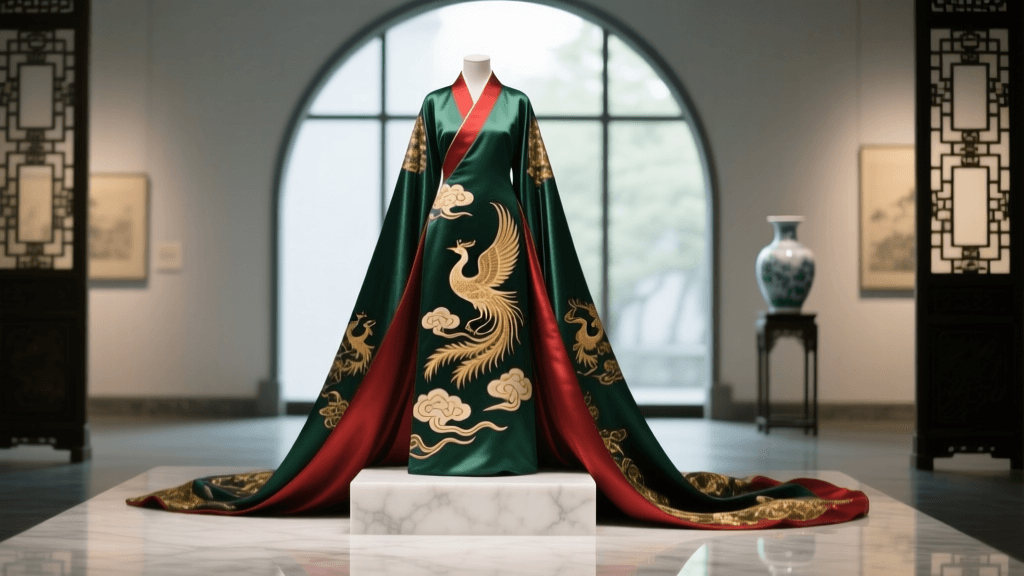
For decades, the Western interpretation of Chinese fashion on the international runway was largely defined by Chinoiserie—a superficial pastiche of dragon motifs, mandarin collars, and exaggerated pagoda shoulders. However, the modern era of Paris Haute Couture has witnessed a profound and necessary paradigm shift. Today, the integration of Chinese heritage textiles is no longer about costume-like appropriation; it is about the meticulous, respectful elevation of ancient, UNESCO-recognized craftsmanship into the upper echelons of global luxury. Pioneering designers like Guo Pei, who became the first Chinese-born designer to receive guest membership in the prestigious Chambre Syndicale de la Haute Couture, alongside European heritage houses like Chanel and Dior, have redefined how traditional Chinese textiles are sourced, structured, and presented on the global stage.
This evolution was notably catalyzed by landmark cultural moments, most notably the Metropolitan Museum of Art's blockbuster 2015 exhibition. According to The Metropolitan Museum of Art, the 'China: Through the Looking Glass' exhibition explored the impact of Chinese aesthetics on Western fashion, ultimately bridging the gap between historical artifacts and contemporary couture. This exposure educated a new generation of high-net-worth collectors and international buyers, shifting their focus from mass-produced 'oriental' prints to the acquisition of authentic, hand-woven, and hand-embroidered Chinese heritage garments.
The Holy Trinity of Chinese Couture Textiles
To understand the value of Chinese-inspired couture on today's runways, one must understand the 'holy trinity' of heritage textiles that international ateliers are now commissioning directly from master artisans in provinces like Guangdong, Jiangsu, and Zhejiang.
1. Xiangyunsha (Gambiered Canton Gauze)
Originating from the Pearl River Delta, Xiangyunsha is a highly complex, eco-friendly silk dyeing technique recognized by UNESCO Intangible Cultural Heritage. The silk is repeatedly soaked in the juice of the Dioscorea cirrhosa tuber, sun-baked, and then coated with iron-rich river mud. This 15-day process, requiring over 30 steps, results in a fabric with a distinctive metallic sheen, a crisp, paper-like hand-feel, and natural water-resistant properties. In modern couture, Xiangyunsha is utilized for structured evening coats and architectural gowns that require volume without the heavy weight of traditional brocades.
2. Kesi (Silk Tapestry)
Translating to 'cut silk,' Kesi is a tapestry weaving technique where the weft threads are discontinuous, creating a carved, three-dimensional effect. Historically reserved for imperial dragon robes, Kesi requires a master weaver to produce merely a few centimeters per day. International couture houses now utilize Kesi panels as structural bodices or dramatic capelets. Because the pattern is woven directly into the fabric rather than embroidered on top, Kesi garments possess a reversible, seamless quality that is highly prized in high fashion.
3. Su Embroidery (Suzhou Silk Embroidery)
Su embroidery is renowned for its staggering delicacy. Master artisans split a single silk thread into fractions as fine as 1/64th of its original thickness. In the context of international runway couture, Su embroidery is employed to create hyper-realistic, gradient-shaded florals—particularly peonies and lotuses—that appear to bloom directly off the silk organza base. Double-sided Su embroidery, where the hidden knots allow two different patterns to be visible on the front and back of a sheer fabric, is frequently used in couture capes and translucent overlays.
Couture Integration & Investment Data Matrix
For collectors, archivists, and private clients commissioning pieces from haute couture houses that utilize these Chinese textiles, understanding the investment parameters is crucial. Below is a comparative matrix detailing the practical realities of acquiring these garments.
| Textile Type | Primary Couture Application | Average Lead Time | Starting Couture Price (USD) | Specialized Care Requirements |
|---|---|---|---|---|
| Xiangyunsha | Structured coats, wide-leg trousers, architectural skirts | 6 - 9 Months | $35,000 - $60,000 | Store flat; avoid wire hangers; keep away from high alkaline detergents. |
| Kesi Tapestry | Corseted bodices, capelets, oblong clutch panels | 12 - 18 Months | $85,000 - $150,000 | Museum-grade archival boxing; strict 50% humidity control; no direct UV exposure. |
| Su Embroidery | Sheer overlays gowns, bridal trains, evening jackets | 9 - 14 Months | $55,000 - $250,000+ | Padded hangers only; interleave with acid-free unbuffered tissue paper to prevent thread snagging. |
Actionable Advice: How to Collect and Authenticate Couture Pieces
Investing in couture that features authentic Chinese heritage textiles requires a discerning eye and precise logistical planning. Whether you are buying off the Paris runway or commissioning a bespoke piece from an Asian couture atelier, adhere to the following guidelines.
Precision Measurement for Asian Silhouettes
Traditional Chinese garments, and the modern couture that draws from them, rely heavily on the drape and the structural integrity of the collar and shoulder. When submitting your measurements for a bespoke Xiangyunsha coat or a Su-embroidered Qipao-inspired gown, standard Western measurements are insufficient. You must provide:
- Hollow-to-Hem: Measured from the base of the neck (the hollow) to the desired hemline, crucial for maintaining the integrity of vertical embroidery motifs.
- Shoulder Slope and Armhole Circumference: Chinese heritage jackets often feature a raglan or extended drop-shoulder cut. Precise armhole measurements prevent the stiff Xiangyunsha fabric from buckling at the underarm.
- Cross-Back Width: Essential for ensuring that Kesi tapestry panels sit perfectly flat across the shoulder blades without distorting the woven imagery.
Authenticating Xiangyunsha and Kesi
As the demand for these textiles rises, so does the market for synthetic imitations. To authenticate genuine Xiangyunsha, perform a tactile and olfactory inspection. Authentic gambiered gauze has a subtle, earthy scent reminiscent of dried leaves and river clay, and it produces a distinct, crisp 'rustling' sound (often called the 'music of silk') when manipulated. Furthermore, genuine Xiangyunsha is naturally water-resistant; a drop of water should bead on the surface rather than immediately absorbing. For Kesi tapestries, examine the transitions between color blocks. Authentic Kesi will show tiny, natural slits or 'cuts' where the weft threads change color, whereas printed or jacquard imitations will have a continuous, unbroken weave structure.
Archival Storage and Climate Control
Protein-based silk fibers are highly susceptible to environmental degradation. Couture pieces featuring Su embroidery must never be stored in plastic garment bags, which trap moisture and emit gases that yellow silk. Instead, use 100% cotton canvas breathable bags. For heavily structured Kesi bodices, stuff the interior with acid-free, unbuffered tissue paper to maintain the three-dimensional shape, and store the piece in an archival-grade corrugated plastic box in a climate-controlled vault set to 68°F (20°C) and 50% relative humidity.
Styling Heritage Couture for Modern Galas
The key to wearing Chinese heritage couture on the international red carpet or at private galas is juxtaposition. The textiles themselves are visually dense and historically weighted; therefore, modern styling requires minimalist restraint.
- The Xiangyunsha Trench: Pair a floor-length, gambiered silk duster coat with a bias-cut, matte silk crepe slip dress in a contrasting jewel tone, such as deep emerald or sapphire. The matte crepe absorbs light, allowing the metallic sheen of the Xiangyunsha to take center stage.
- The Kesi Corset: Style a rigid, woven Kesi bodice over a fluid, high-waisted palazzo trouser in heavyweight wool crepe. This blends the architectural rigidity of imperial Chinese weaving with the relaxed, masculine-feminine fluidity of modern European tailoring.
- Accessorizing with Jade and Filigree: Avoid heavy diamond chokers which clash with the intricate necklines of Su-embroidered collars. Instead, opt for a single, high-grade Type A Imperial Green jadeite bangle or intricate gold filigree ear cuffs that echo the metallic threads used in the embroidery.
Conclusion
The presence of Chinese heritage textiles on the international haute couture runway represents a vital preservation of ancient artistry. By moving beyond superficial motifs and embracing the profound technical mastery of Xiangyunsha, Kesi, and Su embroidery, the global fashion industry is not only creating breathtaking garments but also providing economic sustenance to master artisans in rural China. For the discerning collector, investing in these couture pieces is an opportunity to own a wearable artifact—a bridge between the imperial looms of the past and the avant-garde runways of the future.