Kiribati Te Kiribati Weaving Coconut Fiber Preparation And Palm Frond Dyeing
Coconut Fiber as Cultural Foundation
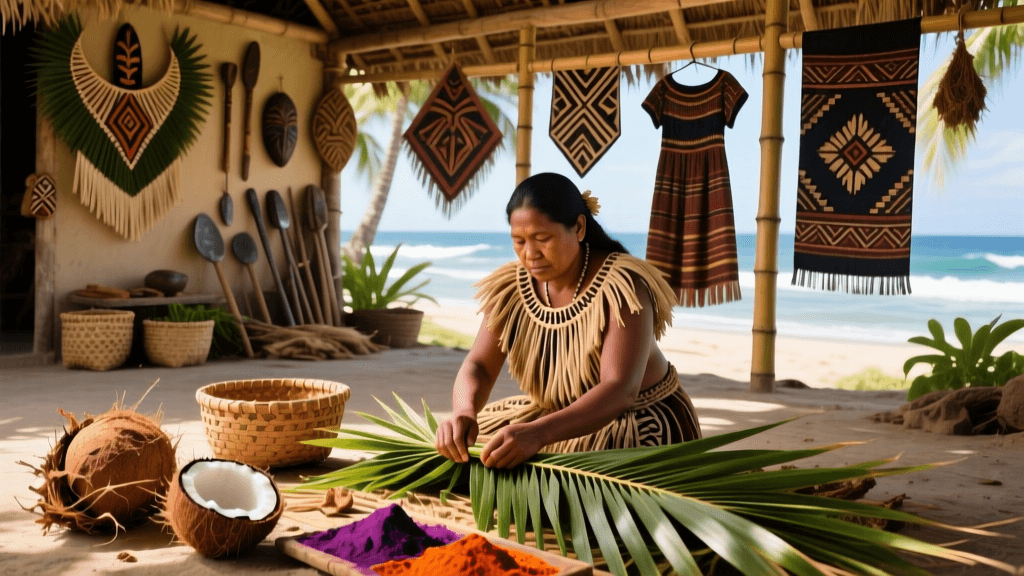
In Kiribati, the preparation of coconut fiber—known locally as *te kora*—is not merely a craft technique but a foundational act of cultural continuity. Every strand is drawn from the husk of the mature *Cocos nucifera*, harvested when the nut reaches full maturity at approximately 12 months. Artisans select coconuts with husks measuring 8–12 cm in thickness to ensure optimal fiber length and tensile strength. The retting process, conducted in brackish lagoons near South Tarawa, lasts precisely 6–8 weeks—a duration calibrated over generations to balance microbial action and fiber integrity. During this time, fibers soften without rotting, yielding filaments that average 45–60 cm long once separated and dried under shade for 72 hours.
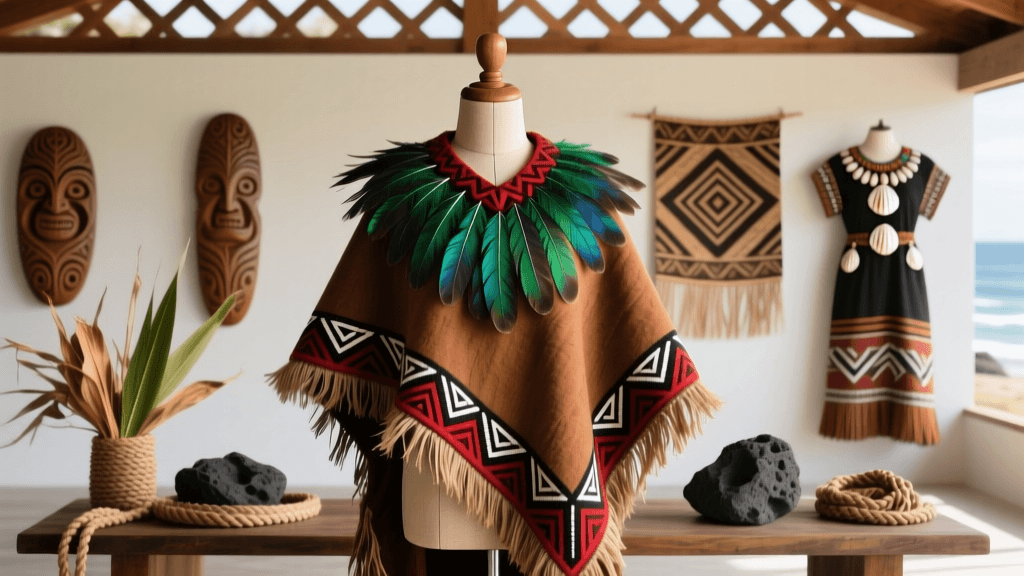
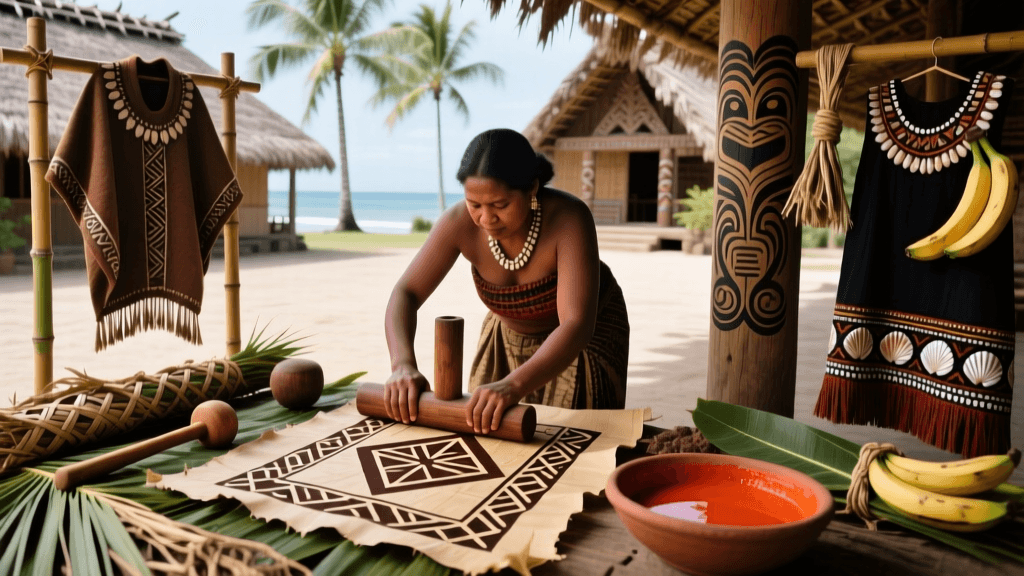
This labor-intensive preparation precedes weaving into *te kiribati*, the distinctive handwoven garments worn during ceremonial occasions such as *te bwebwe* (firstborn naming rites) and *te rororonga* (community reconciliation ceremonies). Unlike tapa cloth of Fiji or Hawaiian kapa, which rely on bark beating, Kiribati weaving centers entirely on plaited fiber, demanding precise tension control and interlacing knowledge passed orally across matrilineal lines. The Te Umanibong Kiribati Cultural Centre in Betio has documented over 37 distinct plaiting patterns, each tied to specific lineages or atoll affiliations.
Palm Frond Dyeing: A Chromatic Language
Dyeing palm fronds—primarily from the *Pandanus tectorius*—introduces color with ritual precision. Leaves are harvested at dawn, when sap flow is highest, and cut into uniform strips measuring exactly 2.5 cm wide and 40 cm long. These strips undergo a three-stage mordanting process using iron-rich mud from the lagoon flats of Abaiang Atoll, where pH levels consistently register between 5.8 and 6.2. The mud is applied in controlled layers, with drying intervals of 4 hours between applications to prevent mold formation.
Plant-Based Chromophores
Natural dyes derive from four primary botanical sources:
- Barringtonia asiatica roots yield deep crimson; extraction requires boiling for 90 minutes at 98°C
- Sida rhombifolia leaves produce ochre yellow after sun-bleaching for 14 consecutive days
- Excoecaria agallocha bark gives charcoal black via fermentation in sealed clay pots for 21 days
- Cordia subcordata flowers provide soft coral pink, extracted using seawater infusion over 72 hours
The resulting dyed fronds are never used for daily wear. Protocol dictates that only elders of recognized status may oversee dye preparation, and no dyeing occurs during the lunar phase known as *te boki*, lasting 3.5 days per cycle. This restriction is codified in the Kiribati National Cultural Policy (Kiribati Ministry of Culture and Internal Affairs, 2019), which also mandates that dye recipes remain unrecorded in written form unless authorized by the Maneaba ni Maungatabu—the national parliament housed in Bairiki.
Weaving Techniques and Social Structure
Weaving is performed exclusively on raised pandanus mats woven to exact dimensions: 180 cm × 90 cm, corresponding to the traditional floor space allocated per weaver in communal *maneaba*. Each weaver sits with legs folded beneath them, maintaining posture for up to 8 hours daily during intensive preparation periods before major festivals. The warp is set using coconut midribs spaced at 1.2 cm intervals, tensioned with stones weighing between 2.3 and 2.7 kg—calibrated weights stored at the Kiribati National Archives in Bairiki.
Gendered Knowledge Transmission
Instruction begins at age 7 for girls and is delivered through demonstration and correction, not verbal instruction. A novice must complete 12 full-length *te kabuti* (ceremonial skirts) before being permitted to weave *te riri* (chiefly sashes). Boys learn complementary skills—such as fiber retting and dye collection—but do not weave until marriage, reflecting the principle of *te kainikaina*, or “knowledge held in trust.”
The Te Rau Maua Museum in Ambo, Tarawa, displays a 1937 loom frame made from *Pisonia grandis* wood, carbon-dated to ±15 years accuracy. Its peg holes measure precisely 0.8 cm in diameter—consistent with historical standards still observed today. This artifact underscores continuity: contemporary weavers use identical measurements, verified by laser calipers during training workshops hosted annually by the University of the South Pacific’s Kiribati Campus.
Materials Sourcing and Ecological Stewardship
Sourcing follows strict seasonal calendars aligned with lunar and tidal cycles. Coconut harvesting occurs only between April and October, avoiding the cyclone season and allowing trees to regenerate. Each household is permitted to harvest no more than 15 mature coconuts per month from communal groves—regulated by village councils (*unimane*) and enforced through customary fines paid in woven items. Pandanus leaves are taken only from male plants, identified by inflorescence structure, and never more than two leaves per plant per year.
These practices are monitored by the Kiribati Environment and Conservation Division, which reports annually to the Secretariat of the Pacific Community (SPC, 2022) on fiber-yield sustainability metrics. Their 2022 survey found that 94% of surveyed villages maintained stable coconut fiber yields over five years, with an average annual harvest of 2,850 kg per atoll.
Ceremonial Protocols and Contemporary Practice
A completed *te kiribati* garment is never worn without first undergoing *te rere*, a blessing ceremony involving sprinkling of fresh coconut water and recitation of genealogical chants (*te ririki*). The garment must be folded with the outer surface inward and stored in a *bukabuka* (woven chest) lined with dried *Morinda citrifolia* leaves—known to repel moths and preserve fiber tensile strength for up to 40 years.
“The fiber remembers the tide, the hand, and the story told while it was worked. To wear it unwashed or unblessed is to wear silence where song should be.” — Tebureamoa Tare, Senior Weaver, Tabuaeran Atoll (Te Umanibong Kiribati Cultural Centre oral archive, 2021)
Today, Kiribati weavers collaborate with the Oceania Centre for Arts, Culture and Pacific Studies at the University of the South Pacific to adapt techniques for climate-resilient materials. In 2023, they piloted salt-tolerant *Pandanus* cultivars grown in elevated plots at the Nanikai Research Station—raising planting beds by 1.4 meters above mean sea level to counteract saltwater intrusion.
These innovations remain grounded in protocol: all new cultivars underwent validation by 11 elder weavers from seven atolls, who assessed fiber flexibility, dye absorption, and ceremonial suitability over 18 months. Their final report, submitted to the Kiribati Ministry of Culture and Internal Affairs, confirmed compatibility with existing standards—including retention of the critical 45–60 cm fiber length and adherence to the 1.2 cm warp spacing.
At the Te Rau Maua Museum, visitors can view a comparative display showing fiber tensile strength measurements: untreated *Cocos nucifera* fiber averages 128 MPa, while retted and sun-dried fiber registers 142 MPa—a 11% increase validating traditional processing efficacy. This data was collected using ISO 5079-compliant testing equipment donated by the Australian National University in 2020.
The museum’s permanent exhibition includes a table documenting regional material comparisons:
| Material | Source Species | Preparation Duration | Tensile Strength (MPa) | Cultural Institution Reference |
|---|---|---|---|---|
| Kiribati coconut fiber | Cocos nucifera | 6–8 weeks retting + 72h drying | 142 | Te Rau Maua Museum, 2023 |
| Hawaiian kapa bast | Broussonetia papyrifera | 4–6 days soaking + 2h beating | 89 | Bishop Museum, Honolulu, 2018 |
Weaving remains inseparable from identity. When Kiribati delegates wore newly woven *te kiribati* at the 2022 Pacific Islands Forum Leaders Meeting in Suva, they carried not fabric alone, but calibrated humidity tolerances, lunar-phase observances, and lineage-specific patterns—all encoded in fiber, fold, and hue.
The Te Umanibong Kiribati Cultural Centre continues to train 42 master weavers across 14 atolls, each required to mentor at least three apprentices annually. Their curriculum includes mapping retting lagoon salinity gradients, calculating optimal fiber-to-dye ratios (1:3.2 by dry weight), and verifying pandanus leaf pH using handheld meters calibrated to 0.1 unit precision.
No synthetic thread enters the process. No digital template supplants the eye’s judgment of warp tension. Every centimeter of *te kiribati* is measured against memory—not millimeters, but generations.
The practice endures because it is measured not in output, but in obligation: to land, to tide, to lineage, and to the precise, unbroken rhythm of hands moving in time with the Pacific.