Japanese Kimono Zero-Waste Construction Guide 2026
The Philosophy of Chokusen-dachi: Zero-Waste Engineering
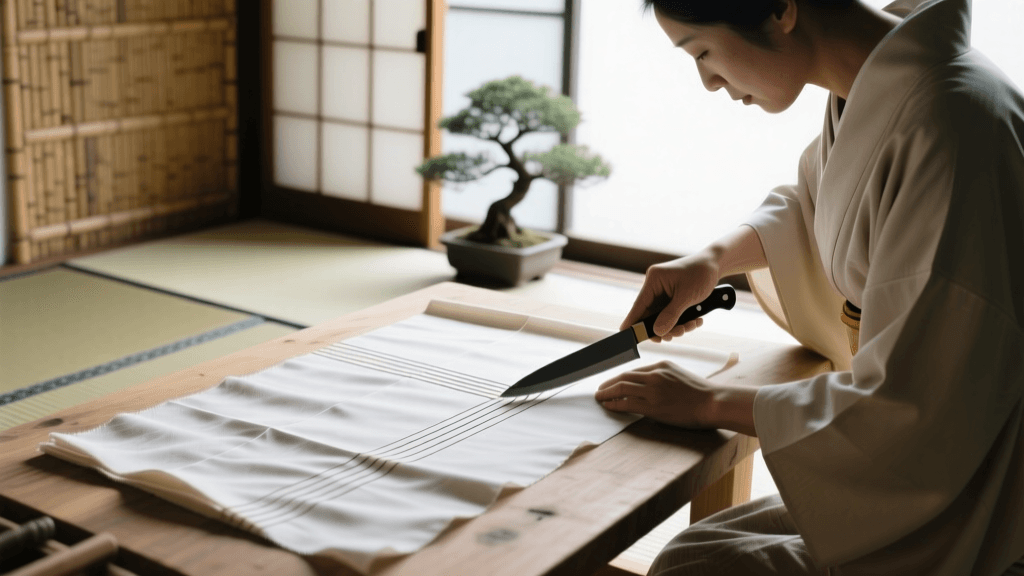
As the global fashion industry grapples with textile waste in 2026, the traditional Japanese kimono stands as a masterclass in sustainable garment engineering. Unlike Western tailoring, which relies on curved pattern pieces that leave behind significant offcuts, the kimono is constructed using a method known as chokusen-dachi (straight-line cutting). This centuries-old technique utilizes a single, uncut bolt of fabric called a tanmono, ensuring that nearly 100 percent of the woven textile is incorporated into the final garment. According to the Victoria and Albert Museum, the kimono's iconic T-shape is not merely an aesthetic choice but a profound reflection of a culture that historically prized the integrity and conservation of precious textiles.
In 2026, contemporary bespoke tailors and sustainable fashion houses are actively studying chokusen-dachi to develop modular, zero-waste clothing lines. By understanding the precise geometry of the kimono, modern makers can create garments that are entirely reversible, easily alterable, and completely recyclable at the end of their lifecycle, aligning perfectly with the Ellen MacArthur Foundation's circular fashion directives for the modern era.
Anatomy of the Tanmono: 2026 Fabric Yield Standards
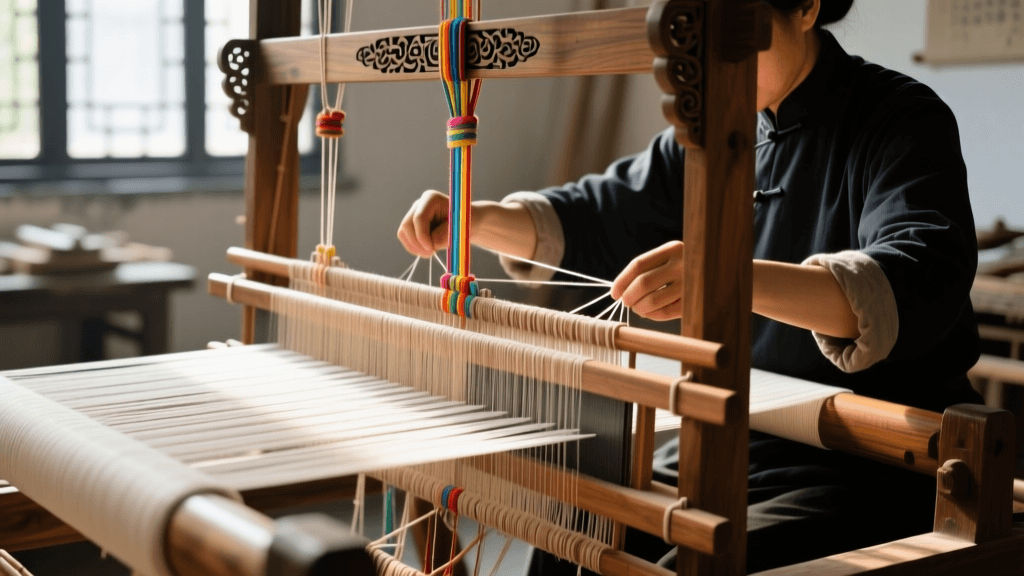
The foundation of kimono construction is the tanmono. Historically, a standard silk bolt measures approximately 36 to 40 centimeters in width and 11.5 to 12 meters in length. This specific dimension is not arbitrary; it is mathematically calculated to yield exactly one adult-sized kimono with virtually no waste. In 2026, while traditional silk weavers in Nishijin and Kiryu continue to produce these classic dimensions, a new wave of eco-textile manufacturers in Fukui prefecture are weaving sustainable Tencel and organic cotton tanmono at 42 centimeters wide to accommodate larger global sizing without breaking the zero-waste mathematical model.
The entire bolt is cut into specific rectangular panels, which are then sewn together using straight seams. Because the pieces are rectangular, the garment can be easily disassembled, cleaned, and resewn—a process known as arai-hari. This modularity is a cornerstone of the garment's longevity.
Kimono Component Dimensions and Fabric Allocation
| Component Name | English Translation | Quantity Required | Structural Function |
|---|---|---|---|
| Migoro | Main Body Panels | 2 (Left & Right) | Forms the primary front and back drape of the garment. |
| Okumi | Front Overlap Panels | 2 (Left & Right) | Creates the overlapping front closure essential for wrapping. |
| Sode | Sleeves | 2 (Left & Right) | Provides the iconic deep, rectangular sleeve pouches. |
| Eri | Inner Collar | 1 | Structural neckline support and framing for the face. |
| Tomoeri | Collar Cover | 1 | Protects the inner collar from skin oils and makeup. |
The Art of Kuke: Hidden Stitching and Seam Allowances
One of the most remarkable aspects of kimono construction is the treatment of seam allowances. In Western garment manufacturing, seam allowances are typically trimmed, serged, or overlocked to prevent fraying, permanently locking the fabric into its current shape. In traditional kimono tailoring, seam allowances are never cut away. Instead, they are folded inward and secured using a hidden blind-stitching technique called kuke.
The kuke technique involves folding the raw edges of the seam allowance together and stitching them to the backing fabric or to each other using nearly invisible silk threads. This serves a dual purpose: it prevents fraying without the use of synthetic serging threads, and it creates a soft, flexible seam that drapes beautifully against the body. Furthermore, because the seam allowances remain intact inside the garment, a kimono can be let out or taken in by several inches, allowing the garment to be passed down through generations and adapted to different body types over decades of use.
Specialized Hand Stitches in Traditional Assembly
The assembly of a high-end kimono relies on specific hand stitches that machines simply cannot replicate with the same tension and drape. In 2026, master artisans charge a premium for these hand-finished details, which are considered the hallmark of true bespoke construction.
- Matsu-ke (Pine Needle Stitch): Used primarily for the hem and sleeve openings. This stitch catches only one or two threads of the outer face fabric, making it completely invisible from the right side while securely holding the lining and seam allowances in place.
- Hon-guke (True Blind Stitch): Applied along the collar (eri) and the front edges. It allows the silk to roll softly over the edge without puckering, creating the crisp, clean lines that define the kimono's silhouette.
- Chigai-nui (Alternating Stitch): A reinforced stitch used at high-stress points, such as the underarm gusset and the base of the sleeve attachment, providing structural integrity without adding bulk.
Shitsuke-ito: Basting Threads and Garment Storage
Another unique construction feature is the use of shitsuke-ito, or temporary basting threads. When a kimono is newly finished, or after it has been professionally cleaned and pressed, long, loose basting threads are stitched along the outer edges, the collar, and the sleeve hems. These threads, traditionally made of soft cotton or silk, are dyed in contrasting colors like red or white so they are easily visible.
The purpose of shitsuke-ito is to keep the layers of fabric perfectly aligned and flat during storage, preventing permanent creases from forming in the delicate silk. When the wearer is ready to put on the kimono, these basting threads are simply pulled out in one continuous motion. In the 2026 market, eco-conscious Kyoto artisans have begun using biodegradable PLA (polylactic acid) basting threads, which offer the same soft tension as traditional cotton but break down safely if accidentally discarded in composting systems.
Adapting Traditional Techniques for 2026 Bespoke Tailoring
The relevance of these construction techniques extends far beyond historical preservation. As noted by the Metropolitan Museum of Art, the kimono is a dynamic garment that has continuously evolved alongside cultural shifts. Today, the principles of chokusen-dachi and kuke are being integrated into modern bespoke tailoring to address the urgent need for sustainable luxury.
In 2026, commissioning a bespoke kimono constructed entirely by hand using traditional zero-waste methods is a significant investment. A custom-woven silk tanmono paired with master-level hand stitching typically ranges from $3,500 to $6,000 USD. However, the rise of sustainable alternative textiles has made these construction techniques more accessible. Artisans are now applying the exact same straight-line cutting and hidden seam techniques to organic hemp, cupro, and peace silk blends, with bespoke pieces starting around $1,200 to $1,800 USD.
By embracing the kimono's structural engineering, modern designers are proving that zero-waste fashion does not require sacrificing elegance or fit. The hidden stitches, the preserved seam allowances, and the mathematical precision of the fabric bolt offer a timeless blueprint for a more sustainable, modular, and enduring approach to garment construction in the 21st century.