Top 2026 Kimono Tailoring Workshops: Kyoto vs Online Classes
The Renaissance of Wasai in 2026
The landscape of traditional Asian garment making has experienced a profound renaissance as modern creators seek sustainable, slow-fashion alternatives to mass production. At the forefront of this movement is Wasai, the traditional Japanese art of kimono construction. As of 2026, learning to craft a kimono is no longer restricted to multi-year apprenticeships in Japan. A diverse ecosystem of workshops and seminars has emerged, catering to global textile enthusiasts, fashion students, and heritage preservationists. Whether you are looking to understand the geometry of the tanmono (fabric bolt) or master the delicate tension of silk stitching, the educational opportunities available this year are unprecedented in their accessibility and depth.
Understanding the Tanmono and Straight-Line Cutting
Before selecting a workshop, it is crucial to understand the foundational philosophy of Wasai. Unlike Western tailoring, which relies on curved seams, darts, and complex pattern grading to contour the human body, kimono construction is based on straight-line cutting. The fabric is woven into a tanmono, a narrow bolt typically measuring about 36 to 40 centimeters in width and 12 meters in length. According to the Traditional Crafts of Japan initiative, this standardized width dictates the entire modular architecture of the garment. Every panel—the sleeves (sode), body (migoro), and collar (eri)—is cut in straight lines, ensuring that the garment can be entirely disassembled, cleaned, and resewn without wasting a single thread of precious silk.
Immersive Kyoto Ateliers: The 2026 In-Person Experience
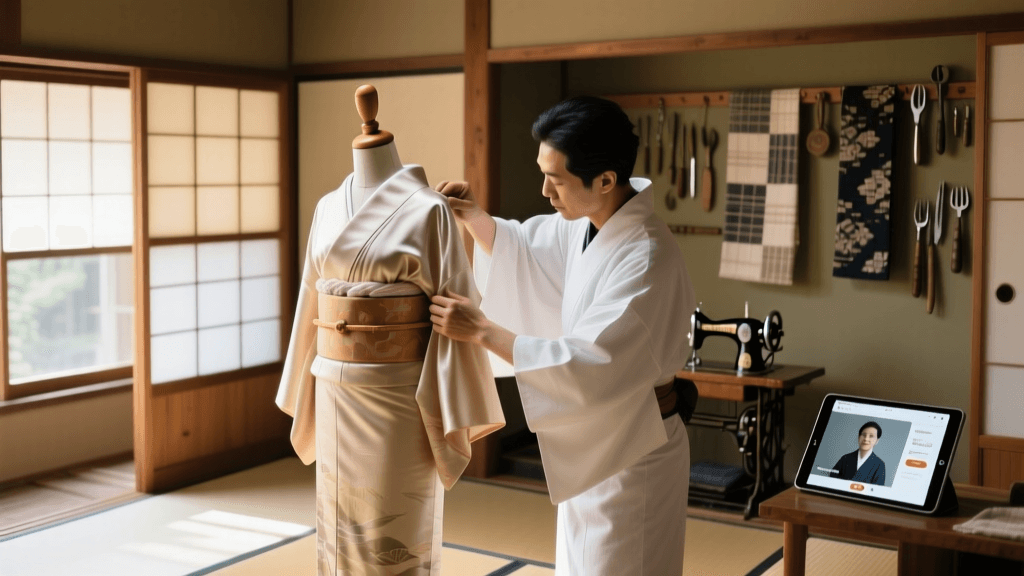
For those seeking total immersion, Kyoto remains the undisputed epicenter of Wasai education. In 2026, specialized ateliers in the Nishijin and Higashiyama districts offer intensive, multi-week retreats. These in-person seminars provide a sensory education that cannot be replicated through a screen. Students work directly under master artisans, learning to read the grain of vintage silk and feeling the precise tension required for hand-stitching.
A standard 14-day intensive retreat in Kyoto currently costs between 250,000 and 320,000 JPY (approximately $1,700 to $2,200 USD, based on early 2026 exchange rates). This fee generally includes all materials, studio access, and guided excursions to historic textile dyeing houses. The physical environment of a Kyoto atelier, with its tatami floors and specialized low sewing tables, forces the student to adopt the traditional posture and spatial awareness inherent to Japanese craftsmanship.
Virtual Masterclasses: High-Definition Remote Learning
Conversely, the virtual seminar space in 2026 has evolved far beyond the shaky, poorly lit video calls of the past decade. Leading online platforms now utilize multi-camera 4K macro setups, allowing remote students to see the exact needle penetration and thread tension of the instructor. Some advanced 2026 cohorts even incorporate augmented reality (AR) overlays, where students can project digital tanmono cutting lines onto their own physical fabrics via smart glasses or tablet applications.
Virtual masterclasses are significantly more accessible, with comprehensive 6-week cohort programs averaging $350 to $500 USD. These courses are ideal for hobbyists and independent designers who wish to integrate Wasai techniques into their existing practices without the logistical burden of international travel. Furthermore, virtual seminars often provide digital access to historical archives and translation services, bridging the language gap that can sometimes hinder foreign students in rural Japanese workshops.
2026 Workshop Comparison: Kyoto vs. Virtual
To help you decide which learning environment suits your goals, we have compiled a direct comparison of the two primary seminar formats available this year.
| Feature | Kyoto In-Person Atelier | Virtual Masterclass |
|---|---|---|
| Average Cost (2026) | $1,700 - $2,200 USD | $350 - $500 USD |
| Duration | 10 to 14 Days (Intensive) | 6 to 8 Weeks (Part-time) |
| Materials Provided | Full silk tanmono and tools | Student sources own fabrics |
| Instructor Feedback | Immediate physical correction | Weekly 4K video submissions |
| Cultural Immersion | High (Tea ceremonies, dye tours) | Low (Focus purely on technique) |
Essential Tools for Your 2026 Kimono Sewing Kit
Whether you are traveling to Japan or setting up a home studio for a virtual class, you will need to acquire specific Wasai tools. The Agency for Cultural Affairs in Japan emphasizes the importance of using correct implements to preserve the integrity of traditional textiles. Your 2026 starter kit should include:
- Shaku: The traditional Japanese ruler, measuring approximately 37.8 centimeters. It is divided into 10 sun, and mastering this measurement system is critical for reading vintage kimono patterns.
- Hera: A polished bamboo or tortoiseshell spatula. It is used to create crisp, temporary creases along the silk without leaving permanent marks or damaging the delicate weave.
- Kakehari: A wooden tensioning device with a needle point at one end. It is clamped to the edge of the fabric and held against the body to keep long seams taut while sewing.
- Kote: The traditional Japanese iron. While historical charcoal irons are studied for context, modern seminars utilize specialized electric kote with variable temperature controls calibrated specifically for delicate silk chirimen (crepe) and rinzu (satin damask).
Mastering the Signature Stitches
The true hallmark of Wasai is not just the cutting, but the hand-stitching. A kimono is meant to be taken apart and reassembled, meaning the stitches must be incredibly secure yet entirely removable. In any reputable 2026 seminar, you will spend hours mastering the following core stitches:
- Hon-gushi (Main Stitch): The fundamental running stitch used for the primary seams. It requires precise, uniform tension to ensure the fabric does not pucker, a skill that takes weeks of repetitive practice to perfect.
- Matsu-nui (Pine Needle Stitch): A specialized, staggered stitch used for securing the hem allowance. It creates a flexible, nearly invisible hold that allows the heavy silk hem to drape naturally.
- Kuke-nui (Blind Stitch): Used extensively for the collar and overlapping edges. The needle catches only a single thread of the face fabric, rendering the stitch completely invisible from the outside of the garment.
How to Select the Right Seminar for Your Skill Level
When evaluating workshops, scrutinize the curriculum for a balance of theory and physical execution. Beginners should look for seminars that offer pre-cut practice fabrics (often cotton or polyester blends) before allowing students to cut into expensive silk. Intermediate sewers should seek out classes that focus on yu-noshi (steam stretching) and the complex geometry of aligning woven patterns across the back seam. Advanced practitioners might opt for specialized micro-seminars focusing solely on the creation of the eri (collar), which is widely considered the most structurally complex and visually vital component of the kimono.
Final Thoughts on Preserving Heritage
Learning traditional Asian garment making in 2026 is an act of cultural preservation and personal mindfulness. Whether you choose the atmospheric, incense-scented rooms of a Kyoto atelier or the high-tech, flexible environment of a virtual masterclass, the discipline of Wasai offers a profound connection to history. By understanding the geometry, the tools, and the meticulous hand-stitches that define the kimono, you are not merely learning to sew; you are participating in the ongoing stewardship of one of Asia's most magnificent textile traditions.