Master Kimono Wardrobe Organization & Seasonal Rotation
The Philosophy of Koromogae: Understanding Seasonal Rotation
The art of kimono storage is not merely about tidying up a closet; it is a profound cultural practice deeply intertwined with the Japanese appreciation for the passing of time. At the heart of kimono wardrobe organization is koromogae (衣替え), the traditional practice of changing one's wardrobe to reflect the shifting seasons. Historically originating in the Heian period (794–1185) among the imperial court, koromogae was formalized as a biannual event. Today, while modern Japanese schools and corporations still observe koromogae for uniform changes on June 1st and October 1st, for kimono collectors and practitioners, it represents a vital rhythm of textile care, rotation, and preservation.
Proper seasonal rotation ensures that garments are not only appropriate for the weather but also that they receive necessary maintenance. Storing heavy winter silks during the humid summer months without proper preparation can lead to catastrophic mold growth, while leaving sheer summer garments exposed to dry winter air can make the fibers brittle. Understanding the rhythm of koromogae is the first step toward building a resilient, well-organized kimono wardrobe.
Categorizing Your Kimono by Season
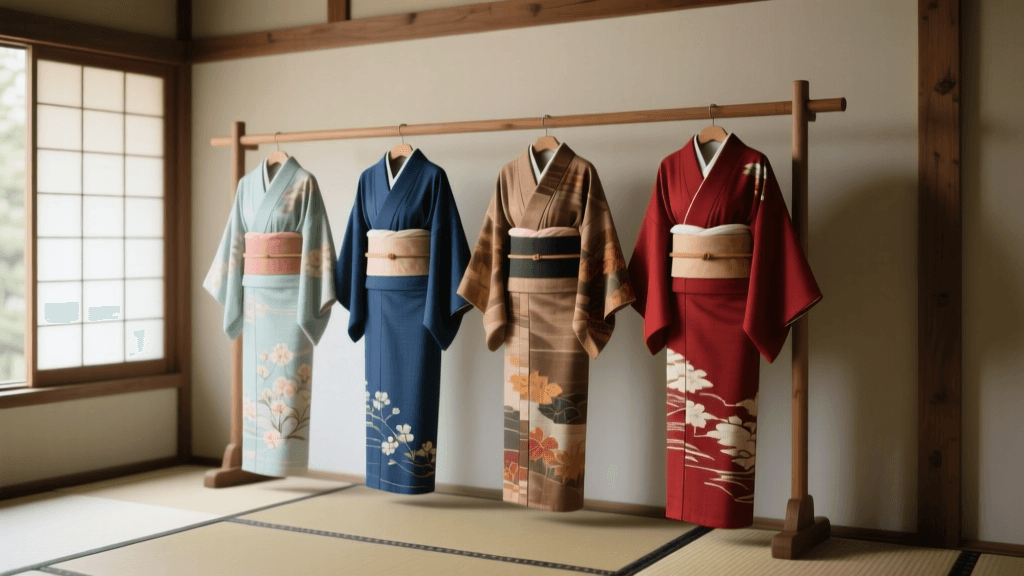
Unlike Western fashion, which transitions gradually, traditional Japanese dress adheres to strict seasonal rules regarding fabric weight, lining, and motifs. According to the Metropolitan Museum of Art's Heilbrunn Timeline of Art History, the kimono is deeply tied to the natural world, with garments engineered to provide both physical comfort and aesthetic harmony with the environment. To organize your wardrobe effectively, you must first categorize your collection into the four primary seasonal types.
| Season | Kimono Type | Months Worn | Fabric & Construction Details |
|---|---|---|---|
| Spring/Autumn | Awase (Lined) | Oct 1 - May 31 | Silk or synthetic with a full inner lining. Worn during cooler months. |
| Early Summer | Hitoe (Unlined) | June 1 - June 30 | Single layer of fabric. Breathable weaves like ro or komon. Worn as temperatures rise. |
| Mid-Summer | Usumono (Sheer) | July 1 - Aug 31 | Highly translucent, gauze-like fabrics (ro, sha, ra). Maximum airflow for peak humidity. |
| Late Summer | Hanaori / Transition | Sept 1 - Sept 30 | Return to Hitoe or lighter Awase. Motifs shift to autumn themes like maple leaves. |
When organizing your physical storage space, group your garments by these categories. This makes the biannual koromogae transition significantly smoother, allowing you to swap out entire sections of your wardrobe rather than sorting through individual pieces.
Essential Supplies for Kimono Storage
Investing in the correct storage materials is non-negotiable for preserving the integrity of silk, hemp, and delicate synthetic fibers. The traditional Japanese approach to storage relies on specific, naturally protective materials.
Tatogami (Storage Paper)
Every kimono should be wrapped in tatogami, a specialized, breathable paper designed to protect textiles from dust, light, and sudden humidity shifts. Standard tatogami measures approximately 85cm by 65cm. Unlike standard paper, high-quality tatogami is acid-free and prevents the transfer of dyes between stacked garments. Never use newspaper or standard wrapping paper, as the acidity and ink will permanently stain silk.
Kiribako (Paulownia Wood Chests)
The gold standard for kimono storage is the kiribako, a chest made from Paulownia wood. Paulownia is highly hygroscopic; it swells during humid months to seal out moisture and shrinks during dry months to allow the wood to breathe. Furthermore, Paulownia is naturally fire-resistant and repels insects. If a full chest is beyond your budget, individual Paulownia storage boxes (kiribako) are excellent alternatives for high-value antique pieces.
Moth Repellents and Desiccants
Silk is a protein fiber, making it a prime target for webbing clothes moths. Traditional Japanese mothballs, such as shobu (made from camphor) or modern alternatives like yatsu-mushi, should be placed in the corners of your storage drawers. Crucial Rule: Never allow mothballs or desiccant silica gel packets to touch the kimono directly, as the chemical off-gassing can dissolve silk fibers or cause localized bleaching. Always place them in small cloth pouches or dedicated drawer compartments.
The Hon-Datami Folding Method
Proper folding prevents permanent creases that can eventually lead to fiber breakage, particularly along the shoulders and hem. The standard folding technique is called hon-datami. Mastering this method ensures your kimono fits perfectly into standard tatogami and storage drawers.
- Align the Seams: Lay the kimono face down on a clean, flat surface. Align the back center seam perfectly.
- Fold the Left Side: Fold the left front panel back along its natural crease line, aligning the outer edge with the back center seam.
- Fold the Right Side: Bring the right front panel over the left, aligning its outer edge with the left side's fold. The front panels should now overlap neatly.
- Tuck the Collar: Fold the collar back so it lies flat against the shoulders, creating a clean neckline.
- Fold the Sleeves: Fold the sleeves inward along their natural seams so they do not extend past the body of the garment.
- Final Thirds: Fold the bottom hem up to the collar, and then fold the garment in half or thirds, depending on the length of your tatogami.
Once folded, wrap the garment snugly in tatogami and secure it with a soft cotton tie or by tucking the paper flaps. Avoid using rubber bands, plastic clips, or adhesive tape.
Environmental Controls: Temperature and Humidity
The greatest enemies of a kimono wardrobe are fluctuating temperatures and high humidity. The Canadian Conservation Institute (CCI) provides stringent guidelines for storing historic textiles, which apply perfectly to private kimono collections. According to the CCI, organic textiles like silk and hemp require a stable environment to prevent biological deterioration.
- Temperature: Maintain a steady temperature between 18°C and 20°C (64°F - 68°F). Avoid storing kimono in attics or uninsulated basements where temperature swings are extreme.
- Relative Humidity (RH): The ideal RH for silk is between 45% and 55%. If humidity exceeds 65%, mold spores can germinate within 48 hours. If it drops below 30%, silk fibers become brittle and prone to shattering.
- Light Exposure: Ultraviolet and visible light cause irreversible fading and fiber degradation. Always store kimono in dark, opaque drawers or chests. Never display a silk kimono in direct sunlight.
If you live in a highly humid climate and lack a climate-controlled room, consider using a high-quality dehumidifier in the storage space and monitoring the environment with a digital hygrometer.
Annual Maintenance: Mushiboshi (Airing Out)
Even in perfect storage, textiles need to breathe. Mushiboshi is the traditional practice of airing out your kimono collection. This should be done twice a year, ideally during late autumn (October/November) and early spring (March/April), when the air is dry, crisp, and breezy.
Unwrap your kimono from their tatogami and hang them on specialized, wide-shouldered kimono hangers (emonkake) in a shaded, well-ventilated room. Never hang them outside in direct sunlight, as UV rays will fade the dyes. Allow the garments to air out for 4 to 6 hours. This is the perfect time to inspect each piece for early signs of trouble: yellowing stains, loose threads, mold spots, or permanent creases. After airing, refold them using the hon-datami method, shifting the fold lines slightly (by about a centimeter) to prevent stress on the exact same fibers year after year.
Organizing Accessories: Obi, Zori, and Kanzashi
A complete kimono wardrobe extends far beyond the main garment. Accessories require their own specialized organization strategies to prevent damage and loss.
- Obi (Sashes): Maru and Fukuro obi are heavily embroidered and stiff. They should be folded carefully in thirds and stored flat in wide drawers. Never roll heavily embroidered obi, as this can crack the metallic threads. Nagoya obi can be stored in their specific, pre-tied folding shapes.
- Obijime and Obiage (Cords and Scarves): These small items are easily lost. Store them in partitioned wooden boxes or clear, acid-free plastic bins. Roll obijime loosely to prevent the braided silk from kinking.
- Zori and Geta (Footwear): Wipe down the soles and straps with a dry cloth before storing. Keep them in breathable cotton shoe bags or their original paulownia boxes. Stuff the toe area with acid-free tissue to help them retain their shape.
- Kanzashi (Hair Ornaments): Delicate silk flowers, lacquer, and tortoiseshell hairpins should be stored in partitioned jewelry boxes lined with unbleached cotton. Keep lacquerware away from direct heat to prevent cracking.
Modern Alternatives for Small Spaces
Not everyone has the space for a sprawling array of Paulownia chests. If you are organizing a kimono collection in a modern apartment or a small closet, you can adapt traditional methods using archival-quality modern materials. Heavy-duty, opaque plastic storage bins can be used, provided they are made of polypropylene (PP), which is chemically stable. Line the bottom of the bin with a clean cotton sheet, and place a layer of acid-free, unbuffered tissue paper between each folded kimono. Include a few silica gel packets in the corners of the bin (wrapped in cloth) to manage moisture, and check the humidity levels monthly.
A Final Warning: Never use vacuum-sealed bags for kimono or obi. The immense pressure will crush delicate silk fibers, flatten embroidery, and create deep, permanent creases that are nearly impossible to remove without professional steaming and stretching (yushinori).
By embracing the rhythm of koromogae, utilizing proper archival materials, and maintaining a stable storage environment, you ensure that your kimono collection remains a vibrant, wearable piece of living history for generations to come.