Kimono Storage Preservation & Collection Management Guide 2026
The Art and Science of Kimono Preservation in 2026
The preservation of vintage Japanese kimono is a meticulous discipline that bridges centuries-old traditions with modern conservation science. Whether you are safeguarding a fragile Meiji-era uchikake (wedding overcoat), a vibrant Taisho-era yuzen dyed garment, or a contemporary silk masterpiece, the structural integrity of the protein-based silk fibers demands rigorous environmental control. As we navigate the fluctuating global climates of 2026, indoor humidity spikes and temperature variations pose unprecedented threats to textile archives.
Silk is inherently susceptible to photodegradation, moisture-induced mold, and protein-eating pests. Furthermore, the metallic threads (surihaku) and delicate embroidery (nui) often found on formal garments require specialized handling to prevent tarnishing and thread snapping. This comprehensive guide details the exact protocols, materials, and digital management strategies required to maintain a museum-grade kimono collection today.
Proper kimono preservation is not merely about storage; it is the active stewardship of woven history, requiring a symbiosis of traditional Japanese wisdom and modern archival science.
The Paulownia Tansu: Traditional Storage Meets Modern Maintenance
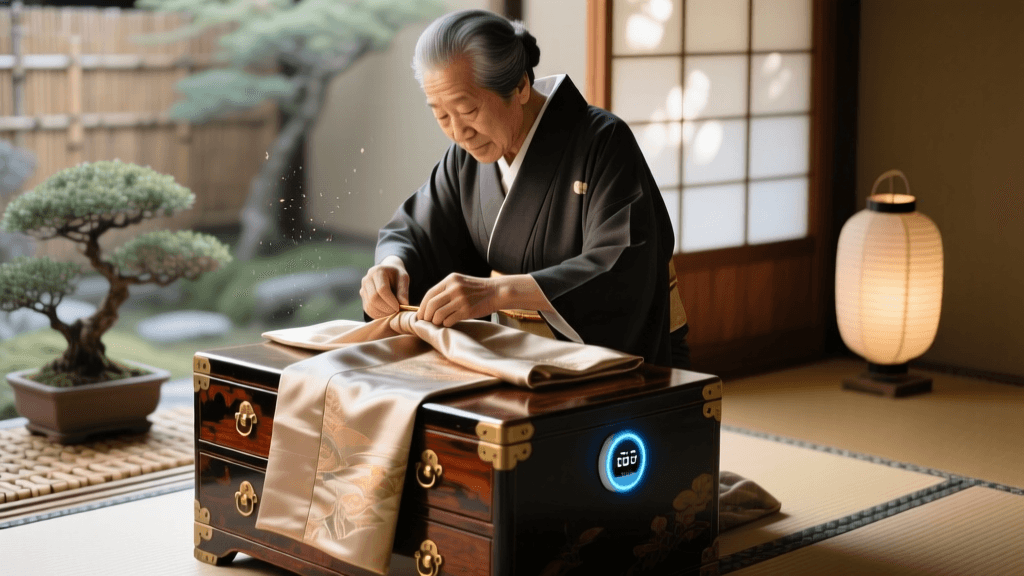
The cornerstone of traditional kimono storage is the tansu, a chest crafted from kiri (paulownia) wood. Paulownia is uniquely suited for textile preservation due to its hygroscopic properties; it naturally absorbs excess ambient moisture and releases it when the air becomes overly dry, creating a buffered microclimate. Additionally, kiri wood is naturally fire-resistant and contains compounds that deter certain insects.
In 2026, sourcing an authentic, high-quality kiri tansu requires careful consideration. Antique Meiji or Taisho-era chests, prized for their hand-forged iron hardware and traditional joinery, currently command prices between $3,500 and $8,000 on the international market. Modern reproductions crafted by certified Kyoto artisans offer a more accessible entry point, typically starting around $1,200. However, regardless of the chest's age, proper maintenance is critical.
Tansu Maintenance Protocols
- Placement: Never place a tansu against an exterior wall or directly beneath an HVAC vent. In 2026, with many homes utilizing high-velocity smart climate systems, direct airflow can rapidly desiccate the wood, causing the drawers to warp and stick.
- Cleaning: Avoid commercial wood polishes or oils, which can off-gas and stain the textiles. Use a soft, dry microfiber cloth to dust the exterior. If a drawer sticks due to seasonal swelling, rub a block of dry, natural beeswax along the wooden runners—never force it open.
- Lining: Traditional tansu are unlined. To prevent wood acids from migrating to the garments, always ensure your kimono are fully wrapped in archival paper before being placed inside the drawers.
Mastering Tatoshi: The Archival Wrapping Technique
Tatoshi (or tatou) refers to the specialized paper used to wrap kimono. Historically, this was made from handmade washi. Today, conservationists mandate the use of acid-free, unbuffered archival paper. Buffered paper contains calcium carbonate to neutralize acids, which is excellent for plant-based fibers like cotton or linen, but can cause long-term degradation to protein fibers like silk and wool. Therefore, unbuffered, pH-neutral paper is the strict standard for kimono preservation.
Standard tatoshi paper measures approximately 70 cm by 90 cm, accommodating a neatly folded kimono. In 2026, a pack of 10 high-grade, unbuffered archival tatoshi sheets costs roughly $45 from specialized conservation suppliers.
Step-by-Step Tatoshi Folding Protocol
The goal of folding is to minimize hard creases, particularly over embroidered family crests (mon) and raised metallic threads.
- Preparation: Lay the tatoshi paper flat on a clean, dry surface. Place the kimono face down on the paper, ensuring the sleeves are spread out evenly.
- Sleeve Folding: Fold the sleeves back over the body of the kimono. If the garment features heavy embroidery on the sleeves, place a small roll of acid-free tissue inside the fold to prevent the threads from crushing against themselves.
- Body Folding: Fold the left side of the kimono body over the center back seam, followed by the right side. The collar should be folded neatly inward to protect the delicate silk crepe.
- Final Envelope: Fold the bottom hem up towards the collar, and then fold the top down. Wrap the tatoshi paper tightly around the bundle, folding the paper edges in like a traditional envelope. Secure the paper with a piece of unbleached cotton twill tape or a strip of the same archival paper. Never use adhesive tape, rubber bands, or plastic clips.
Micro-Climate Management: Smart Sensors for Silk
While the tansu provides a macro-buffer, the micro-climate within your storage room must be strictly regulated. According to the Library of Congress Preservation Guidelines, textiles should be stored in environments where temperature and relative humidity (RH) remain as stable as possible. For silk kimono, the ideal parameters are a temperature of 65°F (18°C) and an RH of 50%, with fluctuations not exceeding 5% in a 24-hour period.
In 2026, relying on analog hygrometers is no longer sufficient for serious collectors. The integration of smart environmental sensors allows for real-time monitoring and automated alerts. Devices such as the Govee Wi-Fi Thermometer Hygrometer H5179 or the SwitchBot Sensor Hub integration are highly recommended. These sensors can be placed directly inside the tansu drawers and configured to send push notifications to your smartphone if the RH drops below 45% or spikes above 55%.
To combat localized humidity spikes within the drawers, utilize indicating silica gel cassettes. Unlike traditional desiccants, indicating silica changes color when saturated, alerting you to the need for recharging. These cassettes should be recharged in a low-heat oven every six months to maintain optimal moisture absorption.
Pest Management Without Chemical Damage
The most devastating threats to a kimono collection are the webbing clothes moth (Tinea pellionella) and the black carpet beetle (Attagenus unicolor). These insects feed on the keratin and fibroin proteins found in silk. Historically, Japanese households relied heavily on shounou (camphor) to repel pests. However, modern conservation science strongly advises against using camphor or traditional mothballs in enclosed tansu.
Camphor off-gasses volatile organic compounds (VOCs) that can react with the metallic foils used in surihaku techniques, causing irreversible tarnishing and blackening of gold and silver threads. Furthermore, the strong odor can become permanently embedded in the silk fibers. The Canadian Conservation Institute recommends an integrated pest management (IPM) approach that relies on exclusion, monitoring, and environmental control rather than chemical fumigants.
2026 IPM Strategies for Kimono Archives
- Pheromone Traps: Place non-toxic sticky pheromone traps near the base of your tansu to monitor for male moth activity. This provides early warning without introducing chemicals to the textiles.
- Quarantine Protocol: Any newly acquired vintage kimono must be quarantined before entering the main collection. Seal the garment in a polyethylene bag and place it in a deep freezer at -4°F (-20°C) for 72 hours to eliminate any dormant eggs or larvae. Allow the garment to return to room temperature slowly inside the bag to prevent condensation on the silk.
- HEPA Filtration: Utilize a smart air purifier with a true HEPA filter in the storage room to capture airborne dust, which serves as a primary food source and nesting material for carpet beetles.
Digital Collection Management for the Modern Archivist
Physical preservation must be paired with rigorous digital documentation. A comprehensive catalog ensures that the provenance, condition, and technical specifications of each garment are preserved for future generations. In 2026, digital collection management has moved beyond simple spreadsheets, utilizing relational databases that allow collectors to tag garments by weave structure, dye technique, era, and condition reports.
When cataloging a kimono, ensure you record the following metadata fields: Provenance/Acquisition Date, Era (e.g., Showa, Heisei), Weave Type (e.g., Chirimen, Rinzu), Dye Method (e.g., Yuzen, Katazome), Motif Symbolism, and Current Condition Notes.
Comparison of Digital Cataloging Tools
| Platform | Ideal User Profile | 2026 Cost Structure | Key Archival Feature |
|---|---|---|---|
| Airtable | Independent Collectors | Free tier / $20 per month | Custom relational fields for textile metadata and high-res image attachments. |
| CollectionSpace | Small Museums & Galleries | Open Source (Hosting fees apply) | Compliant with museum cataloging standards (Spectrum) and condition reporting. |
| TMS (Gallery Systems) | Large Institutions | Enterprise Licensing | Advanced digital asset management and loan tracking for exhibition purposes. |
Conclusion
Preserving a kimono collection in 2026 requires a holistic approach that respects the traditional craftsmanship of the garments while leveraging the best of modern conservation technology. By investing in a quality paulownia tansu, mastering the unbuffered tatoshi wrapping technique, monitoring your micro-climate with smart sensors, and maintaining a rigorous digital archive, you ensure that these magnificent examples of Asian textile heritage will survive to educate and inspire future generations. The stewardship of silk is a profound responsibility, one that rewards the diligent collector with the enduring beauty of Japan's woven legacy.